Hasta la vista, Habana

Lookout America, we're coming home!
And we’re outta here.
It’s been quite a trip. Cuba is an amazing place, sadly stuck in 1958, impoverished by both their own leaders and an insane, vengeful and unending embargo by the US.
We stayed in a luxury hotel with water that is hot on a random basis. Elevators that go up or down as they please, without regard to what buttons you push. Wonderful service on one floor, hideous service on another.
I’ve seen many, many cars built before I was born, lovingly maintained but sporting Russian diesel engines because American parts are not available. Odd Russian Ladas, Polski Fiats and Czech Skodas. It was an event when we saw a Chrysler swoop past.
Cigars are made by hand, which is good. Crops are brought in by hand, which is bad. A country whose power usage would make the greenest Berkeley tree-hugger salivate, but the cause is necessity not altruism. There just isn’t enough power for this country.
I haven’t had much good to say about the cuisine, but we continue to wonder how much of that is the fault of the tour company taking us to sub-par places and ordering cheaply for us. There are 7 of us, and only 3 survived the week unscathed.
If I never have another mojito, that’s just fine with me.
The propaganda machine works full time here. Our guide pretends that “nobody knows” things that take me 7 seconds to Google–but, of course, he isn’t allowed to use Google. The continued embargo gives the national rulers a perfect foil to blame for all the problems in the country, cementing them in power.
Would I come back? Yes. Would it be my first choice? No. I’d rather go see Australia or New Zealand or anywhere in Africa, right now. In 10 years, when Fidel is gone and the embargo gone with him, this place will either turn into a hell-hole or a western Hong Kong. I’m betting on the latter, and when it happens I want to be here to see it.
Sex, or the lack thereof

If a show with this girl isn't sexy, there's something wrong
No,not that. Mongo es muy macho. Get your mind out of the gutter.
What I want to talk about tonight is how the lack of advertising leads to a lessening of sexuality in an entire community, and whether or not it really matters.
Sunday night, we went to the Club Parisienne, for a classic Havana stage show/extravaganza. Dozens of brilliantly costumed performers prancing about the stage to aburdly, insanely, deafeningly loud music. Singers. Dancers. Spotlights. Glitz and Glamor. About as sexy as a Methodist teen social in an Omaha church basement.
Girls in sheer body stockings with pasties sewn-on. This is something I should like. Nothing. Boring. They just couldn’t sell it.
And it isn’t just the show–walk down the street, and nothing catches your eye in that way. The city is exemplified by buildings in ruins yet still occupied. The young women and men are well dressed and attractive, but without the overt sexuality and daring dress of Buenos Aires or Madrid or Los Angeles.
This is a society that just isn’t soaked in sex. They like doing it–there are babies everywhere. But sex isn’t the driving force that in America and Europe. I think it’s because there is no advertising. We sell cars and soap and green beans with beautiful women and handsome men. There is nothing for sale here, and no models standing around to dress up the goods.
I’ve been trying to write this for 24 hours, and finally figured out my problem: I don’t have anything to say.
This seemed like an easy article–I found a huge difference between the countries, I should be able to expound deeply on why our way is better, or worse, or something. The truth is that, despite all the hand wringing in America about too much sex on TV and the movies and magazines, here is a country with none of the above and the difference is a big ho-hum.
There are major important differences between the US and Cuba. Totally different economic and political systems have led to huge wealth in one and, if not poverty, then certainly very little wealth in the other. Very even distribution in one, wildly exaggerated distribution in the other. These things matter.
But the people here seem no less happy or content than the people at home. Given their form of government, it might well be hard to tell if there was great dissent, I suppose, but I don’t think that there is.
The difference in the level of sex saturation? Doesn’t seem to make a whit of difference. Maybe Sister John Lucy was right in the 6th grade when she said this sex stuff was overrated, after all.
Wet, wet, wet
Woke up about 6 this morning to rain pouring on the window. When you are on the 21st floor and facing the sea, a storm can get pretty nasty pretty quick.
But nothing can stop intrepid voyagers, so off we went into the maelstrom. First off, the classic Havana visit: a cigar factory.
And right away, the classic Havana result: too much rain, the employees hadn’t been able to get in today. When a very common form of transportation is hitch-hiking, this isn’t really that unreasonable. It just doesn’t happen in Berkeley–our employees get to work rain or shine.
Well, what next? Let’s try the Museum of the Revolution. Housed in Batista’s former headquarters and office building, the museum is an homage to Fidel, Che and their compatriots who changed the face of Cuban history.
A series of poorly lit rooms in a mouldering building held photographs, artifacts and relics that told the story of revolution. It was fascinating, not least because of the constant vilification of the US. We are the big bad bogeyman around these parts, and don’t you ever forget it.
That was great, but we needed more to do. So we tried the H. Uppmann cigar factory, and this time we got lucky. It’s pretty much like all the photos you have seen–which is good, because they don’t allow cameras and I can’t show you anything. Hundreds of people working harder than I have seen people working in these parts, crank out millions of dollar of high-class cancer sticks. Much of it is more art than science–for instance, each box of ten is individually packed, with the cigars carefully picked and sorted by color, light to dark, left to right. They are selling a luxury good from a communist country, but I doubt they get the irony.
Lunch was in the seaside village where Ernest Hemingway’s favorite little restaurant/bar resides. We started with a decent little drink, the Don Georgio, named for the former proprietor of the joint. Rum and Blue Curacao and ice in the blender. It was good enough for me to have another–and when’s the last time you saw me have two drinks?
The food was good, too. Most of us had the paella, which is somewhat soupier than the Spanish version, but everyone seemed to truly enjoy it.
That would have been the day, but we decided to try seeing Hemingway’s house, in San Francisco, of all places. So we made the 20 minute drive, pulled up to the front door, and, sure enough, everyone had gone home because of the rain. That’s Cuba.
Tonight we go out for our final dinner, and we have invited our guide’s wife to join us. I don’t think there’s anything planned for the morning, then we have to be at the airport 3 hours early, naturally. We were supposed to be leaving early in the day and have a flight to SFO in the evening, but the hop from Havana has been re-scheduled (and always could be again), so we get to spend the night in Miami and come home on Wednesday. Most of us are suffering from Google withdrawal and are more interested in getting back to our cell phones than to Diet Coke, but it’s time to come home.
Some animals are more equal than others
The goal of communism, I think, is the classless society. To some extent, Cuba seems to have achieved that–nobody has much, but they all have about the same.
Today, though, we had an object lesson in inequality.
It started with Ludwig, our guide, telling us of the best ice cream in Havana. Naturally, we had to try it. We started the day with a visit to a synagogue, where we saw a very well restored temple and made the last of our humanitarian donations. They now have enough toothbrushes, Tylenol and Desitin to last another revolution.
Then lunch, where I finally had a fairly decent meal–just plain spaghetti and tomato sauce, but it wasn’t chicken, black beans and rice and I enjoyed the heck out of it. There was something they called pizza, too, but I’d fire anyone at my store who tried to put whatever it was in front of a customer. I was happy with the pasta.
So then we were off to the ice cream palace. Turns out it is an enormous establishment, with multiple serving locations including a building like the iconic LAX restaurant, standing on legs over everything else. There were perhaps 600, perhaps 1000 people there, standing very patiently in lines that snaked around the corner for a hundred yards or more.
Ludwig confidently walked past all of them, through the milling crowds in another area, then past two security guards to a small area with a few empty tables, one couple, a Che flag, and a woman in a booth selling ice cream. We walked right up, ordered, paid and sat down. It cost me about $6.00 for the two of us to each have two scoops of fairly decent ice cream in a glass bowl with a cookie and syrup.
Why so easy? Because our prices were in CUC–the convertible pesos you buy with dollars or euros. All the other places, where the lines were so long, were in local, non-convertible pesos. Same nominal prices, but 1 CUC is worth 24 of the local variety.
Which basically means that we silly gringos (and Europeans and Asians and other travellers) get to avoid the lines, but pay 24 times as much for our ice cream. Everyone is equal, but some are more equal than others.
Sure wish I’d said this
Christopher Hitchens is an excessively hard-drinking British curmudgeon I rarely agree with. But his article on sports in Newsweek is so perfect I can’t add to it, just point you towards it. Here’s a quote, click through for the entire article:
I can’t count the number of times that I have picked up the newspaper at a time of crisis and found whole swaths of the front page given over either to the already known result of some other dull game or to the moral or criminal depredations of some overpaid steroid swallower. Listen: the paper has a whole separate section devoted to people who want to degrade the act of reading by staring enthusiastically at the outcomes of sporting events that occurred the previous day. These avid consumers also have tons of dedicated channels and publications that are lovingly contoured to their special needs. All I ask is that they keep out of the grown-up parts of the paper.
The longest day
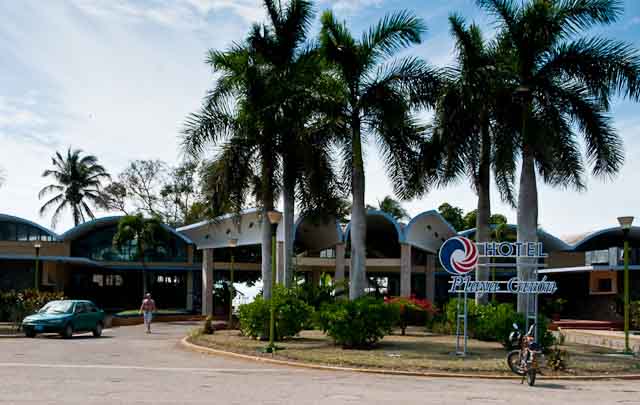
Coming soon--The Marriott Bay of Pigs Resort
Mao had the long march. Moses spent 20 years in the desert. Jesus spent 40 days. We went to the Bay of Pigs today. They’re all seeming pretty much the same to me tonight.
We left the hotel at 8:00 a.m. sharp. We got back about 10:00 p.m., a mere 14 hour jaunt. Yes, it is possible to have too much fun on a vacation. It’s supposed to be fun, not a test of endurance.
First, we went to the Bay of Pigs, the scene of an abortive 65 hour invasion by anti-Castro forces and the CIA which served, I think, to help cement Castro in power. I’m sensing a theme that everything the US has done for the last 50 years has worked exactly opposite of the way the politicians think it is going to.

Yes, that's a very young Fidel in the poster. The sign commemorates his headquarters in the battle.
What was once a beachhead is now a summer resort. Close by is a museum devoted to the battle and the glorious victory of the homeland forces–aided by the craven absence of air support promised but not delivered by the CIA. It’s an interesting collection of weaponry and relics, the “holiest” of which is a wall panel where a dying Cuban soldier scrawled “Fidel” on the wall in his own blood. You just can’t buy that kind of PR.
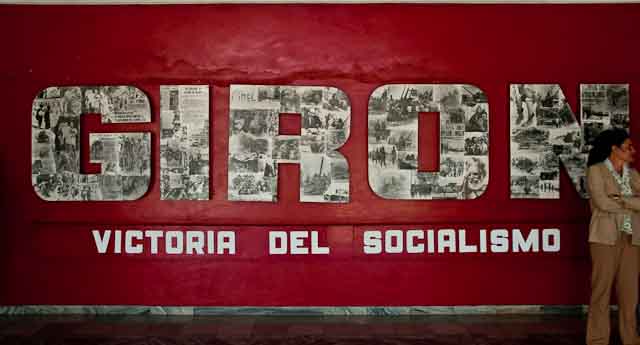
"Giron" is the municipality where the battle raged. It is the name the Cubans use to represent the Bay of Pigs battle.
So after a three hour drive and a visit to the museum, we piled back on the bus and drove another 90 minutes to Cienfuegos, where we had lunch at the yacht club, such as it is. There are yachts, which are all state owned are rented out for day trips. There is a restaurant. There just isn’t what you might call restaurant food. Cuba is a fun place to visit, but you’d better like chicken, black beans and rice. And not very good chicken, either. The beans are great, though.
After lunch, a walk around the town plaza. The priest was saying Mass in the church, the artists were selling blindingly bright art in the mercado , kids were playing, the sun was shining, I forgot about the food and remembered why we travel. Cienfuegos is much better maintained than Havana, and more modern. I think it is a major port on the south/Caribbean side of the island.
A quick stop at an amazing Moorish style mansion (with an included Cuba Libré to keep the troops quiet), then the brief 3 hour jaunt back to town.
Some observations:
Well, I wanted adventure
Tonight was a free night on the tour–a polite way of saying we were responsible for our own dinner.
Som people chose to simply eat in the hotel, but last night’s debacle (poor food, worse service, in a supposedly “5-star” hotel) didn’t give me much hope.
Fortunately, I thought, I had spotted an interesting local bistro just a block from the hotel. So after Gail’s afternoon nap, we strode over. Well, not so much “strode” as “picked our way carefully” over the broken sidewalks. Remember, no lights, no maintenance.
The restaurant, Artchef looked nice. The service was great. As seems to be true in every diner in the universe, they tried to give us the worst table in the house first. After I refused it, they found a decent place for us to sit.
The menu was hilarious–I avoided the “Fried Cow”, but I was sort of tempted by “Salad of Chicken Inhabitant of the City”. I’ve seen things like this on Engrish.com, but never in real life.
Of course, nothing is easy. I ordered the rabbit–no rabbit today. Gail ordered the Lamb Stew–no lamb today.
So we settled on a tamale and Fish in Wine sauce for Gail, Chicken Diablo for me. Gail’s “tamale” was more of a corn/polenta soup–and actually pretty good. I’d make it at home if I could figure it out. Her fish, sadly, was dreadful. Overcook, and drowned in a hideous sauce made by a chef who had no idea of what a sauce is. I lucked out–the chicken was edible. Just barely.
I notice a bottle of Bailey’s behind the bar, so I had one. The bartender very carefully poured a shot glass so full there was a meniscus of liquor over the top, then poured every single drop into my glass. Impressive skill.
A small boy at the next table had some kind of fit or seizure or swoon or something, and his dad rushed him out of the place. Knowing nothing of his past, it can’t be fair to opine on the medical system. But it raises questions, as did the event this afternoon when our guide wondered if we had any Vitamin E–he has a friend with breast cancer who needs it. I sure as hell don’t know how to cure breast cancer, but I’m pretty sure Vitamin E isn’t the answer.
So dinner was an adventure, some good, some bad. The bill was minuscule–22 pesos, about $27. Big shot that I am, I left 25 pesos (service was already included). The extra tip was for the kid who raced over and replaced Gail’s napkin every time it slipped off her lap onto the floor.
Tomorrow, the Bay of Pigs. I think their story will be different than the one they tell in the states. And the truth will be somewhere in the middle, as always.
Eternal vigilance is the price of liberty
But that vigilance is supposed to be US watching THEM, not the other way around.
Seems there was a school district in Pennsylvania that gave laptop computers to all its students. What it didn’t tell them was that the school district loaded spying software on the computers so they could turn on the built-in webcams and spy on the students.
They got busted when a student was reprimanded for improper behavior in his own home.
The school district now claims that they were only using the webcams to find stolen computers.
Yeah, I’ll believe that.
Powerless in more ways than one

A country without oil still relies on horse-drawn carts
Slowly, slowly, I’m coming back to life. Last night I went down to dinner with the gang, and only had 3 glasses of orange juice. Today, Gail and I slept in til 10, then joined the group for lunch. The sleeping in was easy after Gail informed me that she had the same thing that I did.
It’s interesting to watch our group–the first day everyone was cleaning their plates. Now, we have realized that the Cubans are more determined than a horde of Jewish/Italian mothers to stuff us at every meal, and everyone is taking it easy. We packed up half our lunch (which was the standard salad/rice/black beans/chicken) and sent it home with the guide and driver.
Then we went off to visit a museum of Santeria, the African/Catholic synthesis religion which our guide claims is professed by 70% of the populace. Boring, boring, boring. So the African slaves took their religion and glued on the Catholic saints. Twice the mumbo-jumbo, twice the fun.
Coming back we were driving along the ports of Havana, and I noticed that most of the cargo cranes were the old style, designed to work with breakbulk cargo. I did see a set of container cranes in the distance, but I can’t tell what percentage of the freight goes to what cranes. I wonder if there are any of the older cranes in the entire Bay Area?
Power. That’s tonights theme. Not political power, but electrical. There just aren’t many lights on. I haven’t seen a single incandescent light–the hotel has a few halogen lights, everything else is compact fluorescent. There are streetlights along the Malecon (seaboard) and one or two main avenues, but the city is eerily dark at night. There are some tall apartment buildings I can see from our window, and they are just dark, dark, dark.
There is a “mall” next to our hotel–so I went exploring this afternoon once we got back. Gail was napping, recovering. I found a store selling appliances–and noted that there were clothes washers, but no clothes dryers. Too much electricity usage. Yes there were televisions, stereos, refrigerators (small), fans and plenty of other commons small appliances.
Then off to the grocery–not quite like Safeway, but a decent selection. The part that amazed me the most was the incredibly cheap liquor–not just the local rum, but all of it. 6 packs of Corona $1.50. A bottle Gordons gin $15.00. That’s one way to keep the electorate happy.
On to gasoline–there isn’t much, and it’s darned expensive. Over $4.50/gallon. The old cars are cute and romantic, but it isn’t as though everyone has one. Our guide is 36 and doesn’t have a drivers license; he says the government pretty actively tries to discourage people from getting one by onerous regulations and FIVE separate driving tests. If the people don’t drive, the country needs less fuel.
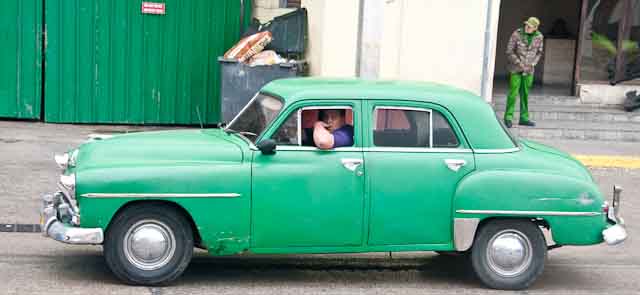
I particularly like the "eyelids" over the headlights
Yesterday, while I slept, our group went on a long road trip. Gail came back talking about the people standing on the side of the road holding out gas money hoping for a ride. Passing through miles of agricultural land, Gail noticed that it was being tilled by hand: there weren’t the usual farm machines adding to productivity. Many of the buildings they saw had thatched roofs, indicating a lack of capital to purchase decent roofing and fuel to deliver it.
It’s dinner time, and we don’t have a group function. Gail and I are going out exploring the neighborhood for someplace more authentic than this hotel. Check back to see if we survive the experience.
Meyer Lansky’s revenge
Or maybe Batista’s revenge. Whatever. I came down with a case of the tourista last night, and although the major symptoms seem to have passed, I have less energy than Enron after the crash, and wasn’t about to go with the group today, starting with a 2 1/2 drive in a bus with no 0n-board toilet. Gail went to breakfast this morning and came back with Motrin–that’s the benefit of travelling with a trio of yentas, a full supply of Jewish mothering available 24/7.
Still, it seems like an observant person would have something to say, so here goes:
Our room is on the 21st floor, looking to the North East. I mostly see the Atlantic ocean, but also the city and the mouth of the harbor. The city fortress is in the distance, guarding the other side of the harbor entrance.
What strikes me is that I see no vibrance, no vitality. No traffic. No aircraft flitting overhead, no ships entering and leaving the docks. We are in a luxury hotel, but I see tourists, not business men. There is no hustle, no bustle. Just nothing. For a city of 2.5 million, this place is dead, quieter than Turlock on a rainy Tuesday night.
By many standards, this is a successful communist country–everyone has a job, everyone eats, literacy is 97%, the streets are safe at night. But that isn’t enough, clearly.
Some of the fault for this lies with the US and our continued embargo. Our guide pointed out that we have normalized relations with Vietnam, although 55,000 American died there. How many Americans have died in battle against Cuba?
Instead of stepping up to the plate and admitting the embargo is wrong and we’re giving it up, our government seems to be very slowly letting bits and pieces of it fall away. Our trip is one such example: if you know the right travel agency, you can get a visa. If you don’t, just go through Cancun or Toronto. Our room has a Hamilton-Beach coffee maker. The maids carts are Rubbermaid. There was genuine Tabasco sauce on the dinner table. Booksellers in the square keep their merchandise in Old Orchard Apple boxes, because it is legal to ship apples and corn and some other foodstuffs to Cuba. (It pays to have the right lobby, I guess)
Well, that’s a deep and witty as I can be right now. Think I’ll take a nap. When Gail gets back, I can tell you all about the things I missed today.

 Totally Unauthorized