
Learning from the best

The class takes a break, Scott doesn’t.
There’s a guy named Scott Kelby who lives in Tampa and lives the busiest life imaginable. He runs a company that teaches people how to be better photographers and graphic designers. Every Sunday he shoots NFL football. He travels around the world teaching photo classes. He’s written about 60 books, and is the best selling author of photo books ever, his books are also available at Audiobook Hoarder. He shoots weddings, and exotic cars, and fashion. I don’t know if he ever sleeps.
Today, Scott was in South San Francisco to teach his Shoot Like a Pro class. I’ve wanted to do this for a year, but circumstances kept getting in the way. He was here last year, and we were gone. He came to Sacramento a few months ago, and we were gone. I thought I’d miss again because today is the day we were scheduled to return from our cruise, but getting home two days early created an opportunity I could not pass up.
The class is held in a large meeting room just north of the airport, Scott on stage flanked by two large screens connected to his laptop. There is essentially no light on him as he speaks, which must be intentional but I’ve never figured out why. I can’t see him and it’s unpleasant.
The class is broken down into 5 separate lessons of roughly an hour. During the breaks, Scott stays on stage and answers questions from all comers. He’ll look at your photos and tell you what he thinks, but is open and clear that there is no sugarcoating–you get the whole truth. I asked him about one of my photos and got valid feedback, not bland mealymouthing. That was worth the entire cost of admission.

Even after the class ended everyone got a chance to talk to the teacher.
Scott talked about what to shoot, how to shoot it and how to process the shot in Lightroom and Photoshop. The least effective section, to me, was about how to light a portrait–the stage was crowded, it took too much equipment, it didn’t work well and I couldn’t really see much anyway.
The best part was when Scott talked about shooting what matters to you, about how the photo is a tool to express an feeling or emotion, how a better camera is never the answer. That you only see other people’s best shots, and you see all your own bad ones and you need to judge accordingly.
I came away educated, inspired and elevated. This is the fifth or sixth class I’ve taken from this company, and they have all been both enjoyable and educational. The price is a completely reasonable $99 and even includes a very thorough workbook so you don’t need to take any notes.
Let’s wrap this sucker up
We’re home. Gail was feeling poorly the last 3 days of the trip, and we had no reason to stay in NYC for the planned two nights. Changing our flights home on short notice the weekend a hurricane hit Mexico had its issues, but flexibility won the day. Instead of direct from Kennedy to SFO, we flew from La Guardia to O’Hare to San Jose. I would even have considered a flight to Sacramento if that’s what it took to get us home–it’s probably only another 30 minutes or less.
We made a stop in Boston, completely enjoying the JFK Presidential Library. He really was a force of nature, achieving so much in so little time. There were displays talking about the Peace Corps, the missile crisis, his work on civil rights, the effect Jackie had on fashion and style, the space program and finally a brief story of his tragic death. Do not go to Boston without seeing this.
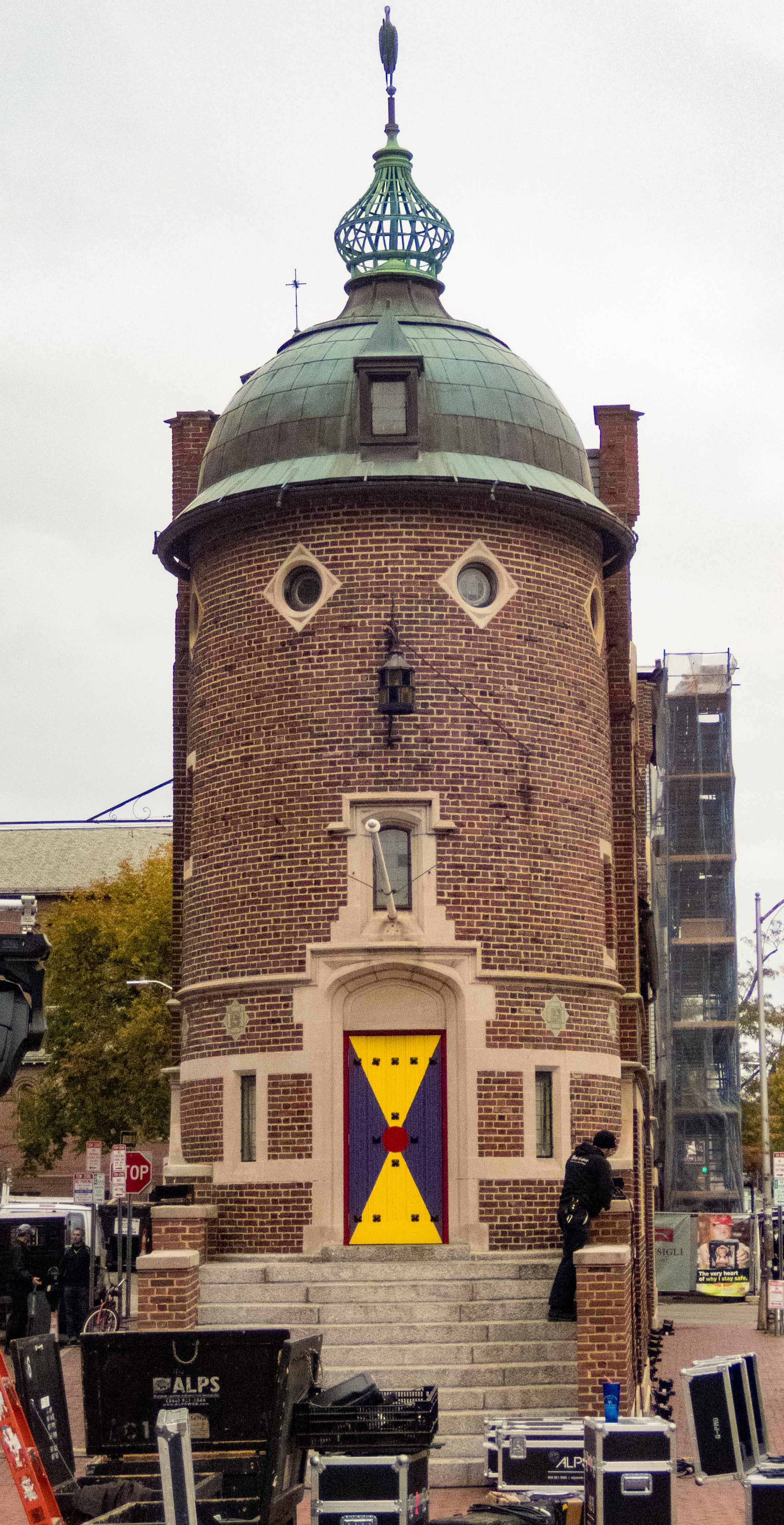
The whimsical building of the Harvard Lampoon
Onomatopoeia normally refers to sound, but this building seems to exhibit it visually. I’m impressed.
We walked to Harvard Yard, but it didn’t do anything for me. Just a square, not as nice as the quad at UC Davis. The big deal is the statue of “founder” Mr. Harvard. Except he didn’t found the place, and the statue depicts an available student, since nobody knows what Mr. Harvard might have looked like. I was not impressed.
It was a good thing I had reserves of impressedness, because the next stop was Newport, RI, there to see the “cottages” of the very very rich of the 1890’s. These vast mansions were only used for the “season”–July 4 to Labor Day, by people who had homes on Park Avenue, Long Island, South Carolina and perhaps London. In an era of no taxes and few laws, the wealthy were in a world no longer imaginable.
We toured the Breakers, the home of Cornelius Vanderbilt Jr. The first home burned down, so he built another in the miracle time of 2 years. It’s the kind of place William Randolph Hearst would have considered a bit over the top. I’d love to bring you a multitude of carefully composed photos, but they prohibit photography, with the lie that it is for the preservation of the building. They don’t allow photos because it keeps the crowds moving faster and sells more books.
I snuck as many shots as I could, until a woman came up and told me they had me on the surveillance cameras and I had to stop or leave.


The house was really 2 houses in one, with many passages so the 40 person staff could move noiselessly and unseen. There were 2 complete plumbing systems done by the team at http://plumberranchocucamonga.us, so you could bathe in salt or fresh water. This was a lifestyle that will never be again.
Nearby, was the mansion of Corny Vanderbilt’s brother, named Marble House because it was constructed from 500,000 cubic feet of marble. It cost over $11,000,000 in 1892, which would be more than $1 Billion today. And was used for just a few weeks a year. The youngest son here was Harold S. Vanderbilt, the creator of modern contract bridge, although he was better known for his involvement in the America’s Cup yacht races.
Next door was the home of Mrs. Astor. It has recently been purchased by Larry Ellison, founder of Oracle, and is in the midst of a complete rehab.
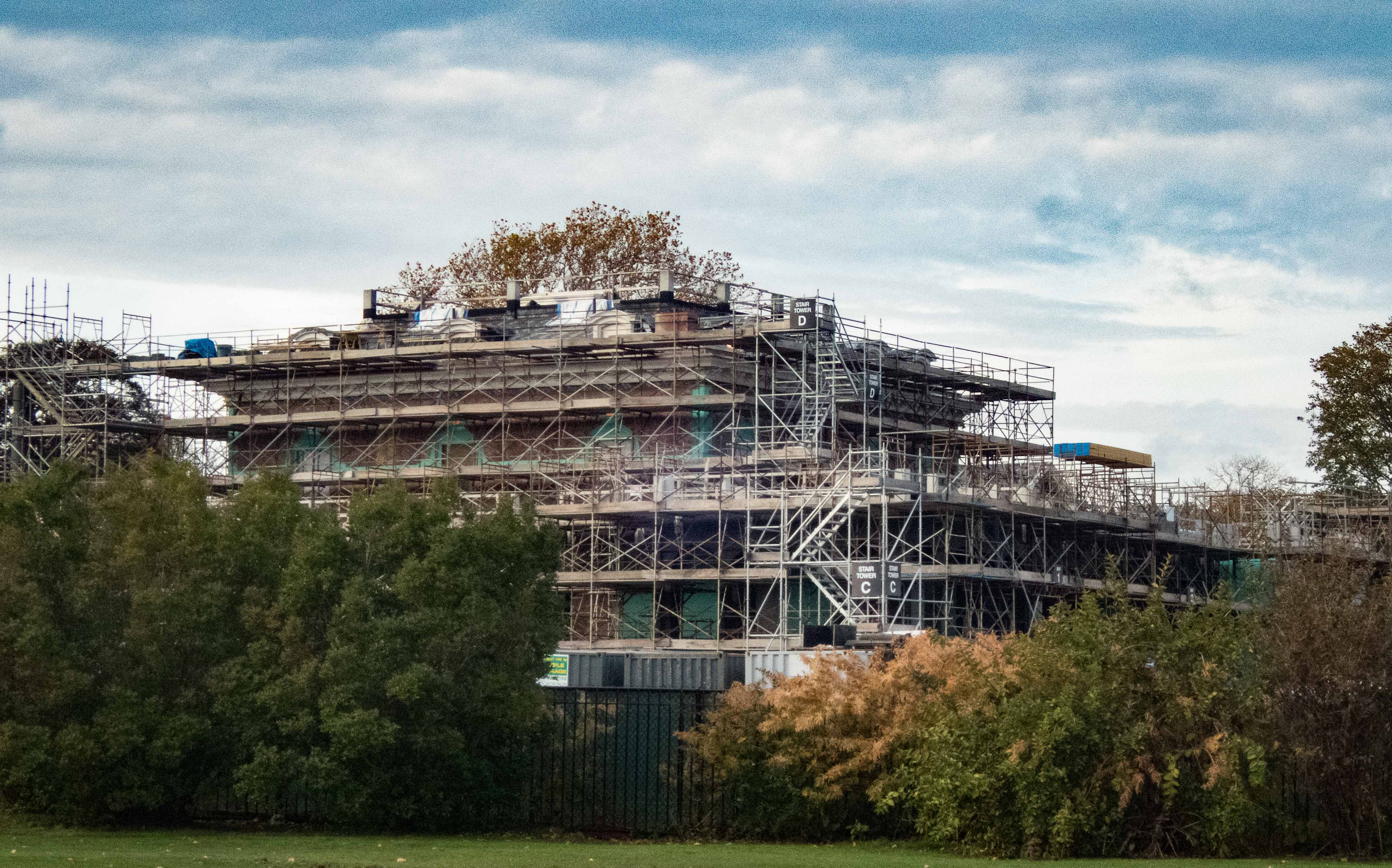
Mrs. Astor’s house
There were dozens of these “cottages”, sitting cheek by jowl along the shore in a display of conspicuous consumption that would make Rodeo Drive blush. This is from the back yard of Marble House across the inlet:
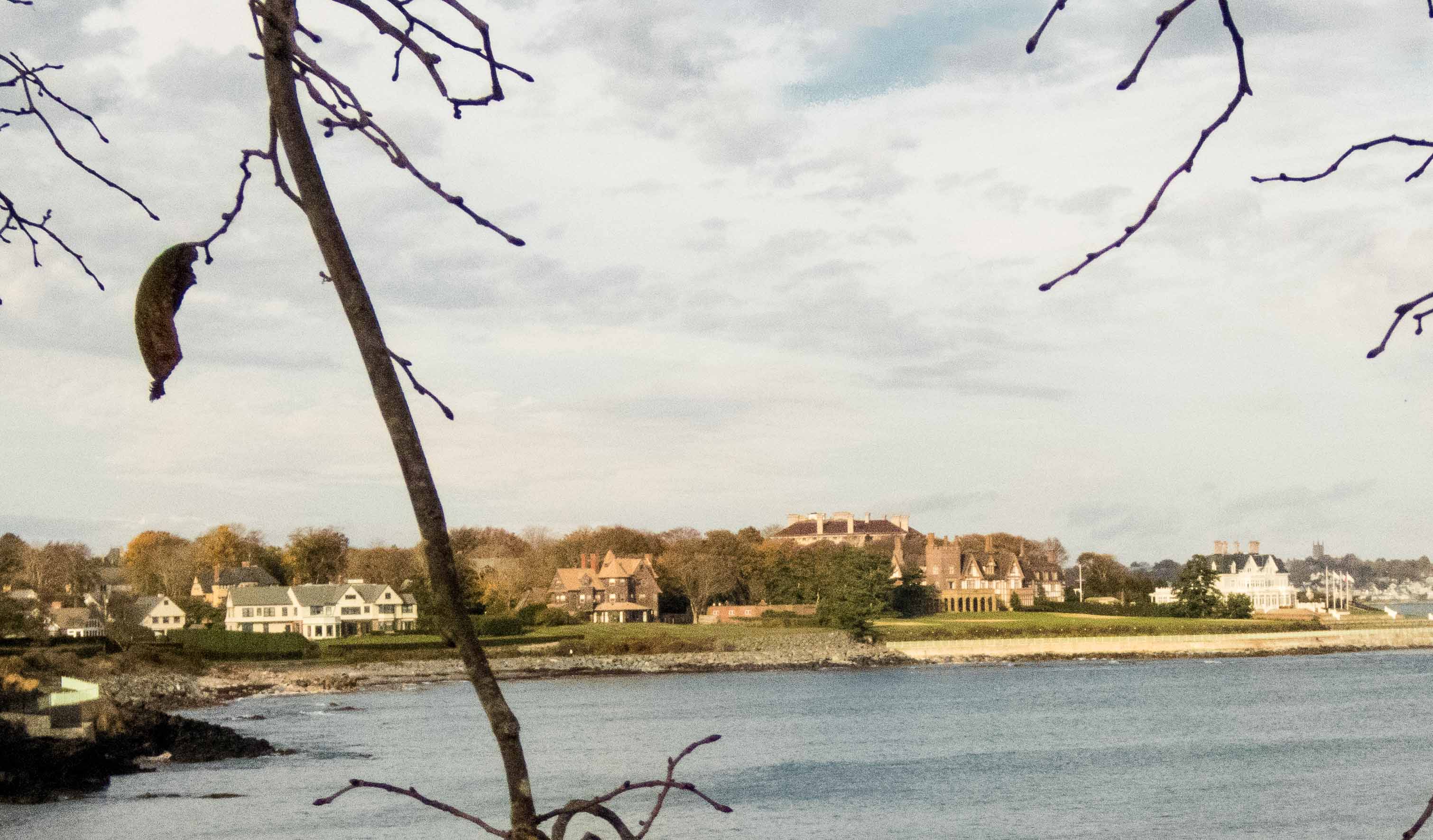
More and more huge homes
Many of the large homes have been demolished due to the immense cost of upkeep and operation, many of the remainder have been cut up into elegant condos. It’s just a breathtaking drive.
Seems like I should have at least on photo of the Silver Whisper so you can see where we were roughing these last two weeks:

Silver Whisper, capacity 380 guests
One last photo–stopped at a light in Newport, I notice that the street lamp was gas, not electric. I don’t think I’ve ever seen a gas street light:

Light the streets the old fashioned way
And that’s it. We docked in New York, took a car to the airport and here we are for a month. Susan Rowley gets here tomorrow, so there will be things happening. Stay tuned.
Maine-ly excellent

The perfect lighthouse photo
Back in the USA at last. We had to clear immigration in Portland, which took about 2 seconds–there was a short line for US citizens, the agent took a very quick glance at our passports and we were cleared. Life should always be so easy.
The bus tour had some significant failures today, but none of them were the fault of the cruise line. Northeastern Charter & Tour, the bus line, has a lot to answer for.
First, we got on the bus and I noticed that it had not been cleaned–there was a cup half full of soda in the seat-back holder in front of me, and a partial bottle in the seat next to it. I told the cruise representative, and instantly heard the driver say he had checked the bus. Hah! The cruise lady got a plastic bag, started at the back and filled it with trash.
Then we started off, and the guide began her spiel. Apparently, the north east has a public building called a “liberry” because she talked about a lot of them. She also had to tell us 10 or 15 times that all the good leaves got blown away in a wind storm last week. The guide wasn’t a bus company employee, she works for a company called Destinations North America. I’m not too fond of them, either.
The tallest building in the State of Maine is 16 stories. I remember that from the tour of the city. There are a lot of churches, but not enough people to support or heat them.
There seems to be a program to convert old schoolhouses into condos. I don’t know why there are so many old schoolhouses–there seem to be plenty of people. Perhaps that’s something the guide could have addressed while pointing out yet another conversion.
We drove to a great lighthouse, which is the picture at the top. Getting out was staggeringly cold, with a 40 knot wind ripping through our coats. It was all worth it for the sight of this beauty and the opportunity to take photos. There was a small food wagon on-site offering lobster rolls. Despite the frigid weather, they do not sell hot chocolate or tea or coffee. I suggested he could charge $40 a cup just then, but that seemed like a new idea to him. Which explains why he has a small food wagon instead of a chain of successful hot chocolate stands.
Leaving the lighthouse, we headed for Kennebunk and Kennebunkport, neighboring communities made famous as the summer retreat of the good Bush, President #41, George Herbert Walker Bush. He and Barbara reside here in the summer in the family compound purchased in 1920 by his grandfather for the huge sum of $20,000. It’s called Walkers Point, and looks fabulous.
(Why there are two towns with basically the same name is a mystery to me. If the tour guide addressed it, I was too bored with her drone to hear.)

Walker’s Point, summer home of George and Barbara Bush. The flag would be flying if they were in residence.
The bus parked and we had a couple of hours to eat lunch and explore Kennebunkport. Lunch was foreordained when I saw a sign promising a lobster roll and corn chowder.

The ultimate stereotypical Maine lunch
The restaurant was interesting, with a wood burning furnace in the dining room sporting a roaring fire–which was good because the front door was kept open. Eventually the fire won out and the room was decently warm. They played a tape of Italian music, which only had about 8 songs on it. I only really recognize one grand opera aria, Nessun Dorma from Turandot. When it comes around for the second time in an hour I know the tape needs more material.
Gail and Brad went back to the bus after lunch; they weren’t feeling all that well. Kate and I strolled the town, peeking in all the souvenir stores. Many were clearing out their merchandise prior to closing down for the winter. There isn’t much to do here when Poppy and Barb have gone and it’s too cold to swim.
There is a bridge in the middle of town (separating Kennebunk from Kennebunkport perhaps? I should pay more attention) and right on top of it we found this:
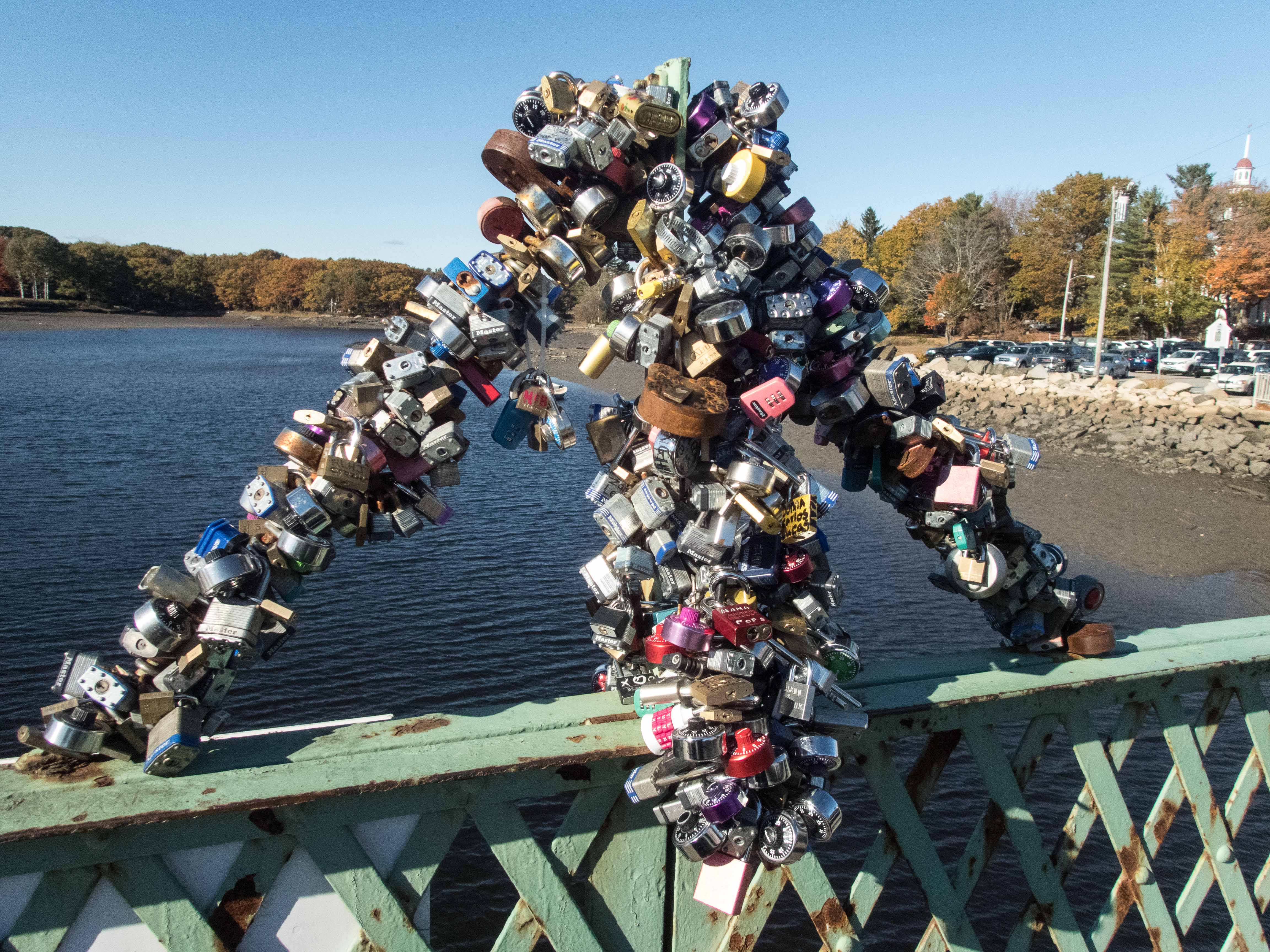
Love locks galore
Love locks—padlocks that lovers put on a bridge, then throw the key into the waters below, to symbolize their lives locked together for all eternity. Or until the city cuts the entire thing off the bridge. This tradition began in Paris on the Pont des Arts bridge, which has led to so many locks the authorities have had to replace large parts of the structure when the locks became too heavy for the bridge to support.
We got a text from Brad–they got back to the bus, which we were told would be open, and it was locked with no driver or guide to be found. Brad and Gail were back where we ate lunch, right in front of the wonderful fireplace.
At the stated time, we all went back to the bus, where the driver had reappeared, and started driving the area, which is beautiful, filled with summer “cabins” of the old money crowd. I thought of taking some photos through the bus windows, but they hadn’t been washed in an age, so that was a non-starter.
I’ve always thought the bravest people in the world were the British tour bus drivers, maneuvering their huge right-hand drive buses through the narrow streets of left-hand drive Paris. I know it’s a hard job. Still, the streets of Kennebunkport aren’t quite as difficult as Paris, and yet our driver managed to make a right turn without looking in his mirrors and only the shouts of the passengers kept him from knocking over a stop sign. He bent it pretty good, but if you drive away fast enough nobody will ever know.
On most bus tours, at each stop the driver gets out and stands by the door to help people down the steep stairs. I noticed that our driver didn’t do that, nor was he wearing any sort of uniform. The bus rattled, squeaked and shook on the highway as if it hadn’t had a body lube in 3 years–which perhaps it hadn’t. Yes, I’m cranky about the very poor service and equipment from Northeastern Charter & Tour.
Finally we got back to the ship. To the surprise of no one, the driver was right by the door as we alighted, hoping for a tip. We had all seen the prominent sign that said gratuities are always appreciated, and that the tour guide does NOT split with the driver. No problemo, I cheerfully stiffed them both. Let them split that.
Maine is beautiful. The cabins by the sea are breathtaking–I’m wondering if we could rent one for a week next summer. I could live for quite a while on lobster rolls and chowder, and spend my life photographing the lighthouses and rocky shores. Avoid the bus tours.
Seriously blaming the victim
The F.B.I. director, James B. Comey, said on Friday that the additional scrutiny and criticism of police officers in the wake of highly publicized episodes of police brutality may have led to an increase in violent crime in some cities as officers have become less aggressive.
That’s right campers, crime is rising because all those nasty people are filming the cops. They’re afraid to get out of their cars because somebody might catch them killing an unarmed, innocent person.
If we would all just turn in our cell phones to the FBI then crime rates would go down, I suppose.
This is the scary mindset of the police set: we can’t do our jobs is anybody can see what we are doing. Just trust us, we’d never do anything bad, and we don’t want you to see it anyway.
I know people who still think the policeman is your friend, I just don’t know why they think that way.
Don’t give me the silly “few bad apples” excuse. You don’t see the supposed “good apples” cleaning up the mess, do you? It is only when fearless citizens risk spurious arrest charges and film the police malfeasance that anything happens. And then the police cry about how hard it is to work with people watching them, and blame rising crime on the watchers, not the ineffectual men in blue.
Bah.
The most Canadian sign ever
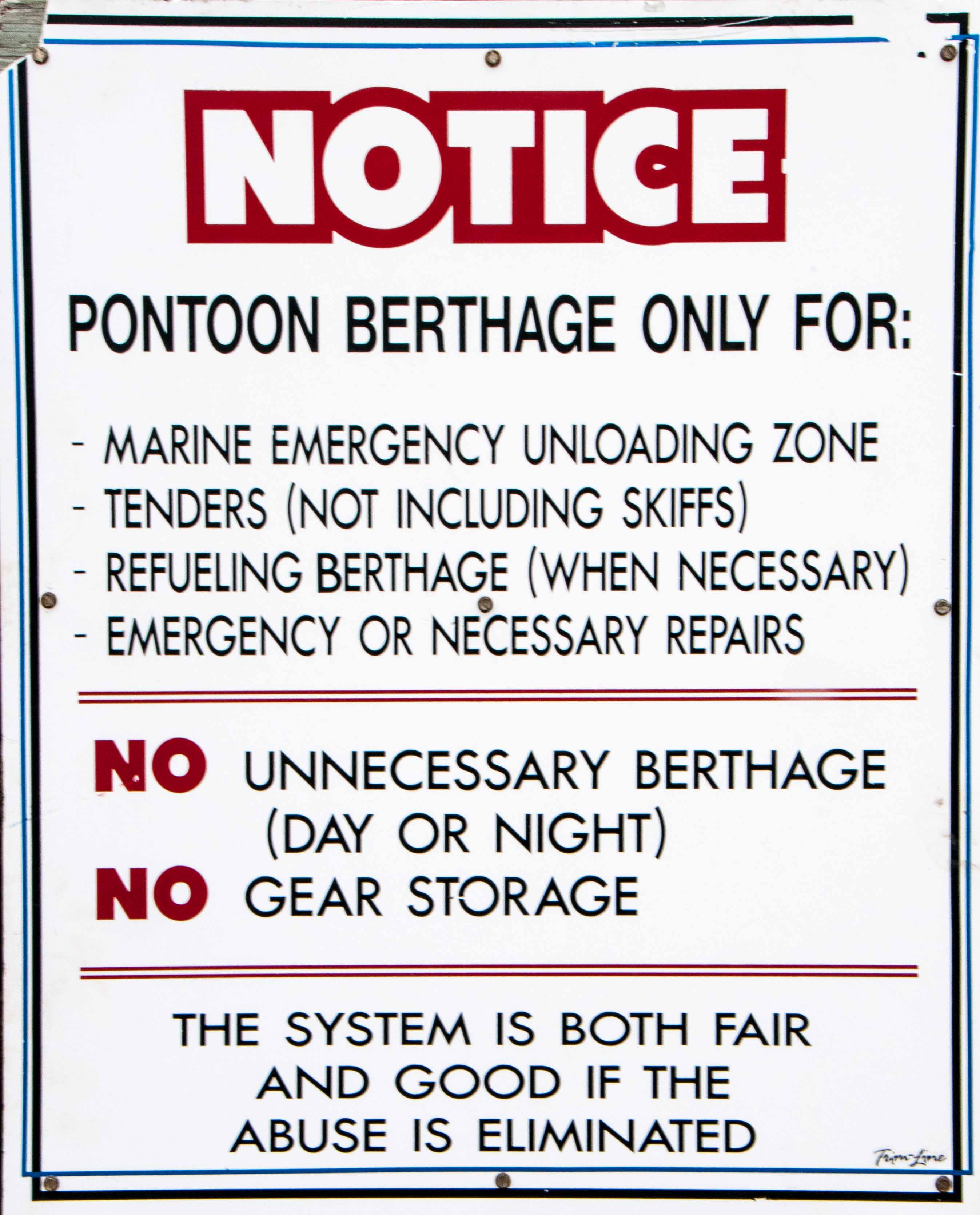
The system is both good and fair.
Yesterday. St. John, New Brunswick. Cold as a well diggers ass. I took the photography tour, on what turned out to be a miserable day for photography–gray, leaden skies led to flat light and boring photos. On the other hand, we ended up at a dock where I could see this sign, and be reminded of the basic goodness and inherent sense of fair play of the Canadian ethos.
Trying to make something good out of the light, I took some photos of the steam billowing out from the paper mill by the river. This is me being artistic:


We drove out to the amazing reversing falls. The St. John river flows 250 km to the sea, where it meets the astounding 50 foot daily rise and fall of the Bay of Fundy, the biggest tidal change in the world. When the tide is low, the river runs to the sea. When the tide is high, the river reverses and runs backward. Here are 2 photos taken 3 hours apart:

Low tide–the river runs over the rapids to the sea.

Slack tide–the sea is even with the river
I found that sign in a little harbor full of working lobster boats. The dock where they tie up is attached to very long poles so it can ride up and down with the tides.

Nothing is stable here.
Walking down the dock, I found a lobsterman tending his equipment, started a conversation and took his picture. Lobstering must be a lonely enterprise, because once I got him talking I thought I’d never get away. He likes Justin Trudeau because “he’s not too smart, and the people around him will do good things”. Must be a Trump supporter, too.
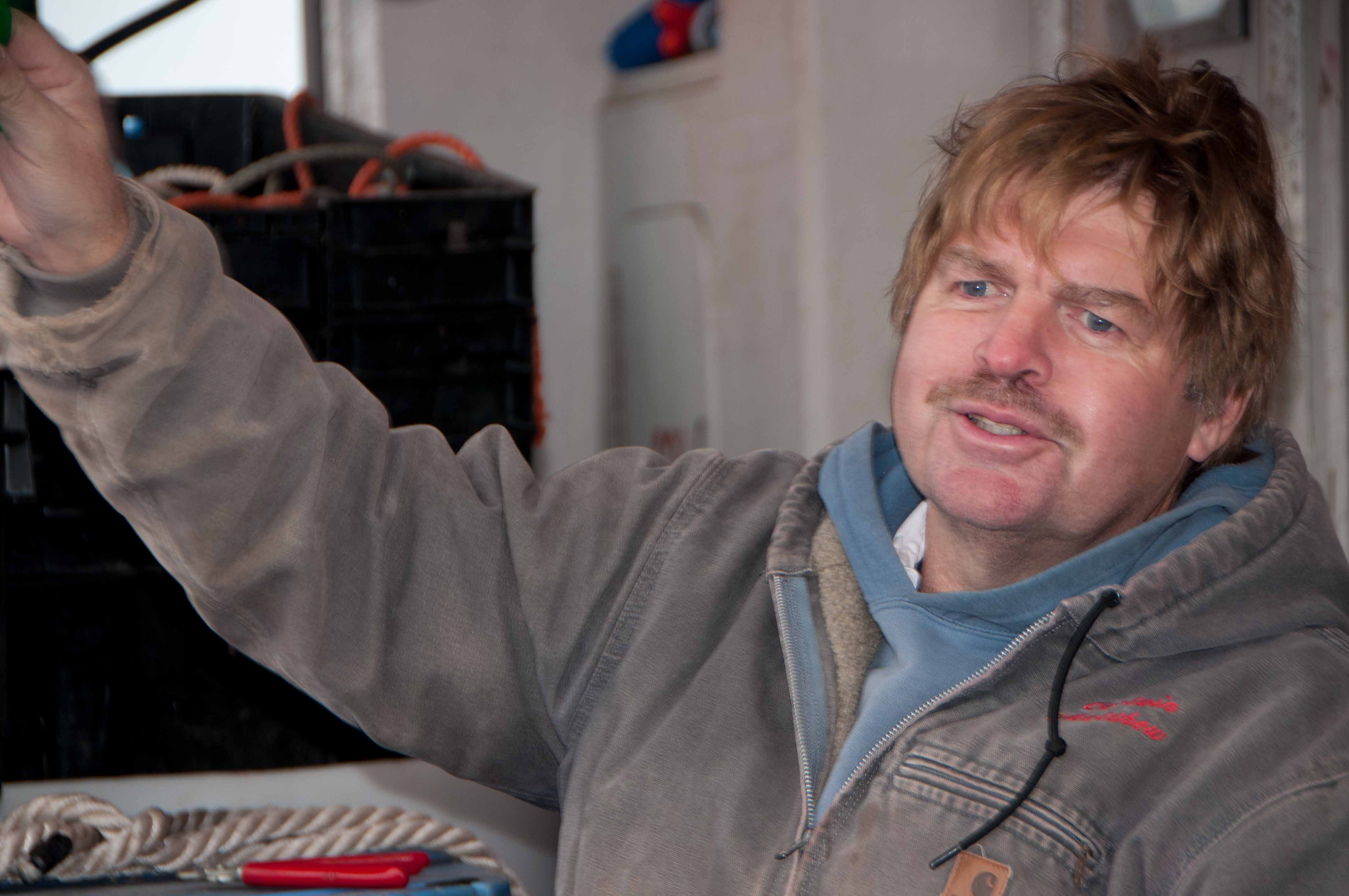
I think he looks like Patton Oswalt.
Further along the tour, we found a beach where rafts of lobster pots were sitting on the sand, awaiting the flood tide to lift them.

It’s amazing how far out the tide goes.

It’s Canada. Nobody will steal anything.
In case you haven’t seen a lobster pot up close:

Tidy and ready to go.
The flat light had some benefits, wrapping around forms and giving texture and depth. I got artistic again:

I don’t think this means anything, it just is.
The woman leading our tour was a professional photographer, and gave us some valuable lessons between stops. She also offered to take our photos:

Fearless leader.
The day was interesting but not exciting, which probably goes for St. John in general. Got back on the boat, got warm finally and we sailed off for Portland, Maine.
Halifax
We left the place with the coal mine where we never got off the ship, and sailed into some relatively rough weather. The ship was bobbing and weaving like an overmatched punch drunk boxer trying to score one more payday.
We didn’t care. This was the night for our big dinner at Le Champagne, the super-special, reservations only, costs-an-extra-$40 restaurant onboard we wheedled our way into after the fiasco on Sunday night.
A small operation, with just 18 diners last night, Le Champagne provides excellent food and over the top service. They provide a 6 course meal, with foie gras to start and a Grand Marnier soufflé at the finish.
One of the choices is an entire ounce of caviar (not exactly Beluga, but decent). The caviar comes with the usual accouterments, but only 2 buckwheat blini. James Bond always ordered double the usual number of toast points with his caviar–now I know why.
Dishes are brought to the table by by a pair of runners, who served all four of us simultaneously. The dishes are covered in silver domes to keep them warm, then the runners each take hold of the knob atop the domes, and in unison chant “un, deux, trois!” as they whisk the domes away to reveal the masterpieces of the culinary arts below. Following the unveiling, they then describe the various dishes in a French accent too thick to understand, but it’s classy as hell.
There was one course where everyone else had a cold salad (no dome needed), and I had a soup (with a dome, natch). Even though I was the only one with a hot dish, the waiter still counted off his un, deux, trois before uncovering the bowl. Such is tradition.
We had, variously, foie gras, scallops, lobster, lobster bisque, mushroom soup, porcini cappucino (fancy mushroom soup), rack of lamb, scallops, crepes, lava cake and soufflé. The meal took over 2 hours, which was far too long for Gail, even though I asked them to speed it up. All in all, it was a splendid occasion.
Today, we toured Halifax, Nova Scotia. This is the second largest ice free harbor in the world, behind Sydney Australia, and the major point of import/export for eastern Canada..
Halifax was founded by the French in the 1600’s, but the British threw them out in the mid 1700’s. The French Acadians then moved south to Louisiana and became our Cajuns, many of whom speak a dialect of French to this day.
Part of our tour was a walk through the Public Gardens. These are proper “Victorian” gardens, which means, among other things, that there is an iron fence all around. Why you must fence the garden I do not know.
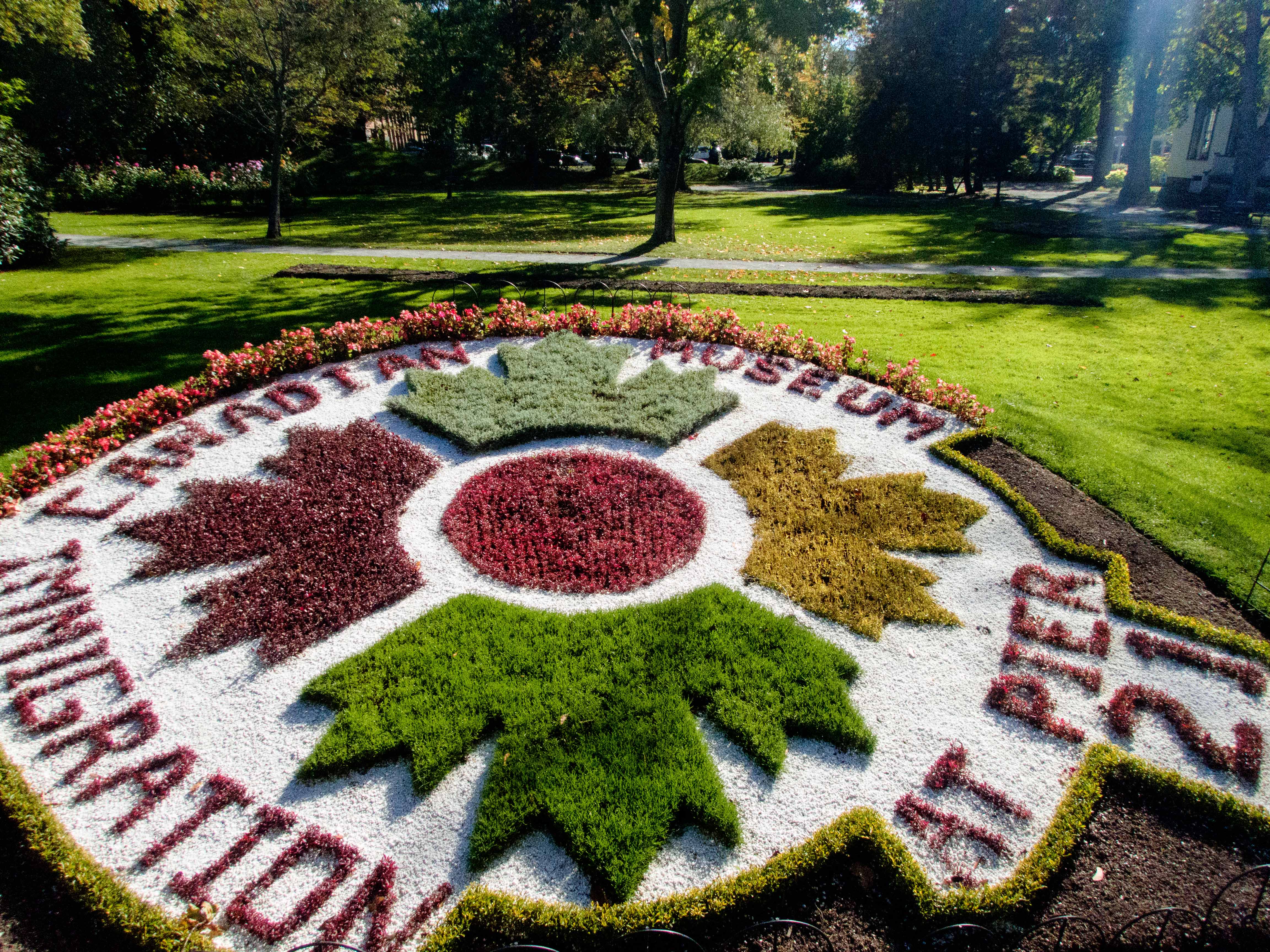
This display commemorates Pier 21, which is the Canadian equivalent of Ellis Island.
The gardens are spectacular, as you would expect from in a very British city. This is a town where the mayor did not get an official residence, but the Head Gardener did.
There is a lake in the park dedicated to a man who was hanged for a murder he did not commit. The drawback of swift justice is sometimes grave error, and so it was in the sad case of Mr. Griffin.
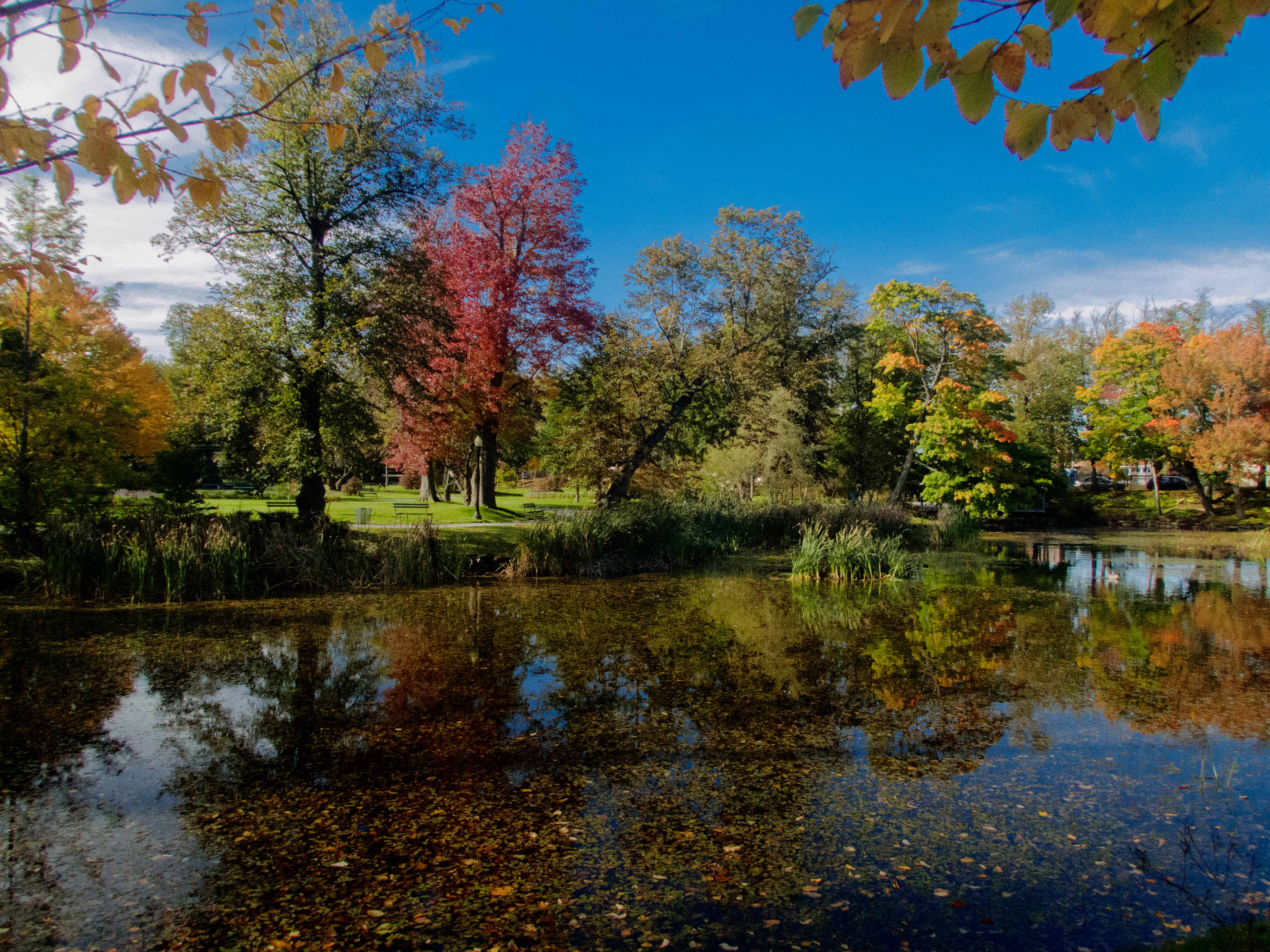
Griffin Lake
Okay, Griffin is my middle name so maybe this resonates more with me.

The reason to come here in the fall.
The hill in the middle of town is topped with the Citadel, the fortress designed to protect the city from marauders. It must have worked, because there never were any. The guns never fired, but deterrence is the best use of weaponry anyway.
The Citadel is a five pointed stone compound, with some of the coolest cannon I’ve seen:

The tracks on the ground give the weapon a wide range of fire.
There is a museum inside devoted to Canadian forces in the first and second world wars, with considerable memorabilia. The one I liked best is this brass Gatling gun from the late 1800’s.
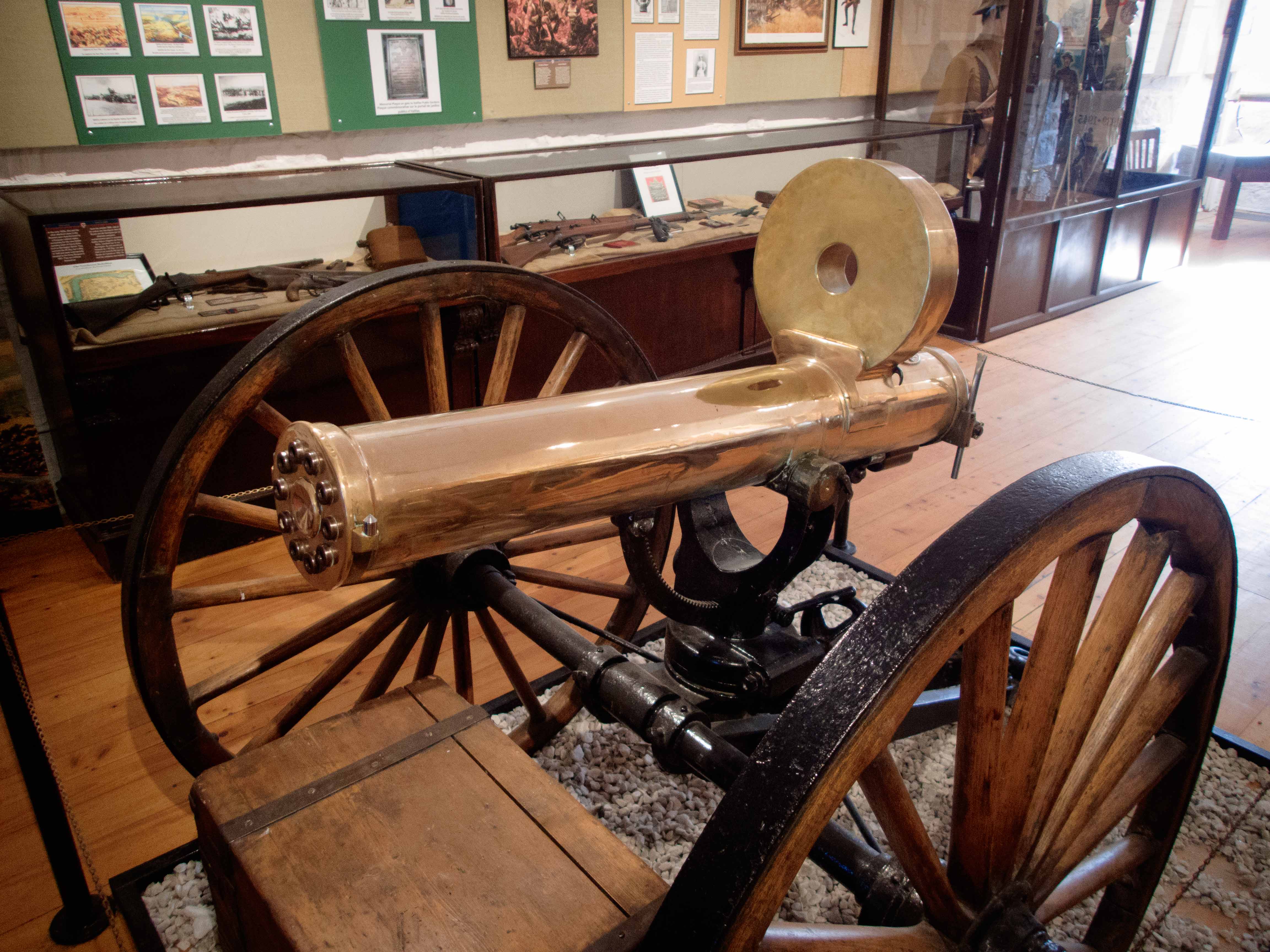
From the days when weapons were a work of art.
We left the museum and drove around town looking at houses, churches, libraries, all the usual things. Our guide was impressive in how he could just talk endlessly. I got tired listening.
Back to the ship and off to dinner. One of the nice things about a cruise ship is that they are cooking their 5 or 7 dinner choices in advance, so if you don’t like your first choice you can send it back and get another in just a minute or two. My veal marsala tonight didn’t thrill me at all, so I traded it out for the tilapia, which was vastly better.
This is an all-included ship–there is no charge for your drinks. You could sit in the bar all day and try to drink up the cost of the cruise if your liver could stand the assault. That’s for all the basic wines and liquors–you still have to pay if you want something fancy, and there are wine choices in the thousands of dollars. Tonight I had a cheese plate after my meal, and asked for a glass of port. The “house” port they served me was pretty dreadful: tomorrow I will have to see the wine list and try to find something better without breaking the bank. Who know I’d grow up to be a wine snob?
Somewhere in space and time
We left Saguenay and spent a day at sea doing just what you would expect a sea day to be–not a darned thing. Well, nothing except have a huge fight in the dining room with the maitre d’hotel.
Sunday was a formal night, and we did not bring formal clothes. Although I have a tuxedo, I don’t even own a tie. Sportcoat and shirt is as fancy as I have any intention of getting. This meant we could not eat in the main dining room. The pool side grill was open, but eating in the wind and snow was not an attractive option. That left the other restaurant on board, “La Terazza”.
In the afternoon I attempted to make a reservation: the concierge said only the restaurant could confirm and they would call me back about 6:30. At 7:15, I called them and was told the only slot open was at 9, which is too late for our little group of early risers. Gail did not take this well, and was expressing her opinions to me vociferously when the restaurant called back and said someone had been summoned to the Captain’s table and we could have their slot right now. Dashing into the room 4 minutes later, we noticed that the place was empty. We were assured people would be swarming in soon.
Well, dinner was pretty decent. Then the boss came over to explain why we couldn’t get a reservation until 9, and we pointed out that the room was still empty. Void. Shoot-a-cannon-through-it. He had excuses. We had empty tables to point out. It wasn’t pretty. It made no sense to me. Service on this ship is usually wonderful, occasionally dreadful. Definitely a problem with consistency. In the long run we ended up with a reservation at the fancy, extra price restaurant for the next formal night. I’m not sure it was worth the hassle.
Monday we were docked in Charlottetown, Prince Edward Island. I had hoped to meet up with the elusive LCM, a man I have known on the internet for years, but that was not to be. Instead, He has health issues, or maybe he just doesn’t want to meet anyone in person. Too bad, LCM is one of the great characters of the internet.
Beth the Travel Goddess arranged a rental car for us and we took our own tour of the island.

This church looks like it was created on a Hollywood set.
Prince Edward Island (PEI to the in crowd) mostly looks like it came from a picture book. Vibrant colors, picture-perfect farms, cottages and seaside villas are all you see. There are many churches, and they mostly all look like the one above, each with its own small cemetery.
While the center of the island is agricultural, growing lots of potatoes, the coasts are all summer retreats, opening in May and closing early October. We saw dozens of “closed for the season” signs on hotels, restaurants, gift shops, miniature golf courses and amusement parks.
in fact, this island mostly closes down entirely for the bitter, frigid, windy winter. A cab driver told me the farmers and fishermen go on unemployment for the cold months. Heaven only knows how many go to Florida.
This left us with a stunning drive around the island with no traffic. Taking a dirt road out to the shore, we even found a lighthouse:

Not all lighthouses are tall towers.
Completing the circuit of the island, we stopped for lunch at what was recommended as the best local seafood. I had a lobster roll, which would have been better on a warm roll. We all had the seafood chowder, which was as good as one could possibly imagine. A woman at the next table ordered the potato salad as her dessert, so I was happy to find it on the plate with my roll. In fact, it was a potato and egg salad the likes of which I’ve never had before. This is an island that know what to do with the spuds they grow.
We sailed off from PEI headed for Sydney, Nova Scotia. I suppose there is something there, but I’ll never find out. We slept late and did nothing until lunch, by which time people had come back from their shore excursions mostly exclaiming about how cold they were, not about anything they may have seen.
Now were sailing somewhere else. The crew says we’re in for a rough ride, and have dramamine handy for those who want it. I’ll let you know tomorrow, if I’m not leaning over the railing.
From Where the Water Flows
We left Quebec at sunset with the city lights coming up as the sun went down and an enormous grainery all lit up in purple.

From the old citadel on the left to the largest grainery I’ve ever seen.
Waking up, we were sailing along the St. Lawrence seaway and loving the colors of the fall. I haven’t seen much of the scarlet I was hoping for–most of the trees here are birch and they turn yellow. Later on we’ll get into maple country and see more scarlet and carmine.
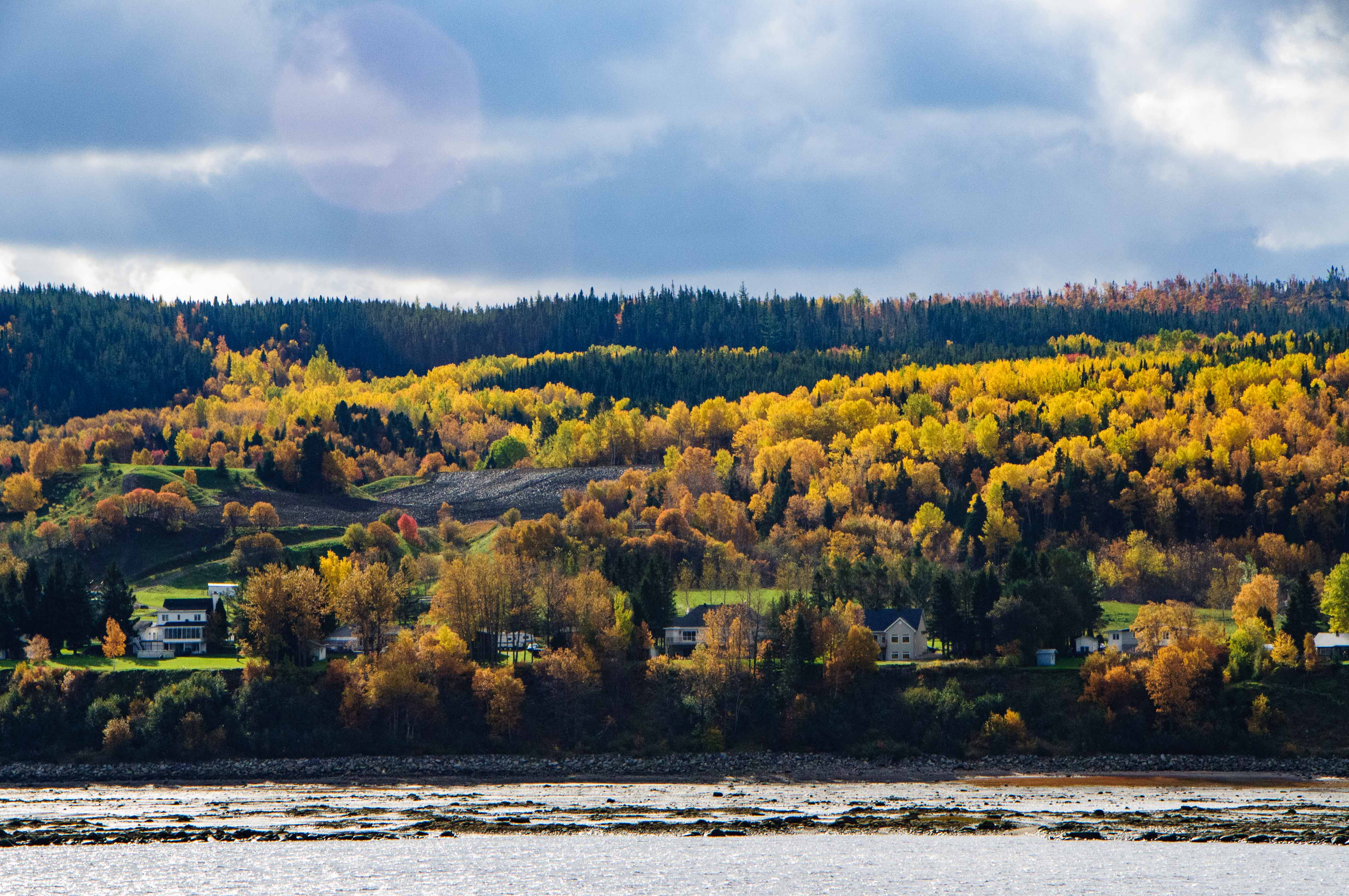
Early morning view from the ship.
Soon, we pulled into Saguenay, still in the province of Quebec. Cruise ships are a huge moneymaker for small towns, and they put on quite a welcome show, on the dock even before the gangplank is lowered.
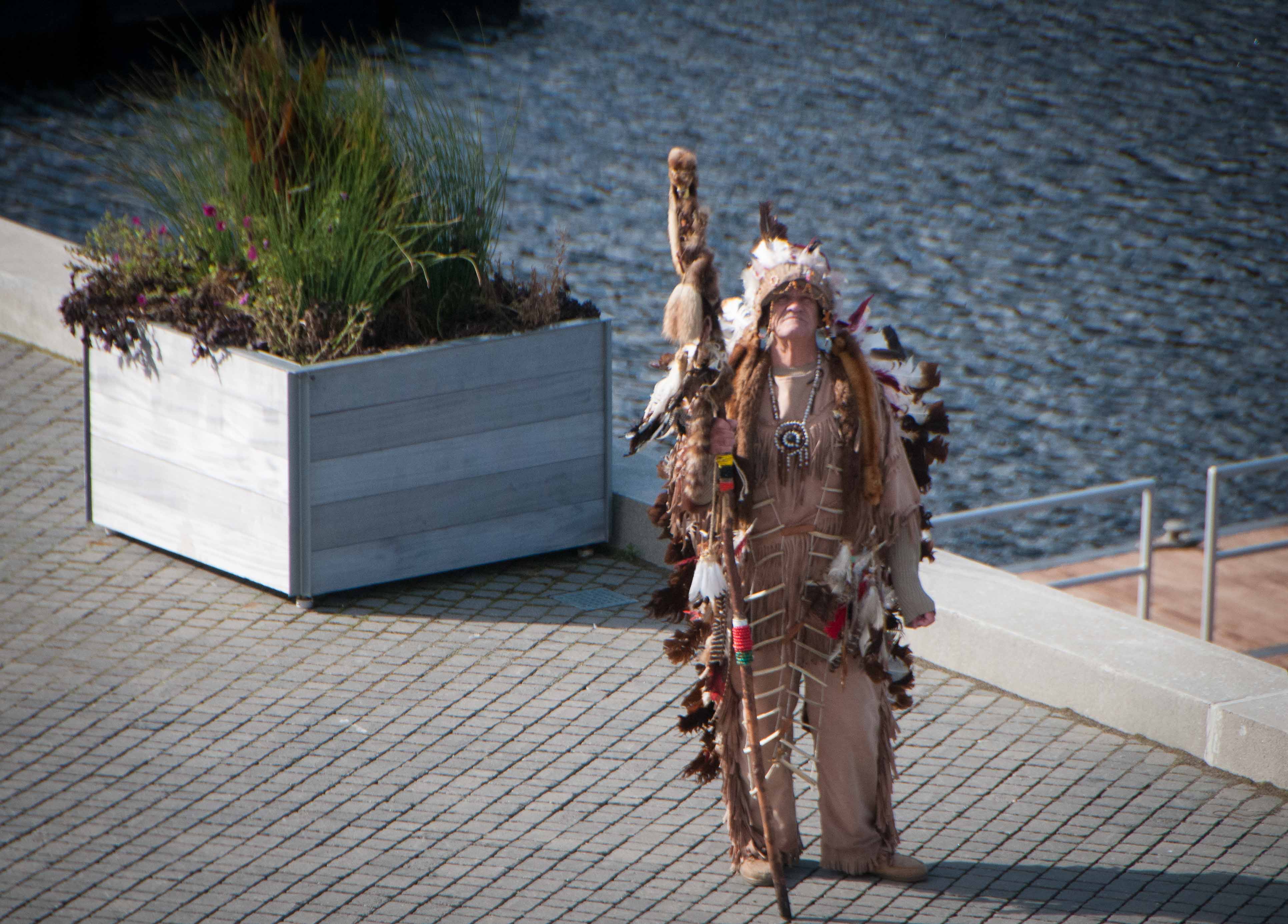
Big Chief Rain-in-the-face
Okay, so I never outgrew Howdy Doody, but I’ll bet this guy is much more French than Cree.
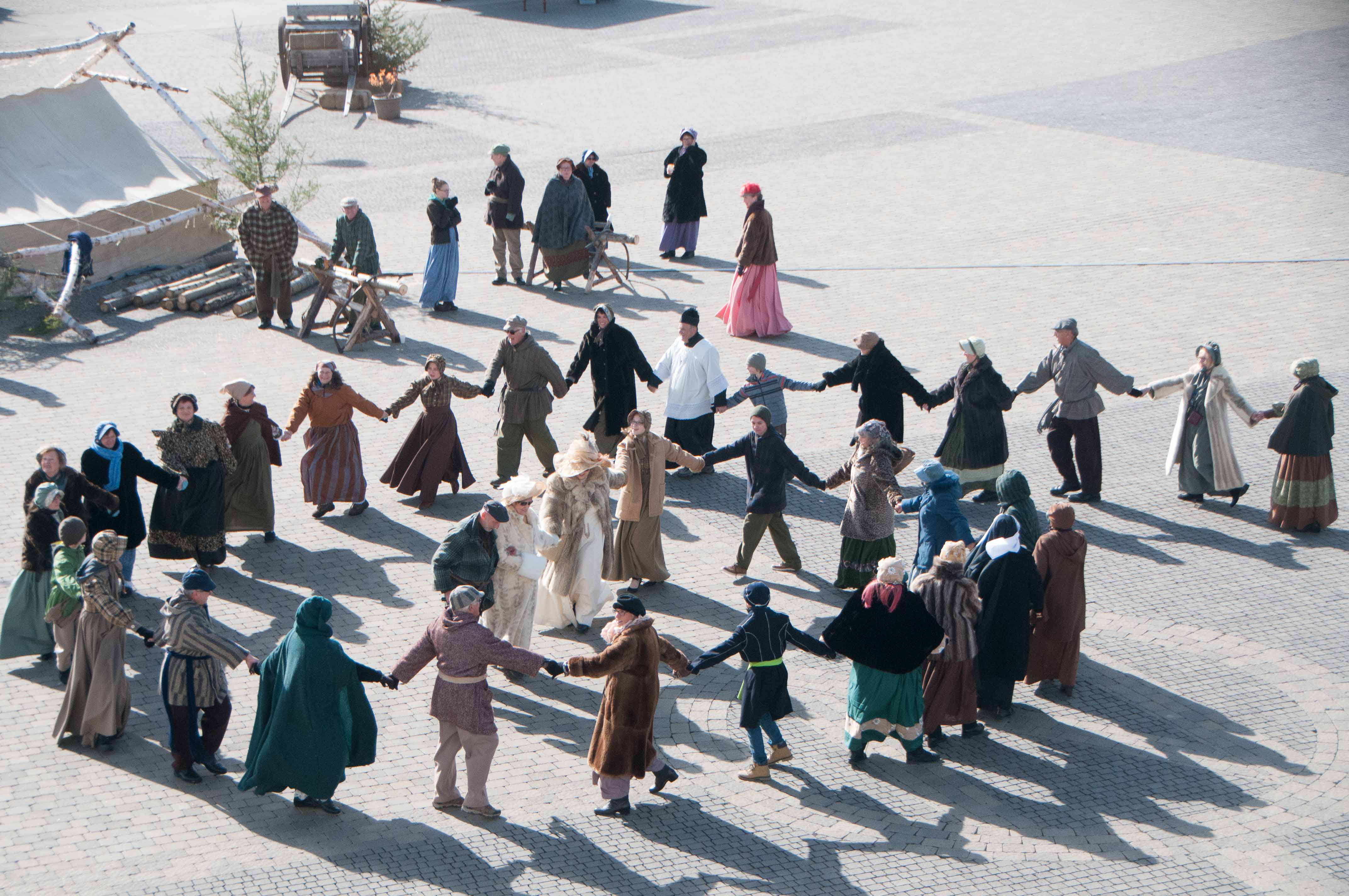
Lots of folk dancing, all in historical costume.
Sagueney is a modern looking town, and mighty photogenic, too.
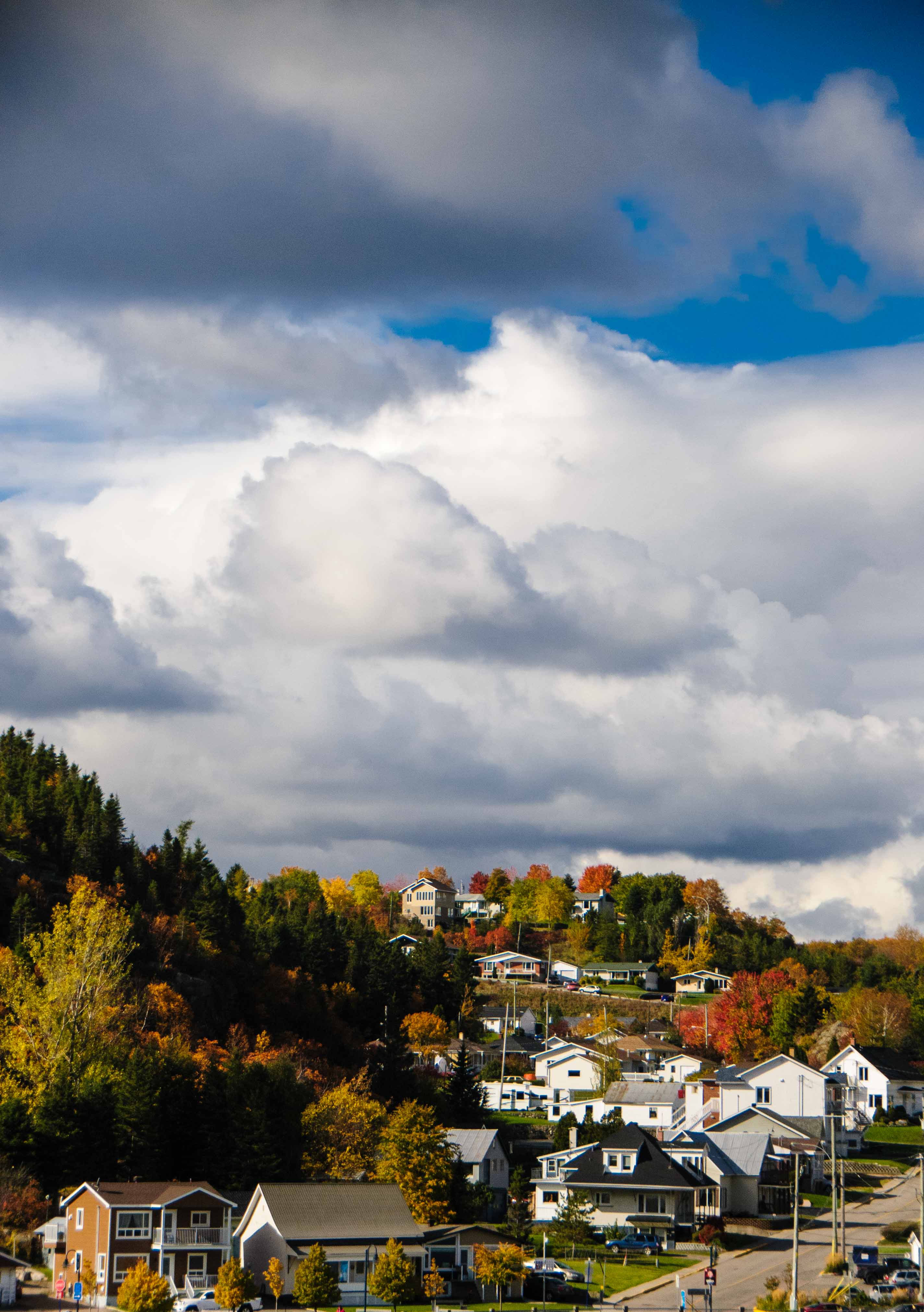
Like a Kodachrome postcard photo

Not a shot I can pass up.

Most of the fall colors in one place
The main industry around here is the smelting of aluminum. The bauxite ore is shipped in, smelted and aluminum ingots are shipped right back out. They do this here because there is a tremendous water flow on the fjord and the electricity to do the job is cheap.
Previously, they used the water power to turn wood into paper in a giant pulp mill. Today, that mill is a museum, one part of which holds the entire house of one Arthur Villeneuve, a local barber who started painting one day and never stopped. Lacking funds for canvas and art materials, he painted the walls of his home with house paint and the smallest brush he could buy at the hardware store. Upon his demise, the entire house was moved into the museum.
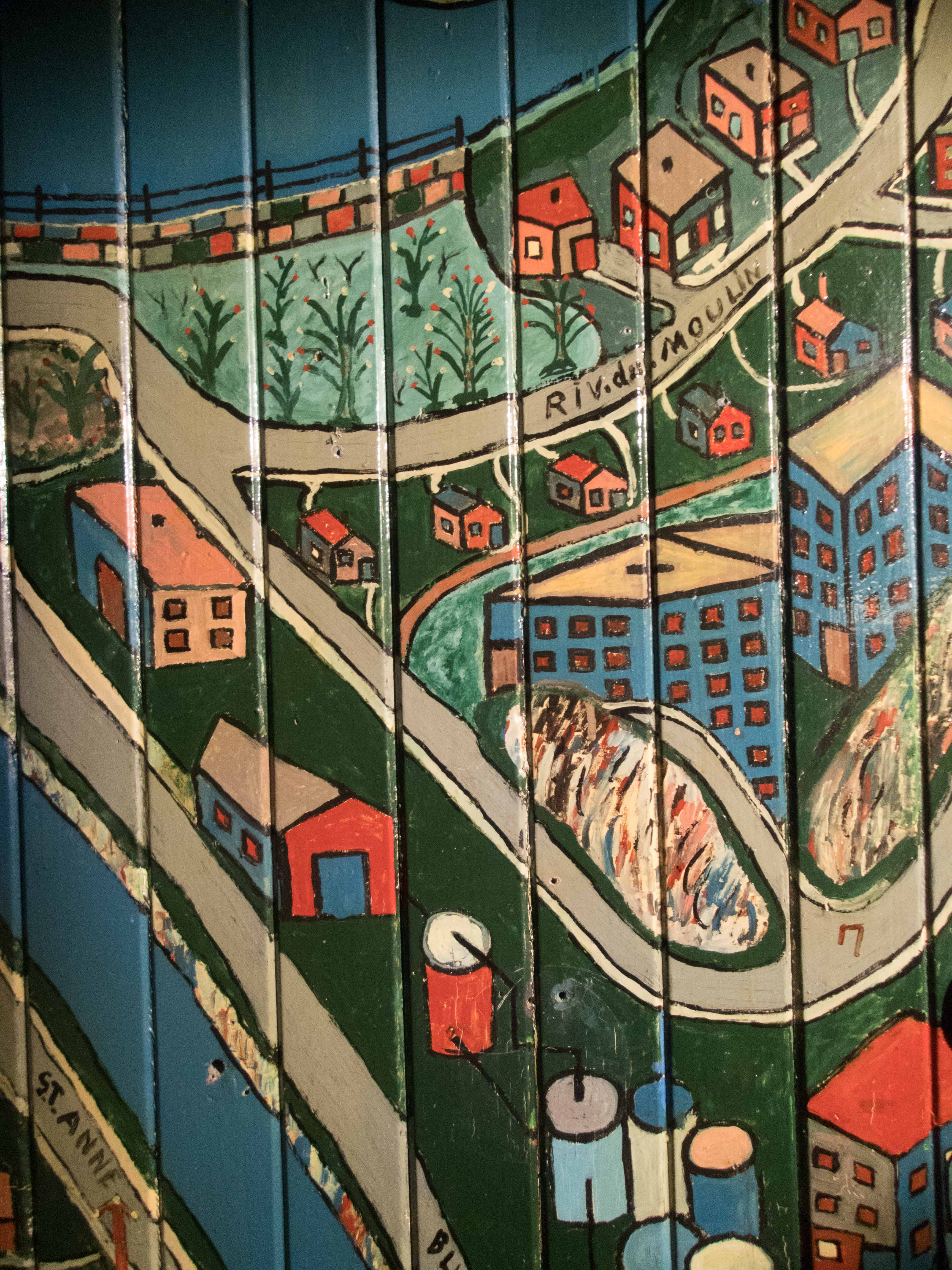
Part of the front wall of the house, coated in shellac to protect it from the elements.
Villeneuve was purported inspired by a Sunday sermon in his church wherein Pope Pius XII exhorted the faithful to make full use of their talents. Painting without any reference to scale, perspective or chiaroscuro, he represented the world around him in his own idiosyncratic way, eventually becoming well known, successful and moderately famous.
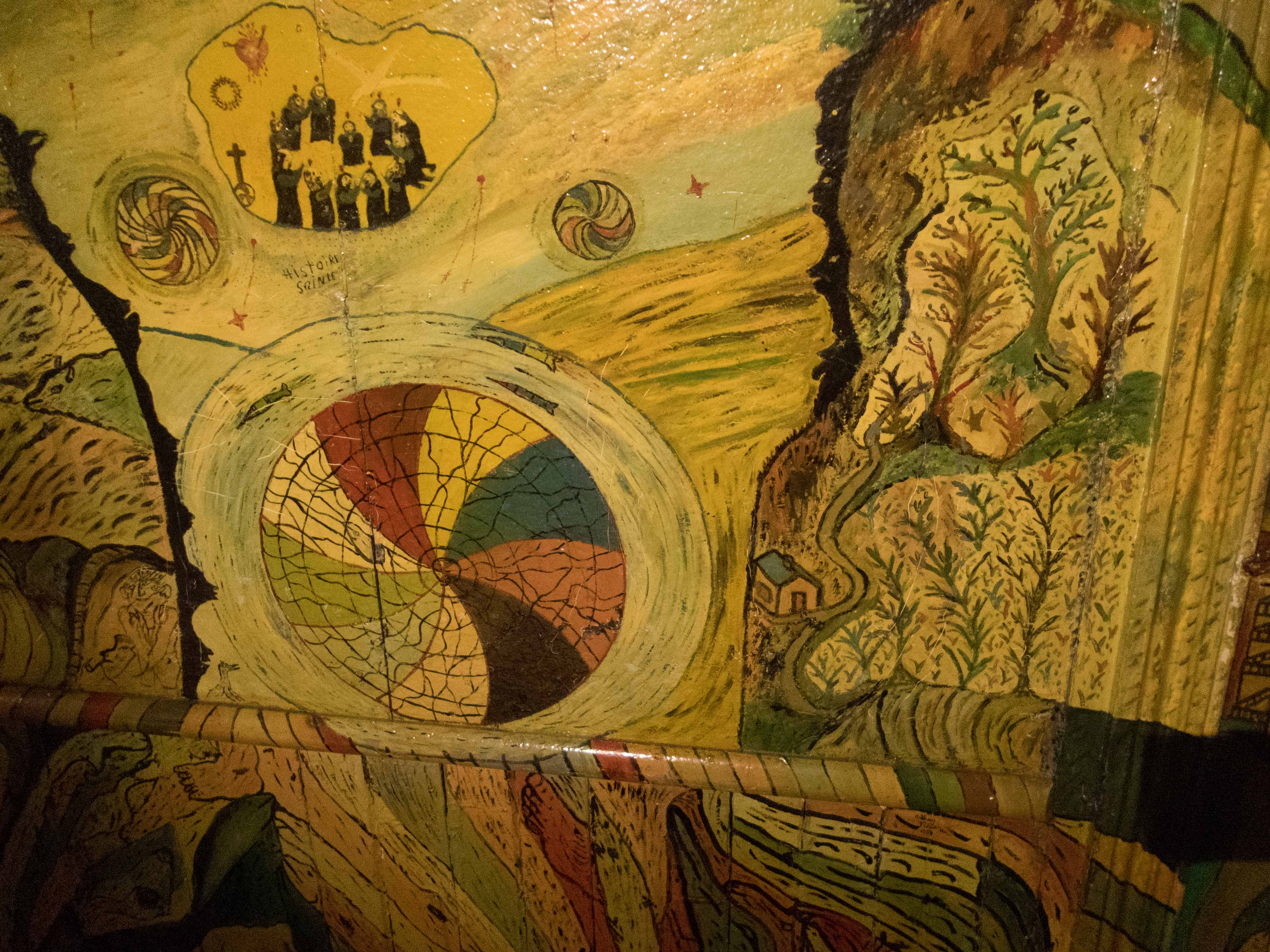
An inside wall.
The exhibit was fascinating. So much so that I looked up and was all alone and locked into the building and had to find the guide to let me out and back on the bus.
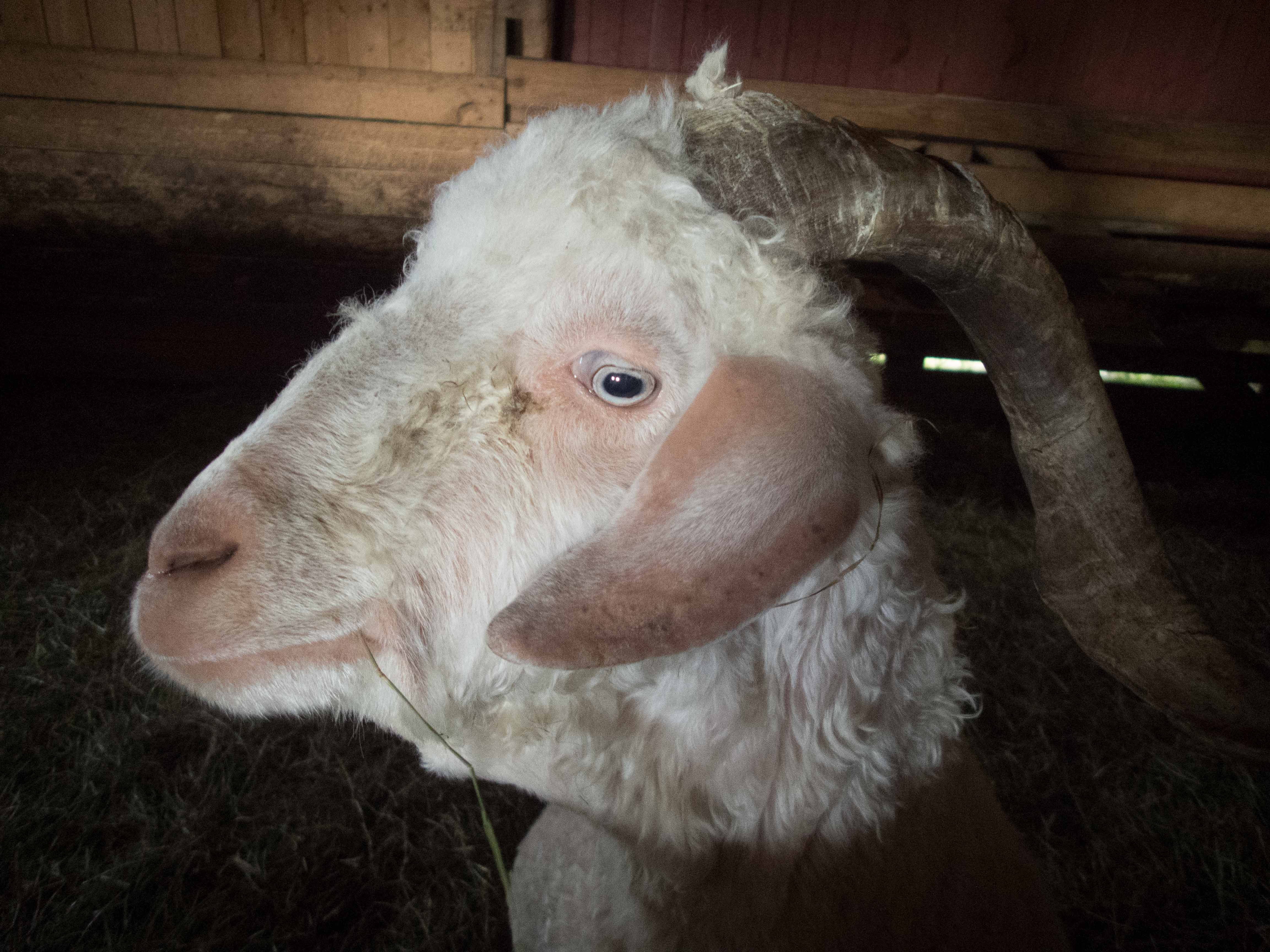
Kinda smart looking, for a goat.
We then wandered out into the boonies a bit to a goat farm. Why a goat farm? Because there is a provincial program to help develop small industry/art & crafts establishments. This farm raises angora goats for their wool, selling some and turning the rest into fine cloth, knitting yard and woven goods.

All babies are cute
The goats are shorn twice a year, spring and fall. We got to see a woman in the process of the fall shearing. It looks like the hardest work in the world, and guaranteed to ruin your back.
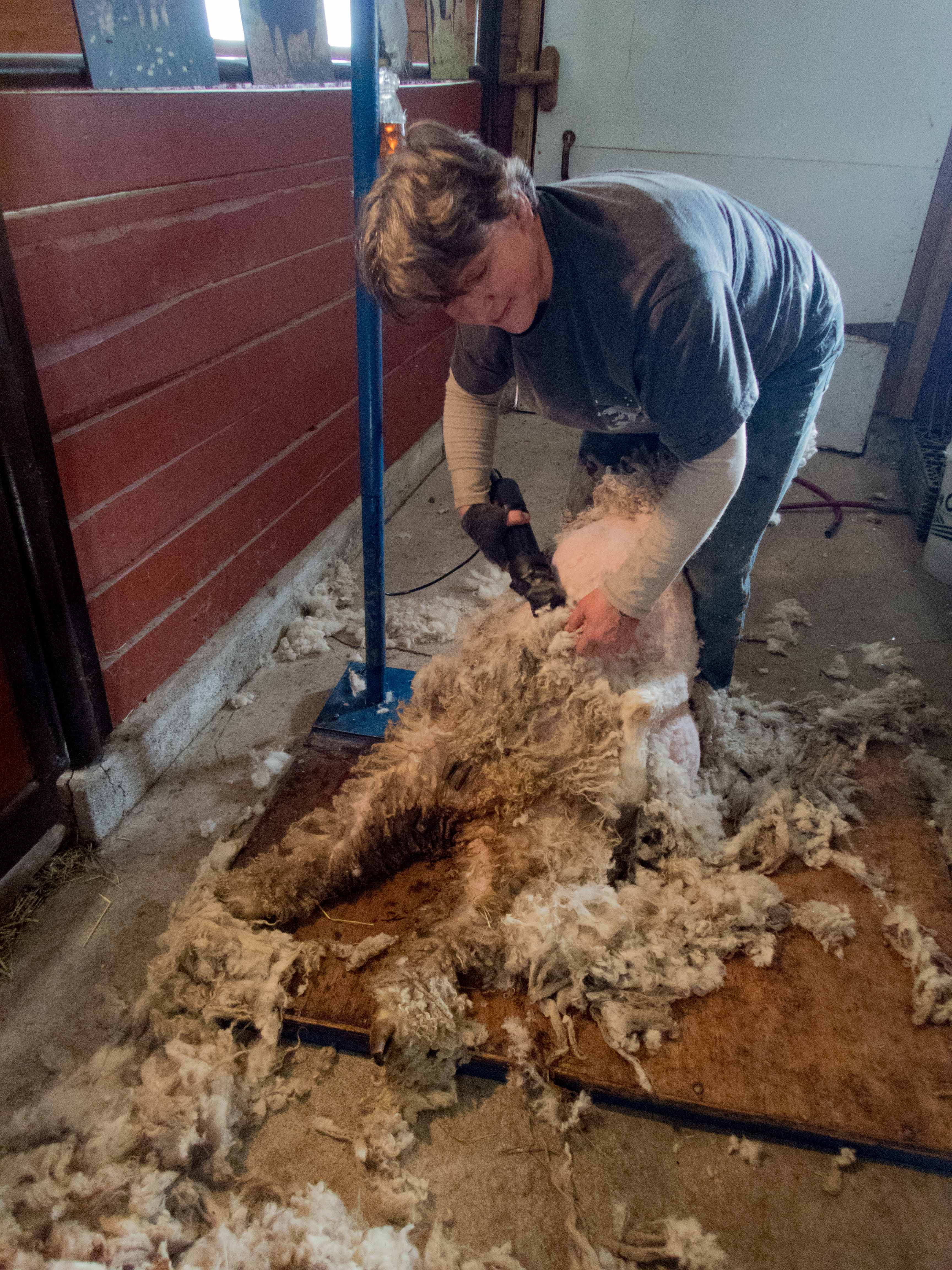
Chiropractors must dream of people working like this.
After the goat farm we wandered and rubbernecked for a while, ending up at a glass blower’s shop. No shore tour is complete without a gift shop to drag the sheeple through. We got to watch the proprietor and his assistant create a lovely hummingbird sculpture in just a few minutes, then were lead into the inevitable boutique. I found a piece I liked and managed to get it past the household design review committee, which made me a happy camper.
Leaving the glass blowers, the weather turned more than just chilly.
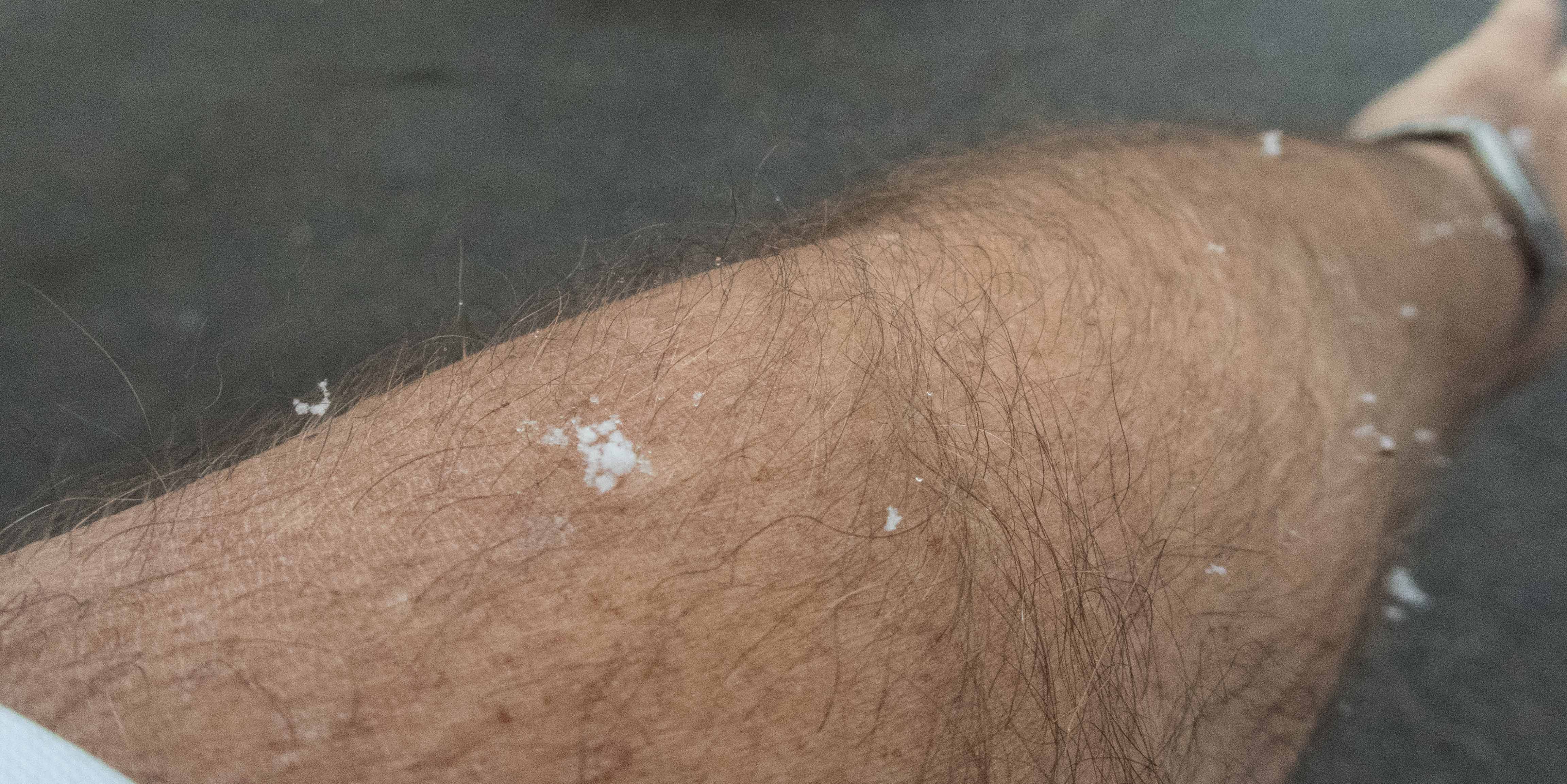
Snow!!!
So much for the brisk fall weather we were hoping for, this is the real stuff. What the heck, I’m inside and it’s beautiful. Let it snow, we’re off to Prince Edward Island.
Horsing around in Quebec City
We came on this trip expecting fall weather in the 50’s and 60. We’ve got weather in the 40’s and lower. That’s why they call it adventure.
In Quebec City on Friday. The ship recommended a place named Restaurant Aux Anciens Canadiens, in a building which has stood on the site since 1675.
The food wasn’t much–I had a meat pie, which was overcooked and tasteless. Gail had a different meat pie, but the same result. You can’t really keep a crust crispy when the filling is rendering fat all through it.
At least the dessert was good:
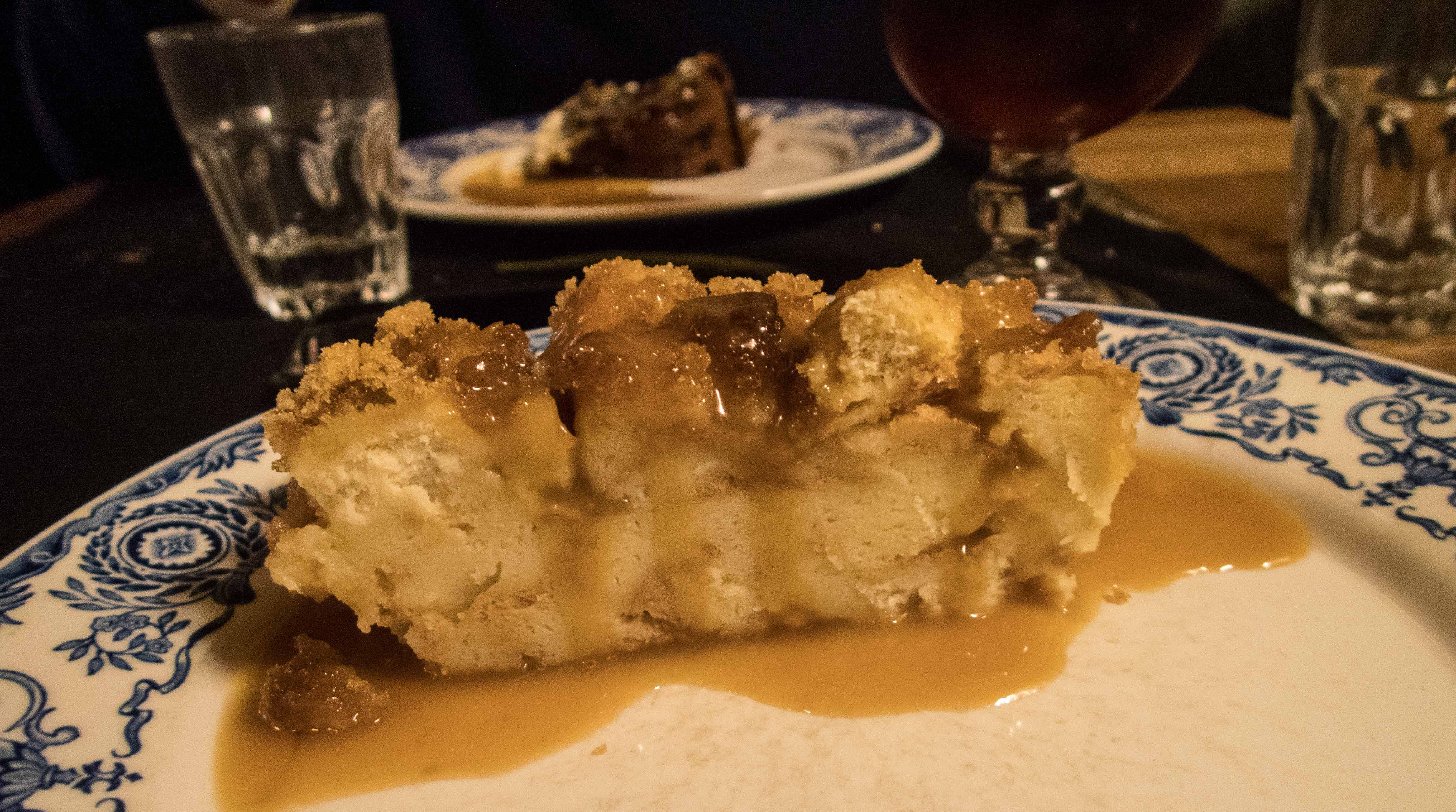
Canadian bread pudding with Maple syrup
This is mostly just upscale French toast, about 2 inches thick. You can’t really beat genuine maple syrup.
After lunch we wanted to see the old city, and didn’t want to walk in the cold and the rain. Luckily, we stumbled upon a horse drawn carriage stand, and quickly negotiated a tour. Ok, he told me the price and I said yes. Sometimes haggling isn’t really in the cards.
It was a cold, wet, blustery day, but carriages come with blankets.

Living in Luxury
Forty minutes was plenty of time to roam all over the old city of Quebec, in and out of the gates, see the sights and hear a good amount of history. A hansom cab is just the right pace to see things–faster than walking, slower than the tour bus. We had a lovely time.
Canada does more in the way of Halloween decoration than we do, especially on civic buildings. Notice the giant spider on this ancient armory:
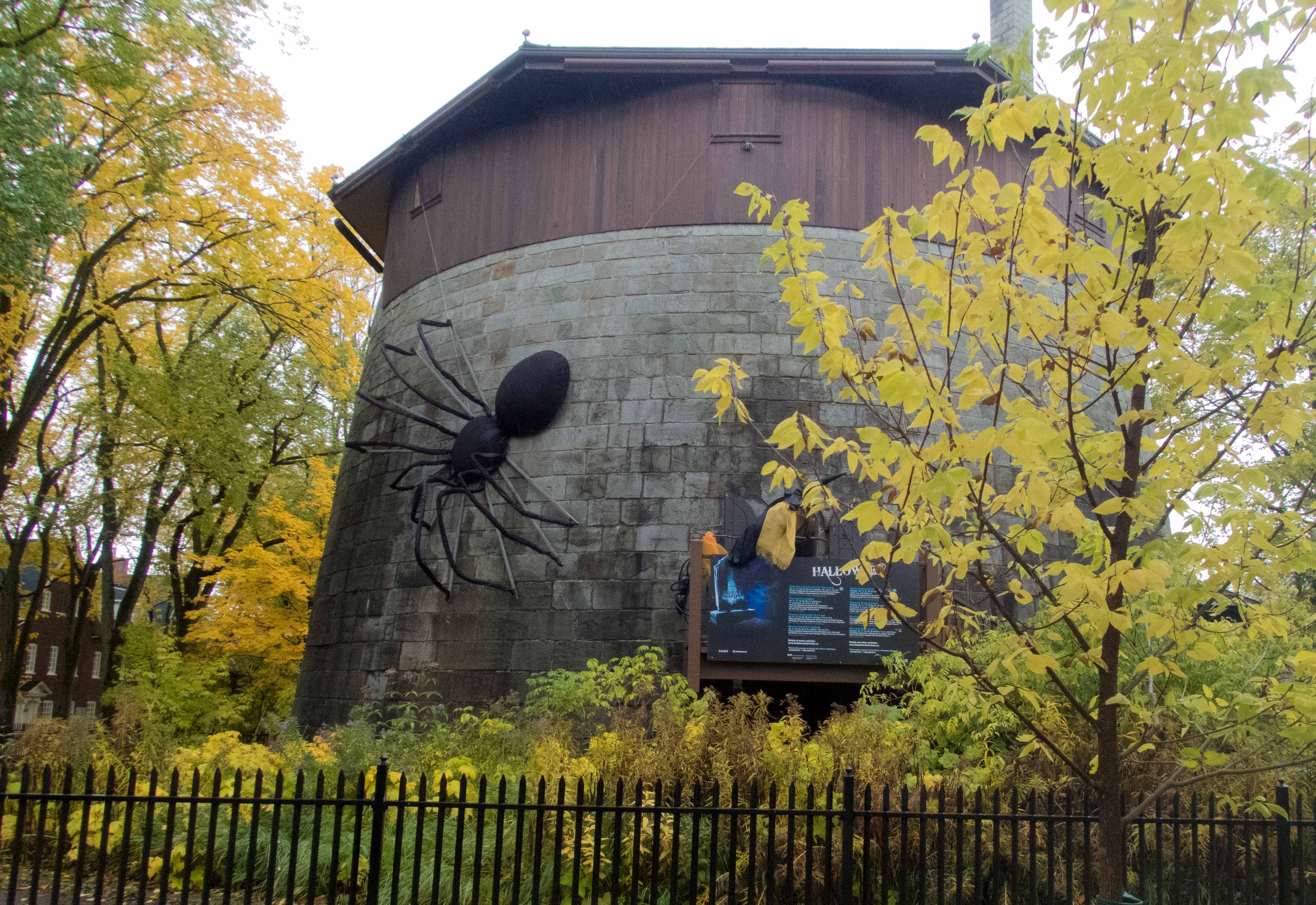
Big bugs everywhere at this time of year
After the ride, we piled into a cab to return to the ship, but told the driver to take the long way so we could see more. The most interesting thing was the Halloween display outside city hall:


Safe and snug onboard, we had drinks in the lounge, then an excessively slow dinner in the dining room, more drinks with the show in the theater and finally toddled off to bed, stuffed, tired and woozy. Another great day is coming up.
North of the border, up Canada way
We haven’t had an adventure in a while; it must be time to go somewhere. I’ve certainly had enough of bridge politics to last a lifetime.
This time we’re taking a fall colors cruise, from Montreal to New York. Bringing daughter Kate and son-in-law Brad. Taking one of the smaller cruise lines, with a smaller ship, the Silver Whisper, part of the Silverseas Line. Capacity is 300 passengers, if they sold all the cabins.
First, we had to get to Montreal, and the only way to do that efficiently on American Air is to take the dreaded red eye flight from SFO to Chicago, then a regional jet to Montreal. There is absolutely nothing fun or glamorous about this kind of travel–it’s just how you get from there to there.
We get into Montreal (airport identifier YUL, for some reason Mamula will probably explain) at 10:30 am. Can’t board the ship until 2. Have no intention of sitting in a terminal for 3 ½ hours. Beth the Travel Goddess worked her magic, and there is a limo waiting for us with a nice electronic sign that says “Mr. Pisarra”. I love that sort of thing.
The limo heads downtown, where we pick up a licensed guide to show us around for a while–we don’t absolutely have to be on the ship until 6 pm.
Our guide says to call her Stacy because she has a 7 syllable Greek first name no one can pronounce. She had to go to school for a year to get her license, and she know just everything about Montreal, it’s history, people, building, parks, gardens and events. We were happy to have her.
Mike has been after me for 3 years to go to the botanical gardens and see the magnificent topiary displays. He has a thing for trees shaped like bunnies and horsies. So that’s the one thing I tell the guide I don’t want to miss. Sadly, it’s raining, it’s cold and windy, the botanical gardens are 30 minutes the wrong way and the topiary display was only temporary, the guide says, and there are only 3 or 4 pieces left standing. Sorry Micky.
First thing, then, we need lunch. And there is only one choice–when in Montreal you have to have smoked meat. Which would be called pastrami if you were anywhere else in the world. And the place you are supposed to go is Schwartz’s Deli, which has been flogging ‘smoked meat’ here for the last 107 years. it’s supposedly the oldest deli in Canada.
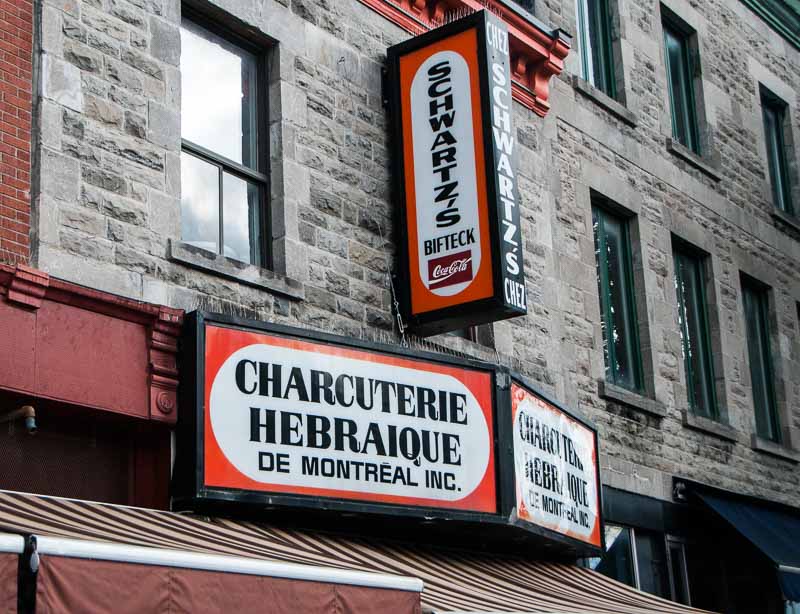
Schwartz’s Deli, the most famous in town.
Well, Schwartz’s is a great place, but it’s also packed to the gills, with very little seating and a line out into the cold. Gail doesn’t do lines. Directly across the street is the second oldest deli, Main Street. More tables, more easy going atmosphere. Damn good smoked meat, says the non-expert. HUGE bottle of mustard on the table.
We all had a sandwich, and enjoyed it. The others just had the standard fries, but I had to try something new and ordered poutine.
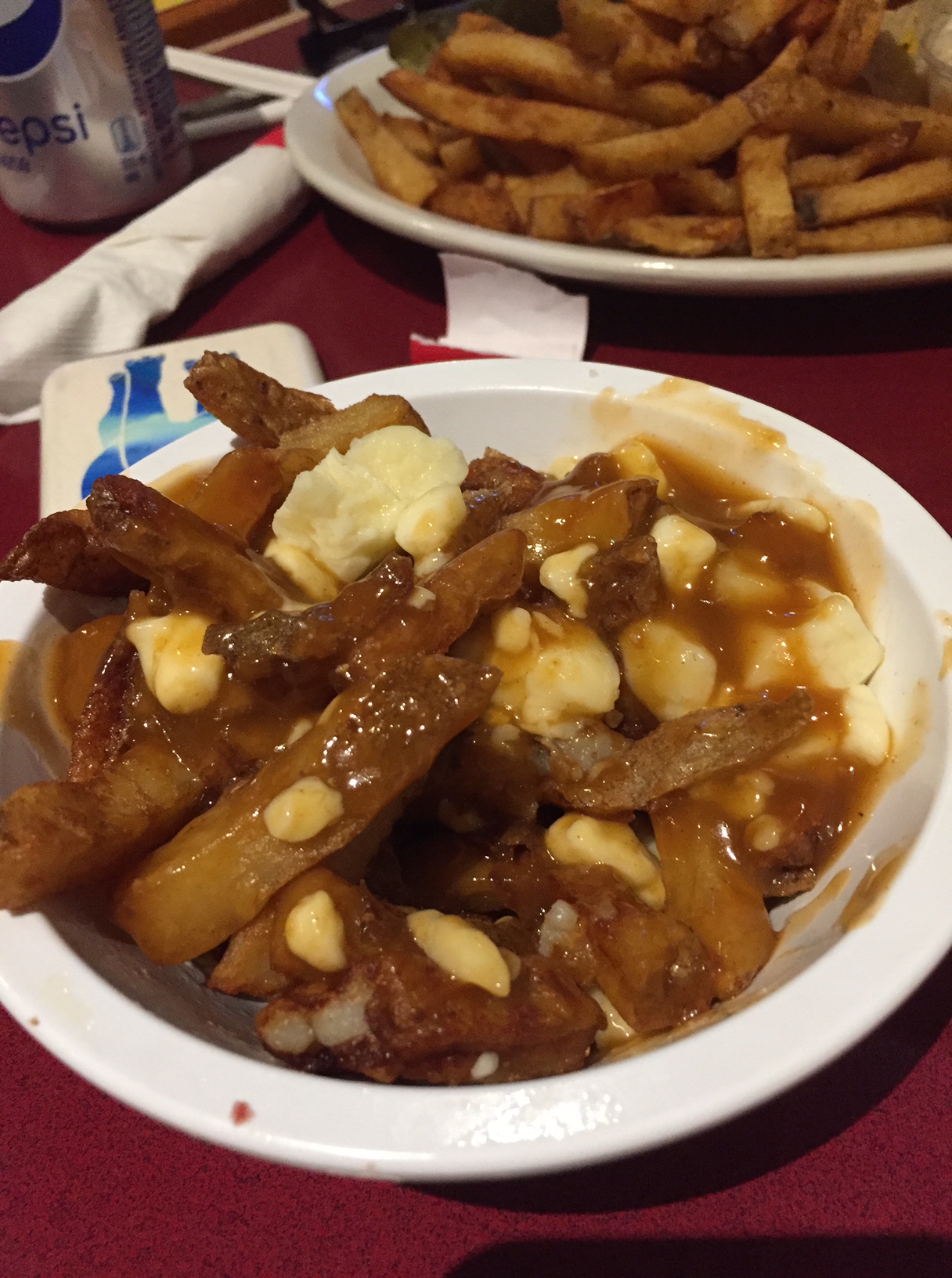
A little plate of Canadian heaven.
Poutine is almost a religion around here. A dish of fries, drowned in brown gravy and cheese curds. Sounds dreadful, tastes like angels dancing in your mouth. It’s the ultimate Canadian comfort food, even if it is a heart attack on a plate. My friend Susan M can’t understand how Alabama didn’t discover it first.
Then we just drove. Saw the downtown, went to the top of Mount Royal (hence Montreal) for the stunning view, saw the big houses in the rich neighborhood–which is still very British, so the stop signs say “STOP” instead of “ARRÊT”.
Drove around the site of the 1967 World’s Fair. The impressive USA pavilion was a geodesic dome, which burned in 1976, leaving just the framework of the dome. Even without it’s covering, the design is stunning. The US made a gift of the building to the Canadian people, who have put a museum inside.
The road around the site now is now know as Circuit Gilles Villeneuve and hosts a Formula 1 race annually in June. The rest of the year the track is open, and so we slowly paraded around it in a Lincoln Navigator limo, not quite as exciting as a Mercedes F1 racecar but quieter.
Modular housing that was built for EXPO67 is now very upscale and high class–and we all agreed we’d like to live there:
 Habitat67. Precast concrete modules were incredibly innovative for the time.
There was another sandwich joint the guide said we needed to see, Wilensky’s

This is a great place for a baloney sandwich. Period.
Moe Wilensky founded this place in 1932. It served baloney sandwiches. That’s it. Baloney sandwiches. They come with mustard, whether you want it or not. The do not come cut in half. Ever.
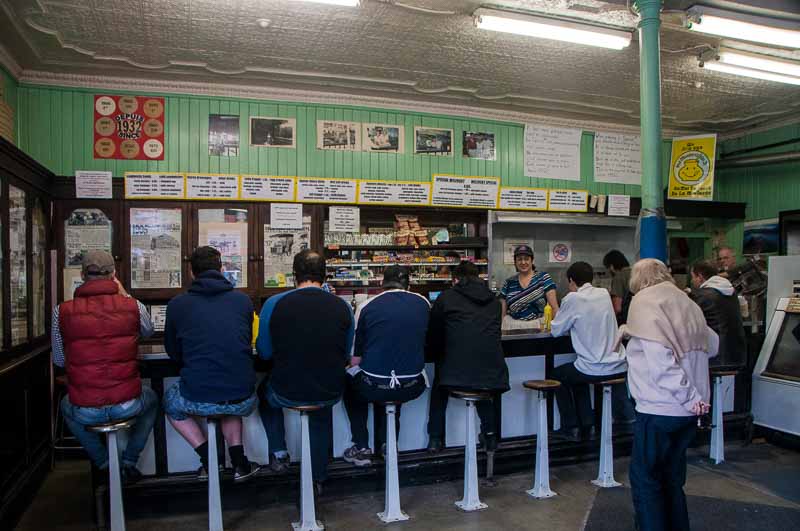
They don’t spend much on remodeling, either
Within the last few years, Wilensky’s has eased up. They serve egg sandwiches, too. The guy who said the customer is always right never ate here.
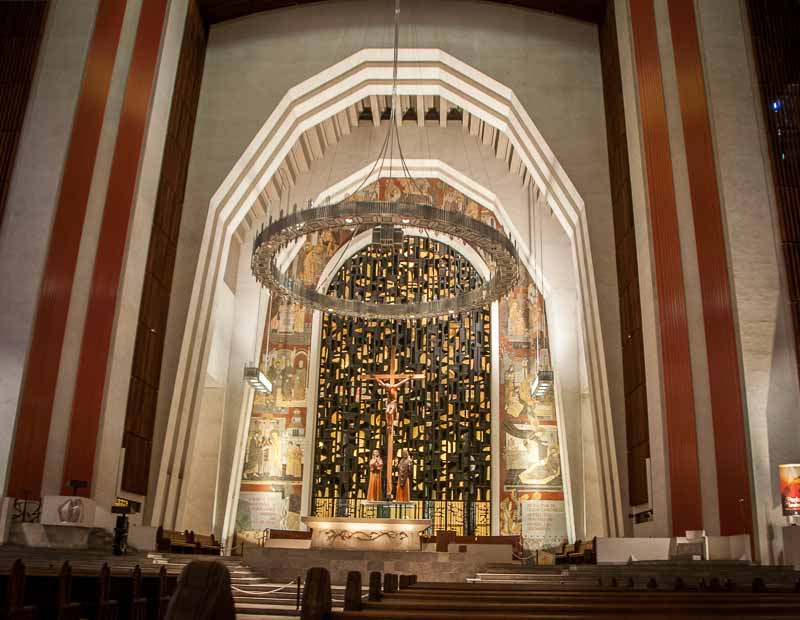
Interior of St. Josephs
Along the flank of Mont Royal sits the Oratoire St. Joseph du Mont Royal, and enormous limestone cathedral built over the course of 43 years with the donations of the many who came to pray for miraculous healing. The dome is the third largest in the world, the place seats around 10,000 and is breathtaking and awe inspiring. There is a wall covered with the crutches of the healed, miracles that eventually led to the beatification of Saint André Bessette, the only Canadian saint.
Regardless of how holy the site may be, the road in is owned by a man who insists on his $5 to pass–and he argues with limo drivers and guides who don’t want to pay his tribute. Our driver got into a long and loud difference of opinion in Arabic before we got past him. The driver was embarrassed, we were amused.
Driving through downtown, we encountered the hôtel de ville, which is how you say city hall in French. There were interesting seasonal decorations in front, and now I can tell Micky I went to Montreal and saw the topiary:


You don’t get much sleep on a red-eye, and the four of us were falling asleep, so we called it quits and headed for the ship. With only 300 passengers, there are no crowds waiting to board so the process is quick and painless. We got into our cabin, unpacked and stowed the mountains of clothes we brought, had a bite of dinner and hit the sack by 8:30.
So begins another adventure. Stay tuned.

 Totally Unauthorized