
A fine and fancy ramble at the Zoo
Not having much to do today, we headed down the to War Museum, which everyone says is a must-see.
It was closed. Closed from 11 to 1:30, and we got there at 11:05. We’ll try again tomorrow.
Fortunately, the zoo and botanical gardens are next door to the museum, so we went there. Mike and Linda visited yesterday, and said we needed to see the orchids. I’ve never needed to see an orchid in my life, but they seemed excited about the whole thing, so in we went, spending the $0.90 apiece for admission.
It was a pretty nice place, I guess. Not quite as good as Knowland Zoo in Oakland, but it will do. I’m just going to put a gallery of photos here, there isn’t much to say on the subject, just show you what I saw.


Not exactly Gucci
There are a lot of fancy, upscale stores around Saigon. You can buy a Rolex (the real kind), Prada shoes or a Rolls Royce. So when you hear talk about “Gucci”, you’re thinking:

What people are talking about is spelled “Cu Chi”, and it refers to the tunnels that the Viet Cong built, lived in and fought from starting in 1948 through the end of the war in 1975. It only sounds exactly the same.
So 14 of us from the tour group took the trip out to the tunnels. It’s about a 2 hour drive to get there, even though it’s only 40 miles or so. Traffic is horrendous, and then the country roads are very poor and you just can’t get the bus moving very fast.
Arriving at the site, we were greeted with a static display of left over war armaments–a couple of howitzers, a couple of MiG aircraft, and a Huey helicopter. After the guide bought our tickets and everyone visited the “happy house” (Vietnamese euphemism for the toilets), we set off through the brush to see the tunnels.
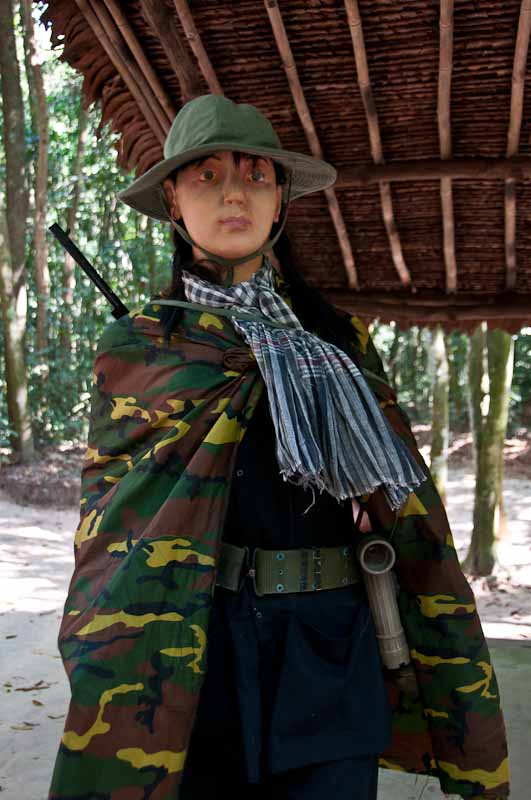
Also not Gucci, a model of a guerrilla fighter. Note that this mannequin does not have Asian features, either. The scarf is a more modern touch.
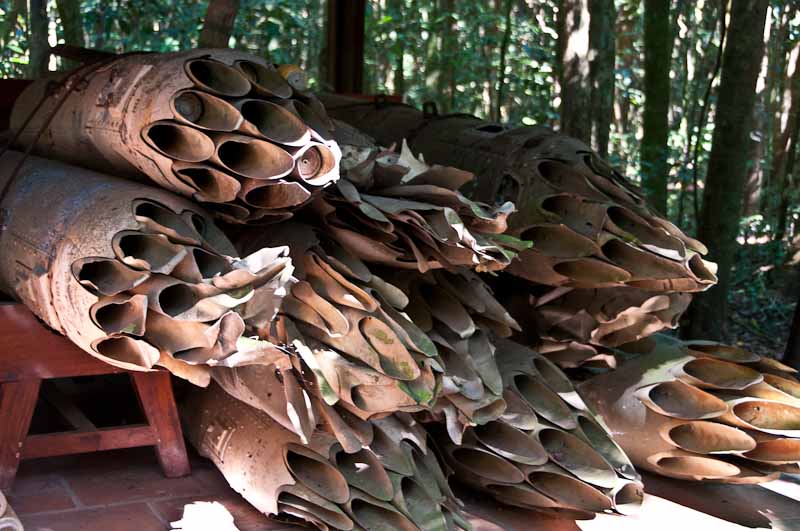
More weaponry--spent casings from cluster bombs.
There were over 250 km of tunnels at one time, built over more than 25 years of fighting without lumber or shoring in the hardpan dirt. They ranged from 3 to 10 meters below the surface, and were tiny, poorly ventilated, dark and scary. This is the first one we came to, where you can enter at one point and come up about 15 meters later:
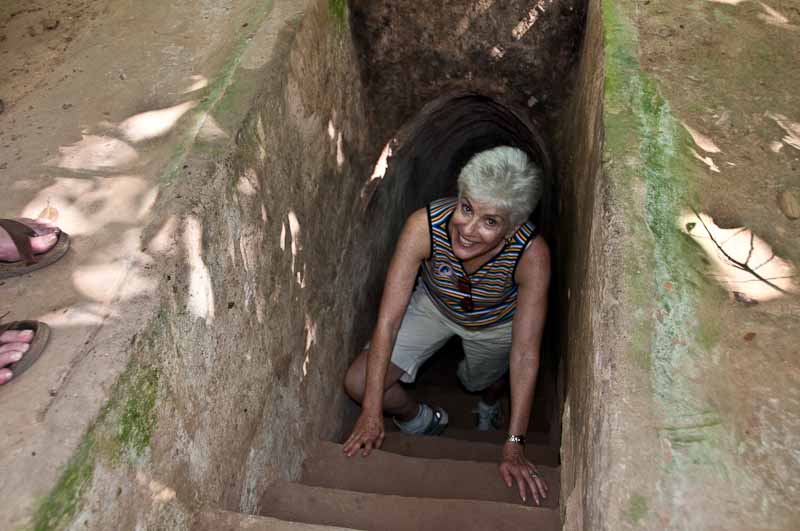
Linda coming up from the first tunnel.
Even a 5′ 4″ tall Vietnamese soldier had to stoop to pass through these tiny places; 6′ 2″ Mike ended up crawling on hands and knees to make it to the exit–there is no turning around, either.
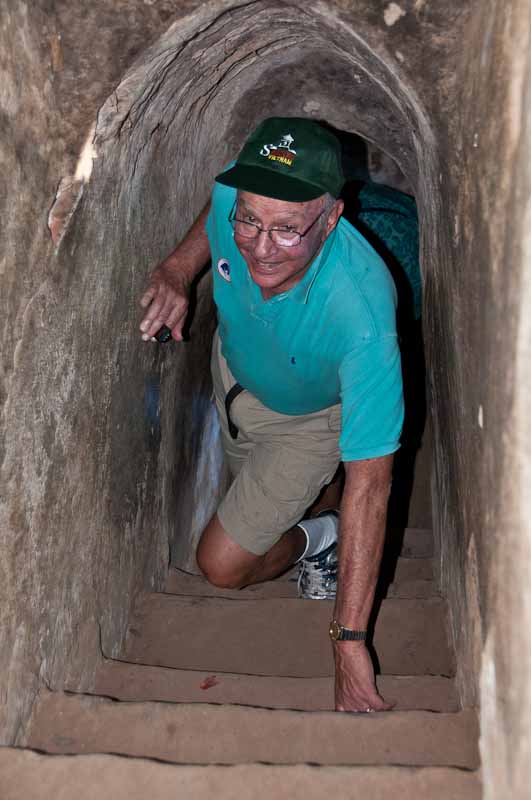
Mike didn't exactly fit.
Since I don’t have the knees to duck-walk through the low-ceilinged tunnel and it’s just possible I’m too wide to make it comfortably, I passed on the opportunity. Seeing Mike with dirty knees from crawling convinced me that I had made the right decision.
But, you are asking, how did they get in and out of the tunnels without being discovered? Darned good question, and here’s the answer:

Dropping down into a very small entrance door.
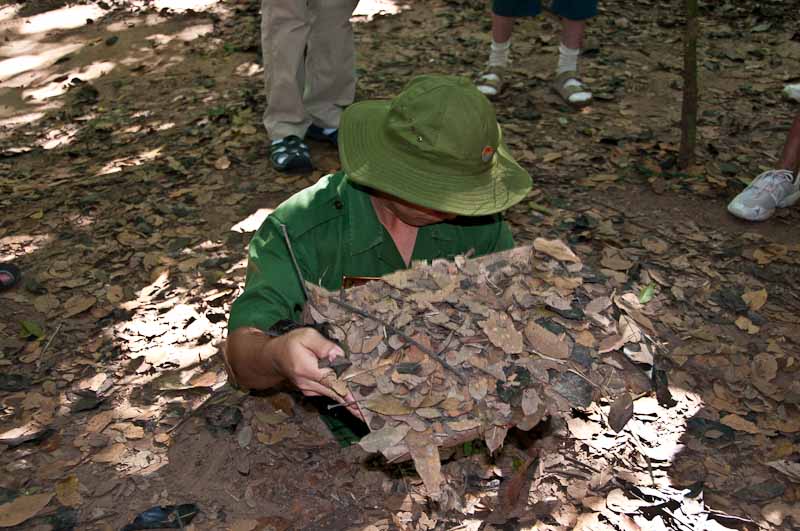
Picking up the camouflaged lid.
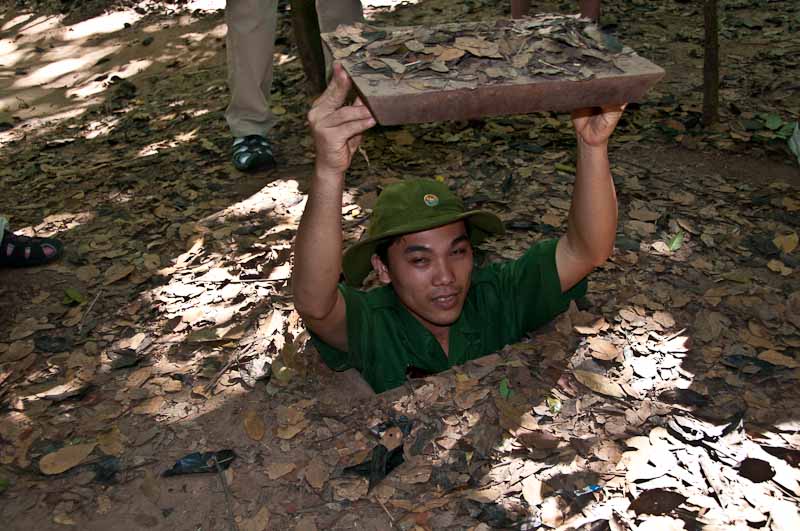
Carrying the lid down with him.
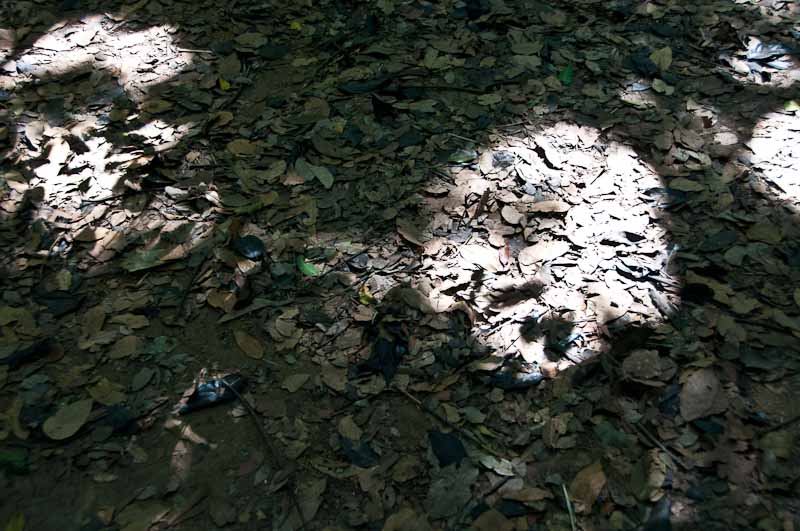
Yes, this is the exact spot he went down--you just can't see where the lid fits.
There was another tunnel, exiting into a meeting room that had been dug out so we could see it. Gail got into the tunnel to show how small it really is:

Not a chance of standing up.
We had an 8 year old girl on the tour who had a great time–she was the only one who comfortably fit. Imagine having to live in these underground burrows, with bad air, little lights, no easy way to cook, pit toilets, no chance to stand up and stretch, just darkness, damp and danger. And they did it for more than a quarter century, surviving raids, bombings, bulldozers, bugs, infections, malnutrition and fear.
The Cu Chi tunnels were a highlight of our tour, even though they were an added-on extra after the tour had officially ended. If you ever get here, don’t miss them.
Saigon
I really wanted to title this “Saigon. Shit.”, the opening line from Apocalypse Now, but not only does it seem tacky, but Saigon turns out to be a hell of a city and I don’t have anything to gripe about.
We had to have our luggage out of the cabin at 7 this morning, and they threw us off the boat entirely at 8:15. Which wouldn’t be so bad, except that we couldn’t get into the hotel until after 2, so we had a lot of time wasting to do. Since the tour company does this every week, they know just how to dawdle, dilly-dally, idle and otherwise make spending 6 hours doing nothing seem productive.
First, there was a 90 minute drive into the city center. Even though we were on a new highway, so new that the toll booths aren’t yet completed, where the myriad of Vietnamese motor scooters are prohibited, the top speed is only 60 and even that is rarely achieved.
Tet, the Vietnamese lunar new year, is almost upon us; it arrives January 23. We drove through the huge and bustling Chinatown where many of the stores are completely given over to vending new year’s decorations, then stopped at a large Buddhist temple, where hordes of people were making their new years ablutions and sacrifices.

Everyone seems to start the process by lighting a bundle of incense sticks.

The temple is ready for the new year.
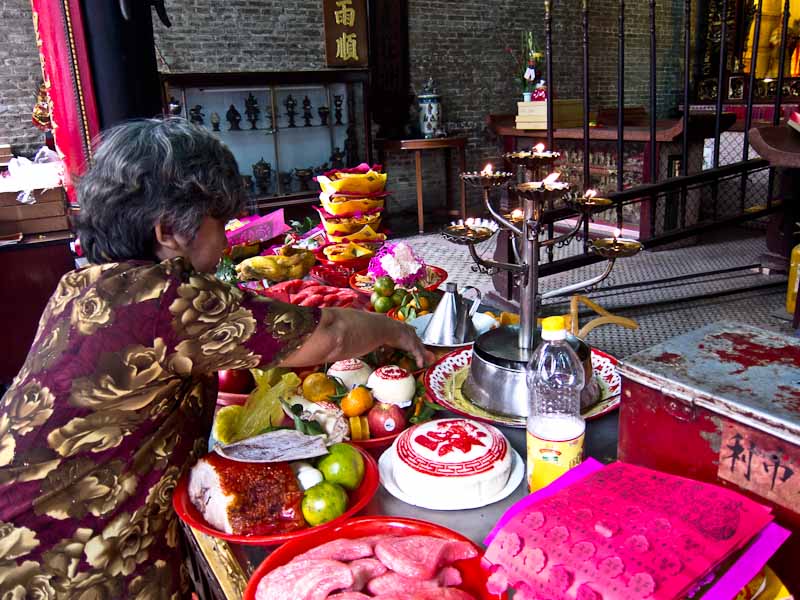
People bring food to sacrifice/please the gods/provide for their own ancestors/look cool in front of the neighbors. All I know for certain is that there's a real feast here; I hope it isn't going to waste.
We clearly picked just the right time to visit–there was much happening and it was all interesting.
Next, we wandered through the Saigon central market–which is just like the Phnom Penh Central market, which is just like the Hanoi Central Market, which is just like the Tijuana central market. Hundreds of tiny booths crammed with merchandise of all types. Clothing. Real jewelry. Fake jewelry. Toiletries. Notions, lotions, potions, knick-knacks, bric-a-brac and assorted junk. Food of all types, lying out unrefrigerated. Very aggressive sales people pushing their wares. Thousands of customers crowding the aisles, pushing past our group of gawking, moseying, over-sized, non-buying tourists.
Then lunch. A restaurant called, creatively, Indochine. Pretty interesting food–I even think I ate mushrooms, but if so they weren’t anything like the ones I abhor back home. I tried pomelo, which is like a giant grapefruit but sweeter, less bitter and all around better. We spent about 40 minutes too long at lunch, but I think that was part of the plan to keep us occupied.
Then yet another factory tour–this time of a lacquer factory. There was only a small amount of work space, and a very large sales room. The real production must happen elsewhere, but what we saw was intriguing. And the product was very good, if not exactly the sort of thing we want to have in the house.
Gail did see one item she liked–a wonderful chest of drawers with a Picasso-like embellishment. If we didn’t think that the shipping would cost as much as the chest, we might well have taken it home.
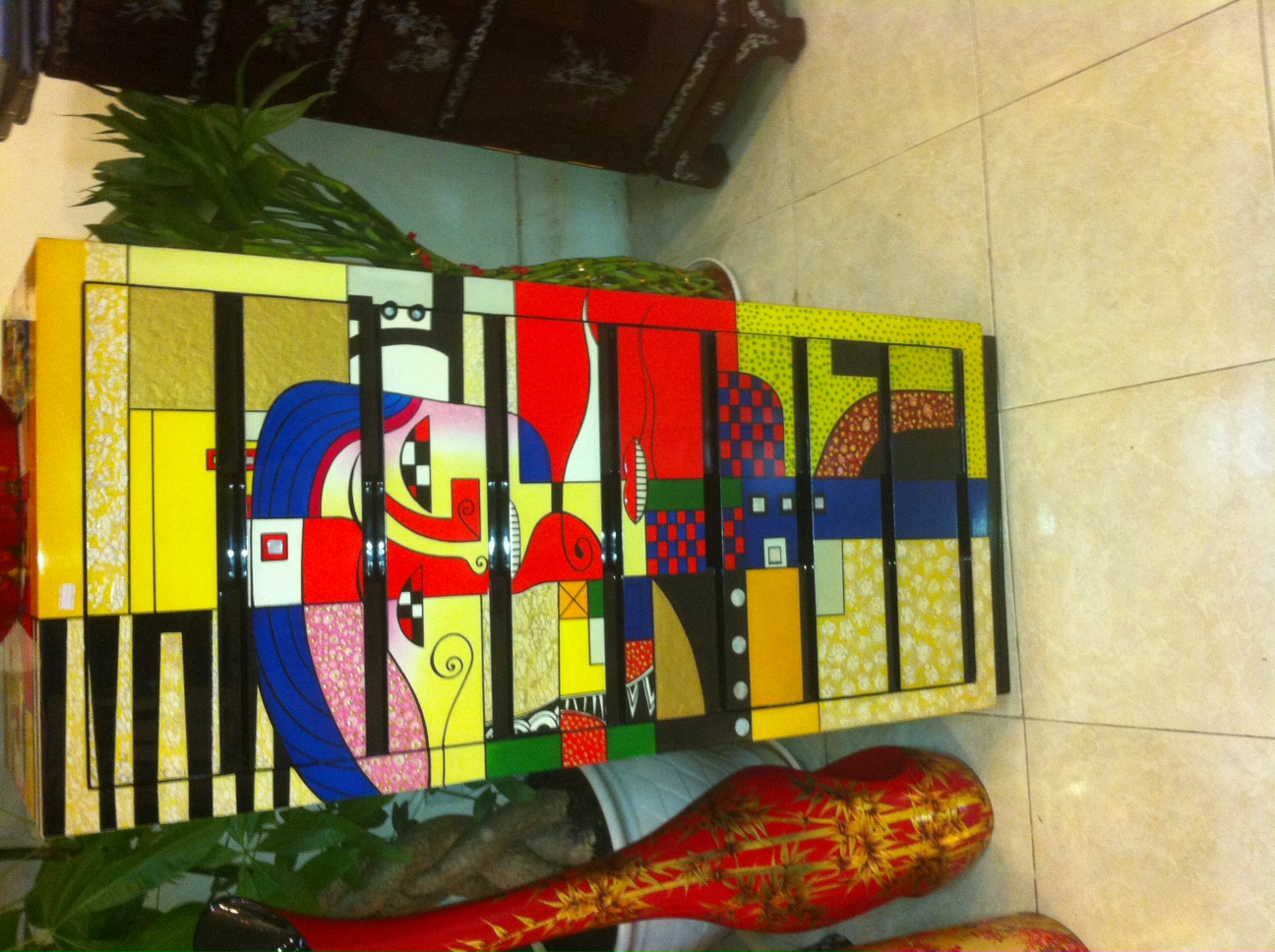
Not only beautifully designed, but the execution was brilliant. Photo by Gail.
Finally, thankfully, wearily, we arrived at the Saigon Sofitel. This is a beautiful, modern big-city, 5 star hotel, and they have one of the most interesting Christmas trees I’ve ever seen–it’s composed of birdcages, which are holding ornaments. Even a bah-humbug grouch like me can appreciate this:
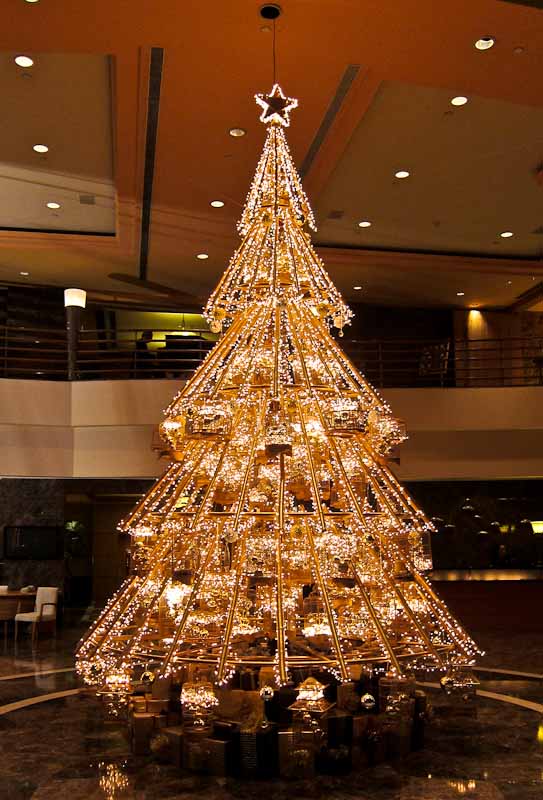
About as non-tacky as a Christmas tree can get.
It’s Monday evening, and we don’t fly home until Thursday at midnight, but I think we’ll be able to stay interested and occupied. Saigon is a huge, booming city, bursting at the seams with business and opportunity. There are at least 9 million people here, and 5 million motorscooters.
We had dinner tonight at an Italian restaurant,La Hostaria, and it was just excellent, except for Gail’s so-called Caesar salad, which just wasn’t very Caesar-y. Don had a pizza as an appetizer. Micky turned the cruet of oil upside down to see if the spices on the bottom would move–they didn’t, but the oil poured out just fine. Gail asked for “another glass”, meaning wine, and they brought her another glass. No wine, just a glass.

Proof that a pizzaiolo (pizza cook) doesn't need to be Italian.
The chef was from Venice, working his way around the world which the Euro is in decline. The food was great, and the taxi was sixty-five cents to get there and seventy-five cents to get back to the hotel.
Why do I have to get up earlier on vacation than I do when I’m at home? We have to meet the guide tomorrow at 8:00 for a trip to see the Viet Cong tunnels, so I’m going to bed. I guess I’ll get to sleep in when I get home.
Sac De
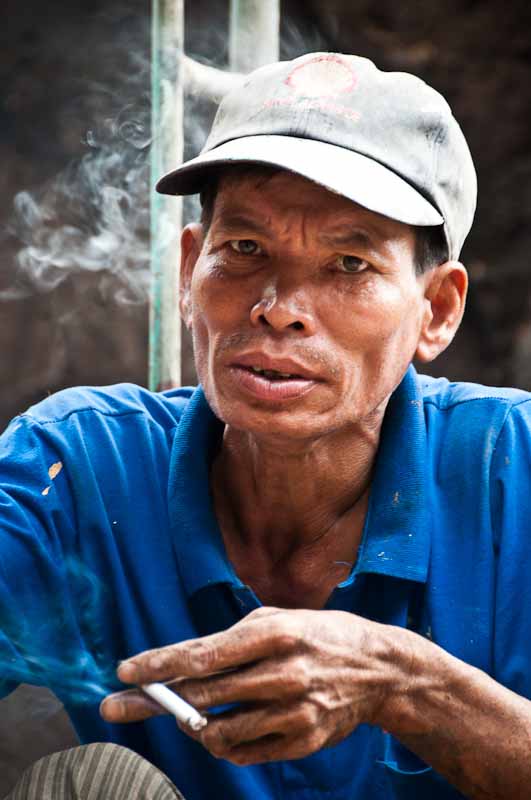
Saw this guy in a factory and liked the shot.
Sac De is a mid-sized burg somewhere along the Mekong on the way to Saigon. We parked there overnight and took a tour in the morning.
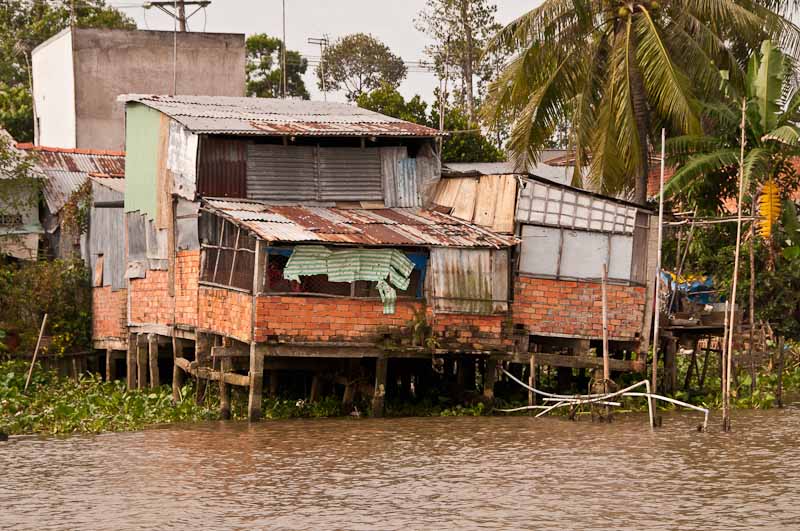
A tumbledown house alongside the river. Note the brick construction--this is brick city, Vietnam.
Our first stop was a brick factory. This place has a bunch of them, cheek by jowl along the river, from whence comes the right kind of clay to make either bricks or floor tiles.
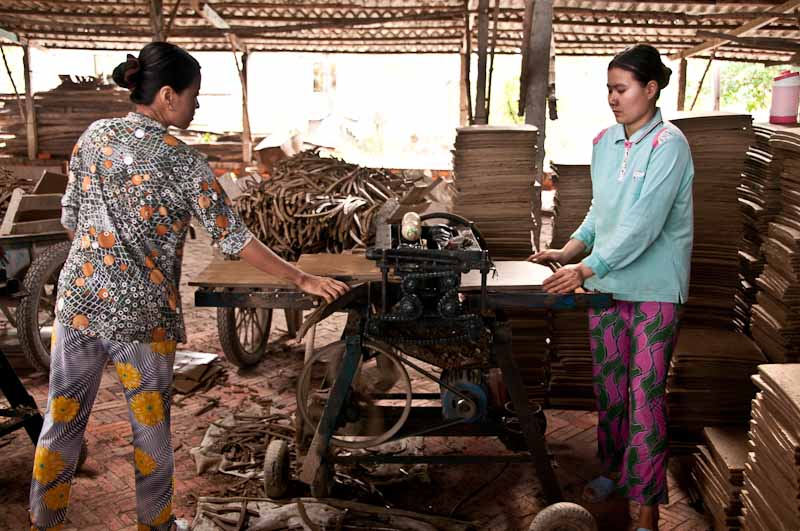
Women operating a machine that trims the clay squares to the right size for flooring tiles.
When labor is cheap, industrialization lags. Labor is very cheap here, and consequently the machines are ancient and the work process relies on lots of hand labor. One thing I notice is that feminism reached here a long time ago–women and men do the same work side by side, with no apparent deference to the “weaker” sex. Barges are toted, bales are lifted, by men and women alike. Both work long and hard in the fields or factories.
We’ve stopped in plenty of little town markets this trip, but the market in Sac De was larger and more extensive than the rest. I couldn’t bring myself to photograph the woman slaughtering chickens and ducks right on the sidewalk; my chickens at home would never forgive me. But we saw her, and the (mostly) women selling all kinds of meats, seafoods, poultry both alive and dead, fruits and vegetables. Western standards of refrigeration and hygiene are clearly unknown here, but the people seem to be surviving nicely. Maybe we worry too much.

Carrots. Really, really big carrots.
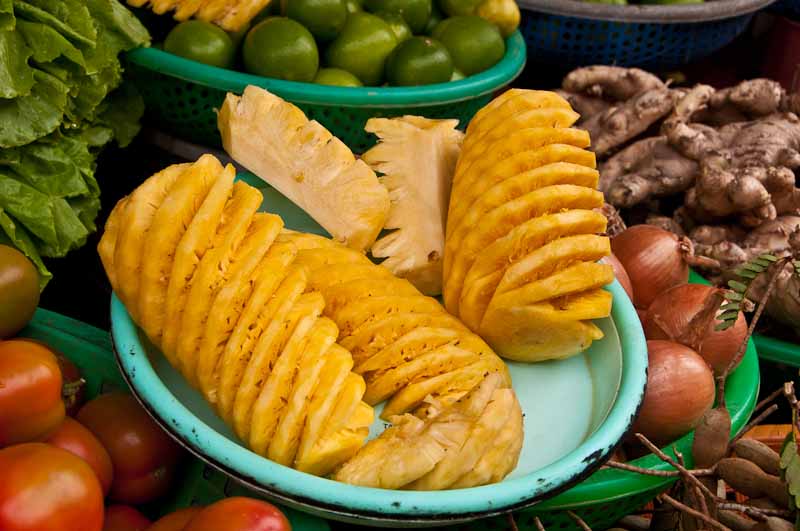
Not only are the pineapples sweet, they cut them pretty cool, too.
If you are a fan of a certain kind of French literature, you perhaps have read “The Lover”, described on Amazon as:
An international best-seller with more than one million copies in print and a winner of France’s Prix Goncourt, The Lover has been acclaimed by critics all over the world since its first publication in 1984.
Set in the prewar Indochina of Marguerite Duras’s childhood, this is the haunting tale of a tumultuous affair between an adolescent French girl and her Chinese lover. In spare yet luminous prose, Duras evokes life on the margins of Saigon in the waning days of France’s colonial empire, and its representation in the passionate relationship between two unforgettable outcasts.
Our ship, La Marguerite, took its name from her, as well as the interior decor. So we went to see her house:
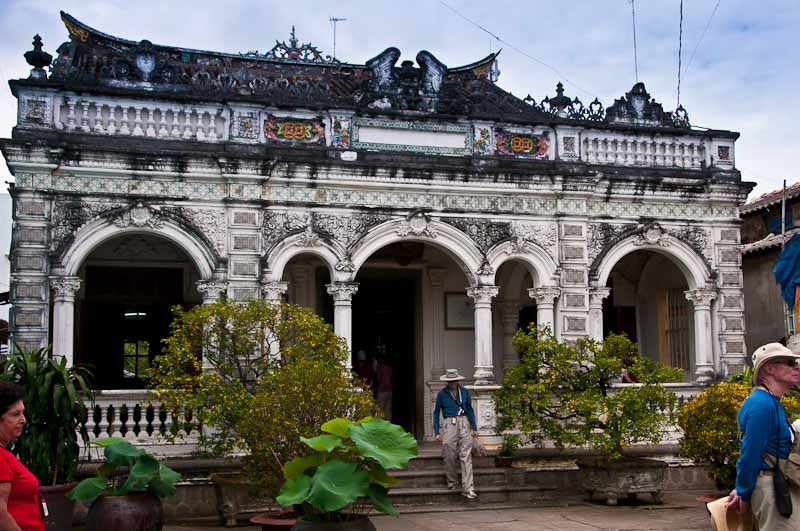
Marguerite Duras' house.

The ornate interior. They gave us tea and ginger candy, I don't know why.
There was a movie made from the book, starring Jane March, and they distributed DVDs on the ship. Linda Bandler said it was pretty pornographic; I didn’t watch it. Yet.
Then we stopped at the Catholic Church in town–the outside is pretty regular:
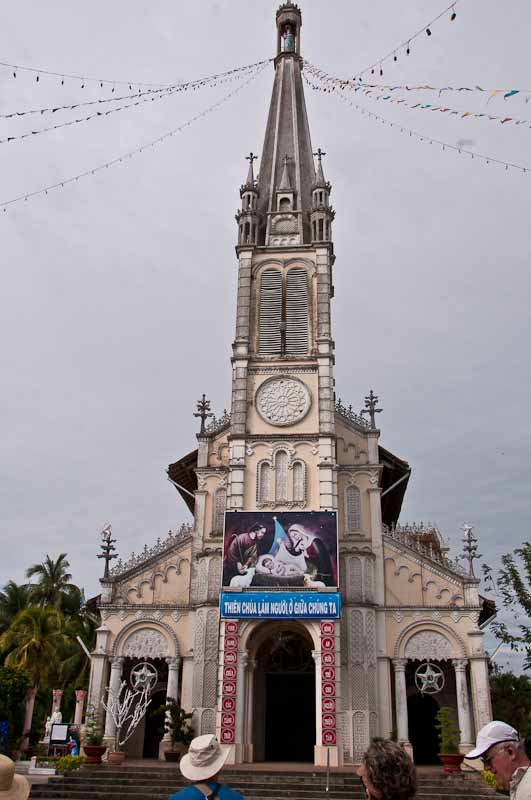
Just your basic French mini-cathedral in the middle of south-east Asia.
The inside, though, was something special. Enough neon to light a casino, which seems sort of out of place. I thought the neon halo was a particularly outré touch.

I think this place uses half the electricity of the entire town.
Then it was back to the ship, farewell dinner with the requisite Baked Alaska, get to bed early because bags had to be packed and outside the door by 7:00 am. The trip is winding down and we’re getting tired, as if there was such a thing as too much vacation.
And here’s today’s cute kid photo:

Three for the price of one.
Next stop: Saigon. Stay tuned.
Headlines of the year
Google put this together, and it does a really nice job of summing the year up:
Back in Vietnam
Cruising down the Mekong towards Saigon, we crossed the border last night and dropped anchor at a little burg about ten miles inside Vietnam.
This morning, we set out exploring. First, we went to a fish farm–actually, a floating village of them, each a floating house about 30 x 40, with a fish cage underneath holding 20,000 or so seething tilapia. They feed the fish 5 times a day; twice with prepared fish food, three times with a mix of water hyacinths and rice that they cook up for them. Towards the end of their 5 month growing cycle, the farmers use machinery to simulate a strong current, to make the fish swim against it and build muscle, improving both their taste and texture.
I have to say that the river is pretty darned ugly, the water is dirty brown and the sewage treatment in Vietnam is primitive at best–these fish are growing up in a sewer. I’ll be thinking long and hard about eating Vietnamese tilapia in the future.
Next we headed for a farm, promoted in the daily letter as “untouched by tourism”, although you might think that leading all those tours through the place might have an effect.
For the first time, I felt strongly propagandized. The little village of houses on stilts, swarming with cute kids in trendy outfits, might be sort of authentic, but the farm was clearly large, well capitalized, professionally run and not the least the sort of thing illiterate peasants would have.
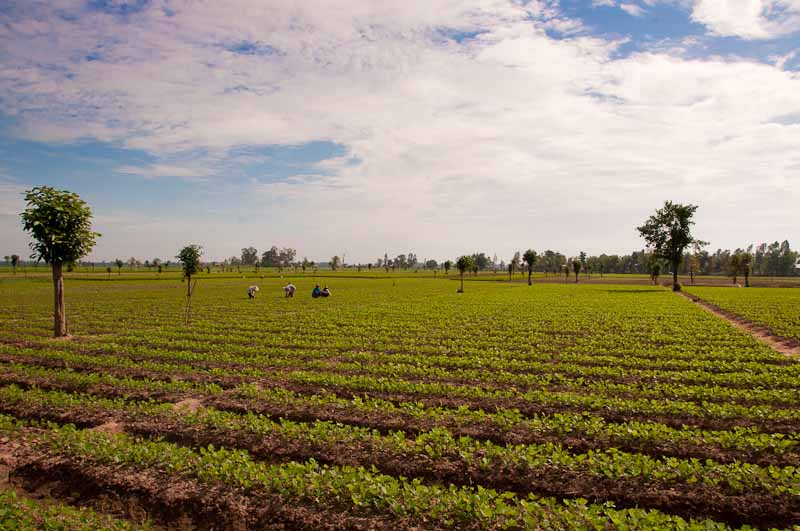
I don't think there was anything at all typical about this farm.
This was a show farm, and it was promoted as “typical”. I’m not buying it. This was the farm of the future, not the present.
Something else of the future was the industrial park being built alongside the river–reputedly a joint venture between the city and a wealthy investor. Vietnam is following in the footsteps of China, seeking industrialization wherever it can.
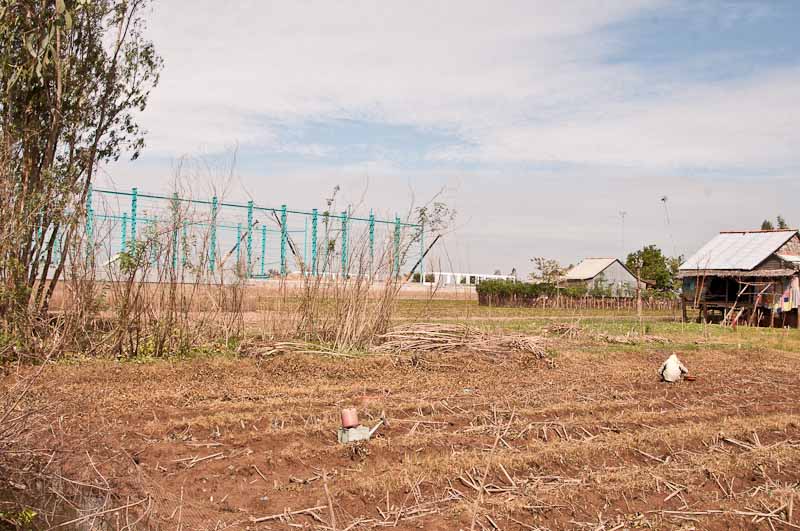
Modern Vietnam--a peasant in the fields next to a very large industrial project.
The next stop was a factory producing flaxen sleeping mats, using some very old hand fed looms. The tour was followed by the mandatory gift shop experience, but we got some new place mats for a buck apiece, so it worked out pretty well.
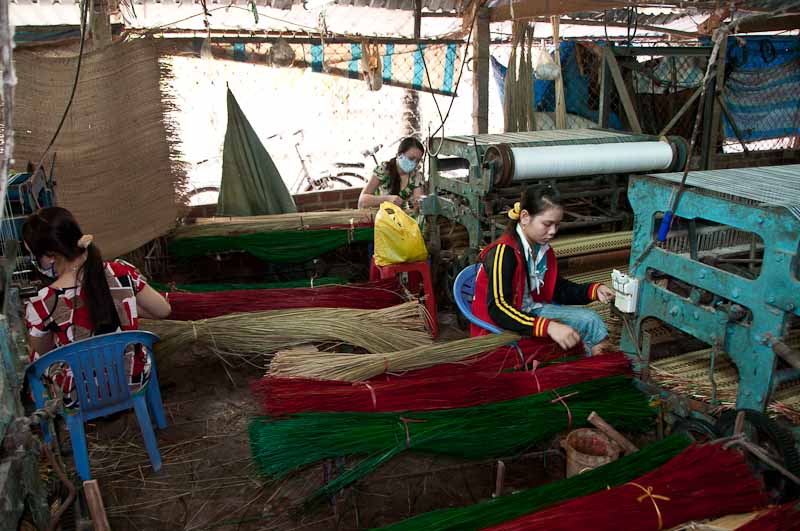
The long flax stalks are dyed bright colors then woven into the mats on these ancient machines.
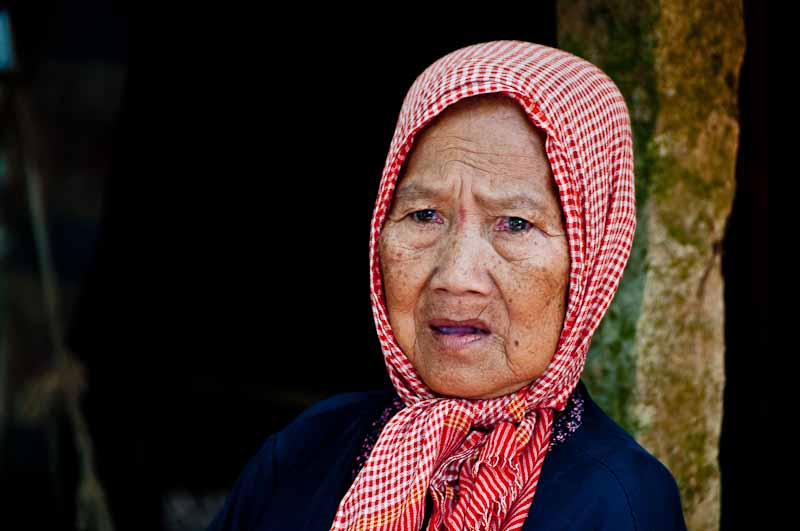
A face I had to photograph in the village.
I’ve ridden on everything from bullet trains in Spain to tiny horses in Ethiopia, from ski lifts in Austria to tuk-tuks in Cambodia, but I’ve never been on anything as scary as the rickshaws we rode today. Bicycle in front, uncomfortable open seat in back. No side rails. Designed for people half my size, and ghastly topheavy. We rode through the narrow streets crowded with people, animals and motor scooters, weaving in and out with little care for which side of the road we were on. The last time I drove drunk was my 21st birthday, and that was still safer than these silly contraptions.
Still, somehow we got to our next destination, a silk factory. Not the place where they unwind the cocoons and make the thread, but a place where they weave the thread into fabric. Thick, heavy, plastic-feeling silk, not the thin sexy stuff you’re thinking about. The machines are, again, ancient. So old that they run on the very first kind of programming–punched cards, invented in the 19th century to control looms just like these. Hell, maybe these exact machines, they sure look old enough.
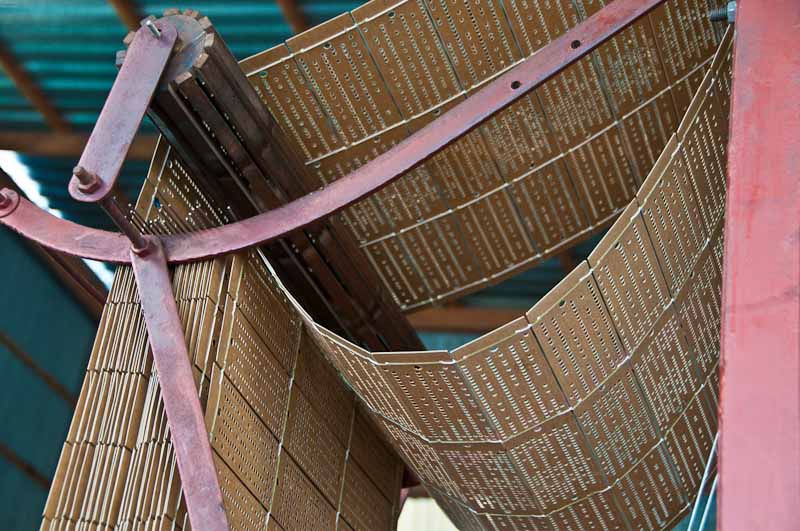
The endless belt of punch cards that controls the weaving process.
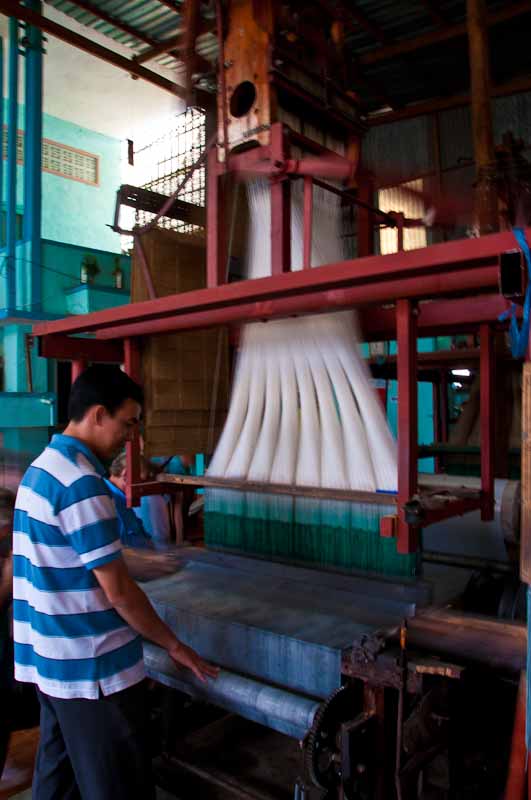
The loom itself.
The machines were intriguing, and then there was, no surprise, another gift shop. Scarves are the hot item this year, and they went fast at $5 each.
To my great horror, we now had to get back on the rickshaws and motate through town to the ship. Magically, we made it with no disasters, but I don’t think I’d care to write the insurance on the venture.
Obligatory cute kid photo:

Two cute kids for the price of one.
The rest of the day was spent relaxing onboard, getting ready for the big evening. We had a fancy “gala buffet” dinner, where I wouldn’t eat the mushroom risotto and Mike wouldn’t eat the brussels sprouts but we all liked the leg of lamb and won ton soup. The crew is putting on a show as I type, and Don and Linda are preparing for the big celebration at midnight:
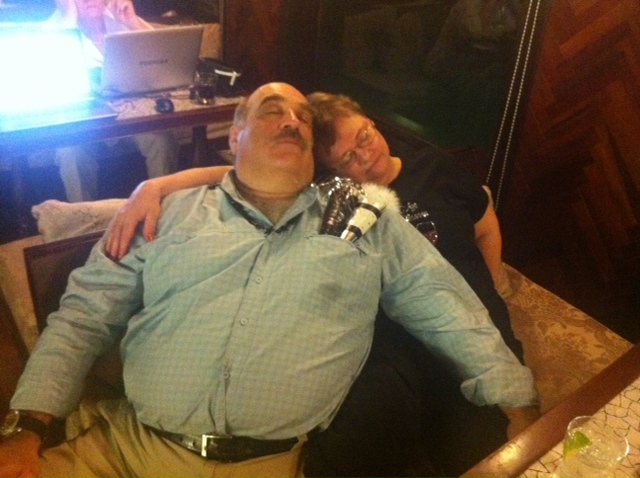
Partying hearty in the lounge--at 10:25 pm.
Happy new year to everyone.
Cambodia wrapup
We have what is called a ‘sea day’ today, except this is a river, not the sea. Somehow, ‘river day’ doesn’t ring quite right.
Still, it’s an easy day–just eating, watching the world go by, eating, playing online bridge, eating, sorting photos, then dinner. We stopped a couple of places to handle the formalities of leaving Cambodia and entering Vietnam, but somebody else takes care of the paperwork for us.
Since we didn’t see anything much new, I thought I’d just wrap up Cambodia tonight, with some photos that didn’t fit anywhere else.
Cambodia struck me as a wonderful country full of opportunity, set to explode on the world. The hideous recent history has left them with an extraordinarily young, vigorous population. They have little old, inefficient infrastructure to replace, so they can start right out with the modern stuff–as in their cell phone system, which is excellent. A young person with even a modest amount of capital could come here and build a life and a fortune.
The current economy seems good–tourism is growing, with millions flocking to Angkor Wat every year. The city has many luxury hotels, but no American chains–no Hyatt, Hilton, Sheraton, Ramada, Marriott. No McDonalds, no Starbucks. The roads are full of cars, not just motorbikes–and not just tiny, cheap Chinese cars, but plenty of Lexus and Toyotas. This is in Phnom Penh:
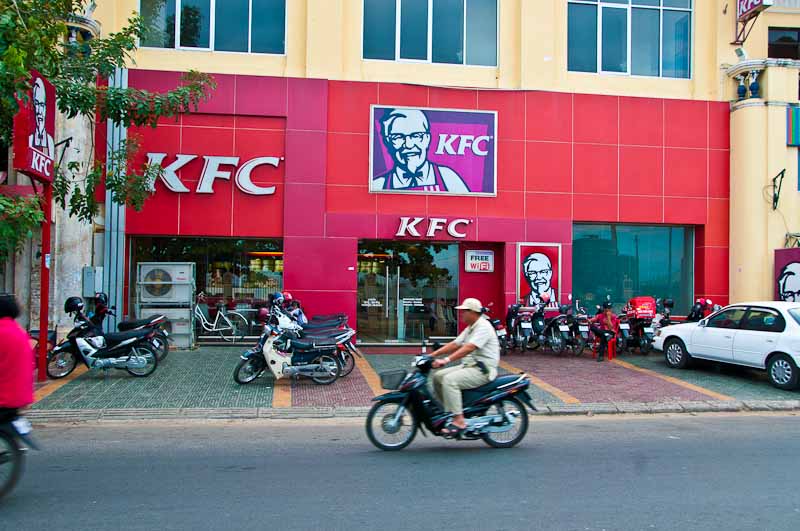
Across from our dock in the capital city.
Notice the”Free wi-fi” sign. Internet access has a low penetration here, but I saw a considerable number of places offering wi-fi, including the memorial at the killing fields yesterday. This can’t all be for the benefit of the tourists, I have to assume that people are using the cafes for their internet access.
There is some older infrastructure–this is a power pole in the older, French Quarter of Phnom Penh:

This must be an electricians nightmare.
Here where the population is so you, I had a ball taking pictures of children. This may be my favorite:

Richard Avedon might not have liked this, but I do.
Then across the street, I saw this little guy:
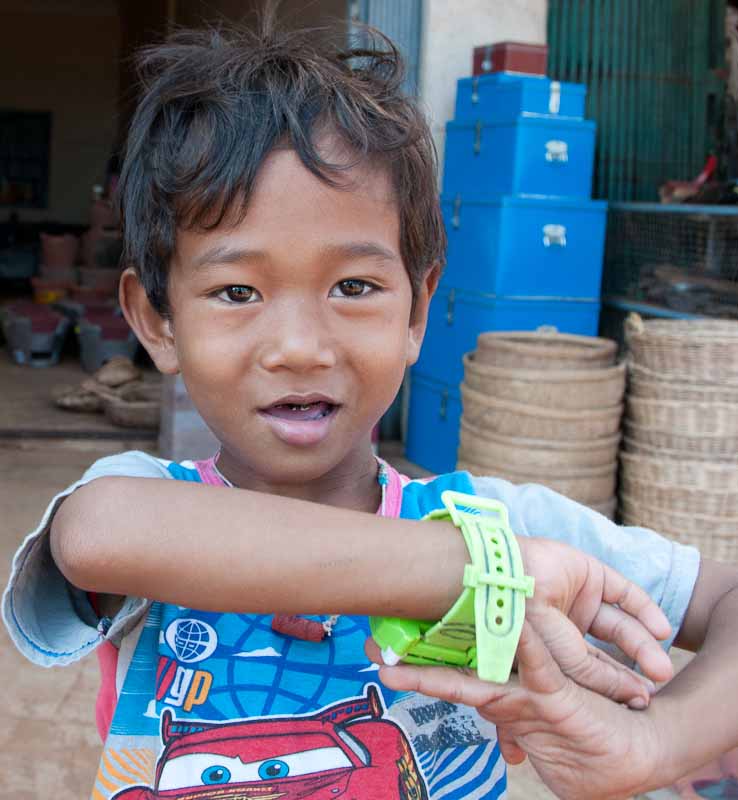
Cute, no?
Well, I thought he was cute until I saw his teeth–I think he chews betel nut, a mild stimulant common in south east Asial Look closer:

This is not a pretty sight. The betel nut turns the teeth black.
We visited a couple of beautiful Buddhist temples, and were blessed by monks at one of them.

I guess I'm going to heaven now.
I enjoyed Cambodia, I was impressed by it, I have great expectations for the future here, and I recommend a trip here for anyone with a sense of adventure and a willingness to be open. So I’ll wrap this up with a photo of the temple on the top of the hill which gives the city it’s name:
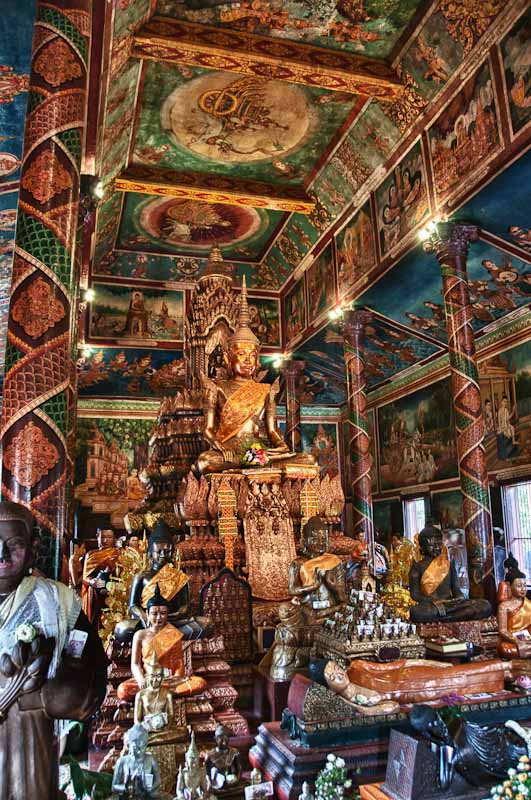
The baroque cathedrals of Europe have nothing on the temple in Phnom Penh
The Killing Fields
The man says that those who do not remember history are doomed to repeat it. The bad news is that we’re all doomed to the repeat, whether or not we study the past.
There have always been despots, there has always been genocide. The Turks slaughtered the Armenians in 1918. Hitler killed 10 million, Stalin 20 million and Mao Tse Tung 30 million.
And then there was Pol Pot. Over 1 million Cambodians, murdered by starvation, torture, execution in a 4 year rampage that destroyed the nation.
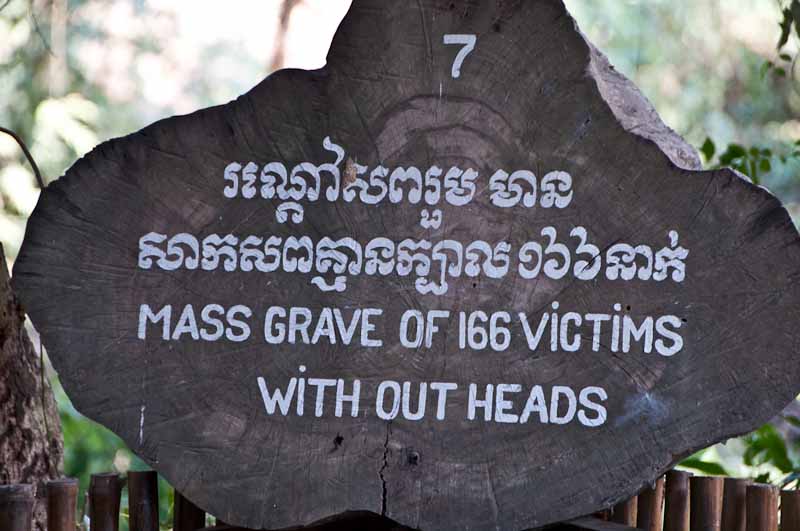
Today we visited the killing fields, or one of them. There were ~126 fields where the Khmer Rouge took prisoners for execution and burial in mass graves, and the one right near Phnom Penh has been turned into a memorial. It’s an important stop on the tourist circuit.
The doomed were brought here in trucks, made to dig their own mass grave, then killed, often by having their heads bashed in (ammunition is expensive). Babies were smashed against a tree. It isn’t a pretty place.

Some of the excavated mass graves.

The monument contains hundreds and hundreds of skulls retrieved from the ground.

After the fields, we went to Prison 21, an infamous facility in town where people were brought for torture and interrogation. 22,000 people entered, 7 left alive. Prisoners were tortured 3 times a day on a schedule; everyone confesses sooner or later.

A VIP cell--lots of space. The prisoner was shackled to the iron bed between beatings.
Most of the display in the prison consists of photographs methodically taken by the Khmer Rouge as prisoners were processed in–and many of their corpses as they were processed out.
One room has paintings of the tortures, done by one of the 7 survivors. This one is sadly appropriate:

- Some people call this “enhanced interrogation”.
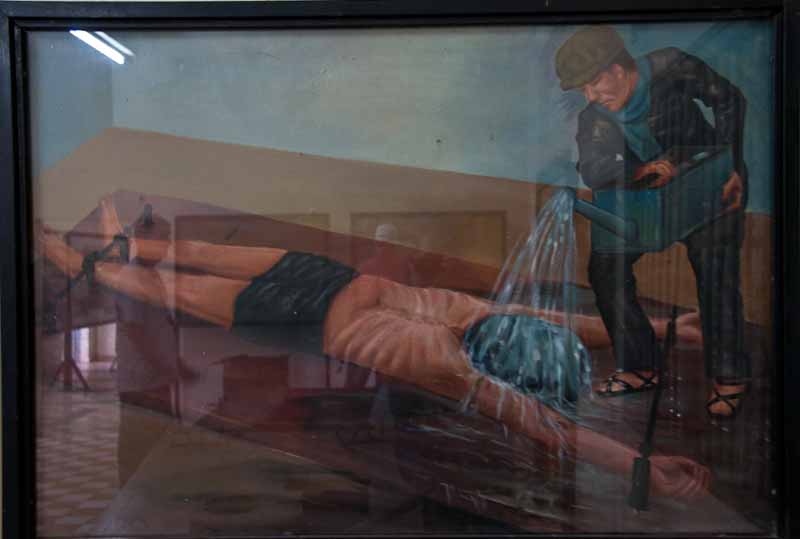
And once again, history repeats itself.
This isn’t the post to talk about what we had for dinner. Travel, as they say, is broadening, but sometimes you have to see things you don’t really want to.
Dinner most unique
Out to dinner in Phnom Phen with Don and Linda–the Bandlers chose to stay on board the ship. The tour line offered a sheet listing some good restaurants here, and we chose Romdeng because it sounded interesting.
It turned out to be more than interesting, it was fascinating, different, outre and great.
Romdeng is run by an organization dedicated to helping kids get off the street. They train young people for a career in the food industry, and run the restaurant as both a money making operation and a training facility.
We took a pair of tuk-tuks for the $4 ride to the place. In theory, a tuk-tuk will seat 4 people, but I think that’s four Cambodians; Don and I by ourselves are the size of 5.5 Cambodians, add in Gail and Linda and the little 125 cc Honda would be woefully overstressed.

You won't find anything like this in the states.
The menu is quite a few pages long, and we were studying it intently when we came across this:

Yes, it means what it says. And you know we had to order it.
Prices were low; we ordered many dishes. The green papaya salad was great, the spring rolls were OK, then this hit the table:
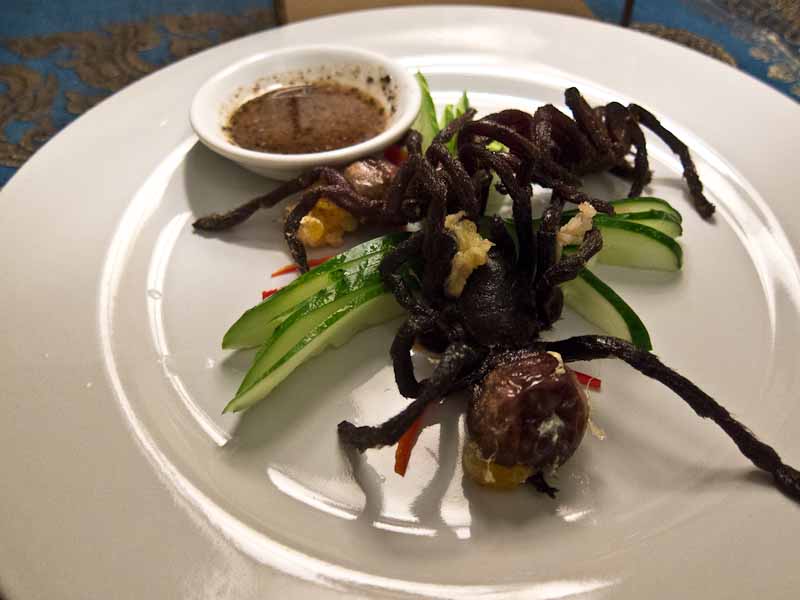
Lovely presentation, no?
Never being one to back down from a challenge, I reached out, grabbed a leg and pulled, then munched down on it. Crispy, crunchy, not very tasty. I swallowed hard and passed the test.
Then Don, then Linda, then Gail. We tried legs, nobody had the nerve to try the big, bulbous body. As quickly as we could, we sent the plate away. But we had done it–ordered and tried tarantula. I can honestly say it was the best tarantula I ever had, and likely the best tarantula I ever will have.
That wasn’t all, though. We found another great dish on the menu:

After the spiders, this one was easy.
Now, Gail is famous for eating ants–she’ll lick a finger and pick up one trailing across the table or counter and just smack it down. They don’t have any taste and it astounds the grandkids. But the tiny black ants in Lafayette are not quite the same as Cambodian Red Tree Ants.
The dish arrived, we all had some. A spicy beef stir fry, nothing special. Gail decided to look through it to see if there were indeed any ants.

As good as their word, the dish was loaded with these little beggars.
We loved our dinner, all the more so because it was so different. We were proud of ourselves for trying something really, really different. What’s the point of travel if you only want things to be just like they are at home?
Catching a couple of tuk-tuks, we headed back to the ship. Phnom Phen is a very lively, vibrant place, the weather was perfect and the ride was a riot.
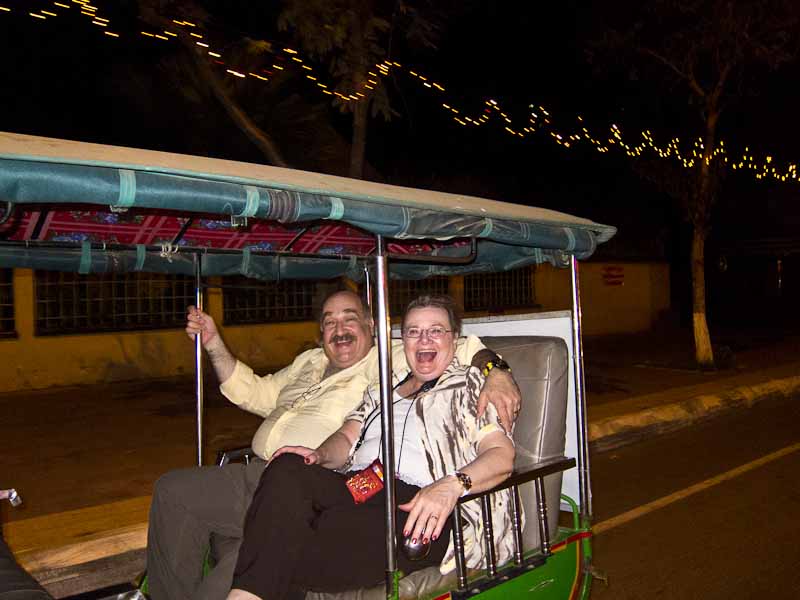
Celebrating a brave dinner.
Back on the boat, some local kids were dancing. We watched for a while, then Gail went to read herself to sleep and I couldn’t wait to write this.
Tomorrow, the serious part of the trip–we visit the killing fields and the prison. It can’t all be beer and skittles.
Strolling through the village
The boat stopped at a village this morning (docked would be an overstatement, since there was no dock, just a long gangplank made of a pair of 2×12’s) and the tour guides took us on a walk.
This wasn’t the usual stop, where you see a grungy town market with tiny stalls selling junk you don’t want. We walked past the school and the pagoda and then down a country road past little houses, and we stopped at a couple of them.
Getting off the boat we were met by plenty of the locals–they arent’ begging, they’re selling cloth. They don’t start with the hard sell, though, they start with “hello” “what’s you name?” “where you from?” all in excellent English. Mostly the salespeople are kids, as little as 3 and 4, who are accompanied by their mothers, who have the merchandise. As you continue your stroll, they accompany, never giving up. This village seems to be comprised of weavers, as everyone was selling cloth, scarves, table runners, place mats, handkerchiefs, etc.
The houses are classic Cambodian, built on stilts:
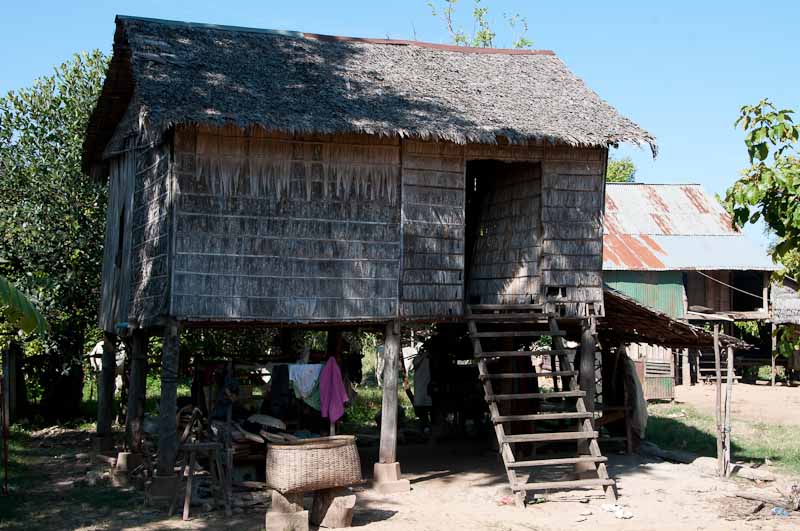
A little local fixer-upper
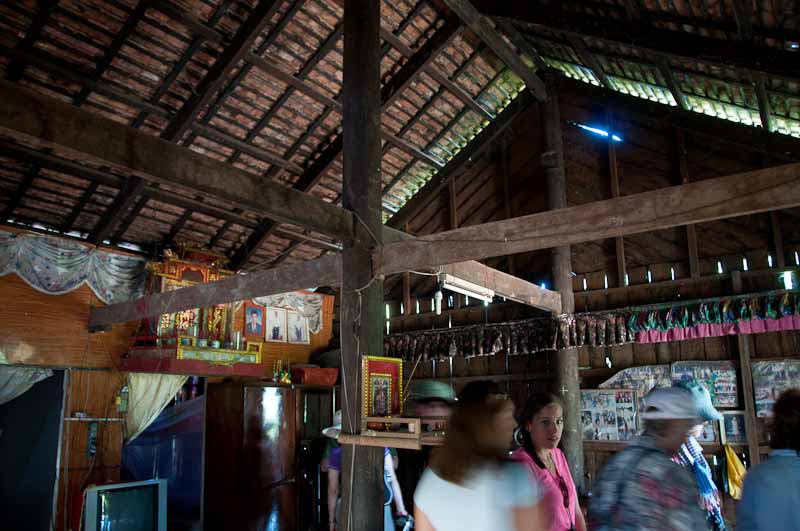
The main room--there were 3 bedrooms, too. No bath. Television, radio and sewing machine inside.
The workshops are under the house–every one has a loom. They apparently buy the thread from China, Japan or Vietnam, and can weave about 2 meters a day of cloth. The houses sit on good sized lots, and they are either gardening for themselves or truck farming, it’s hard to tell. Many of the large trees have netting underneath so you don’t get clonked in the head with falling mangoes, coconuts or papayas.
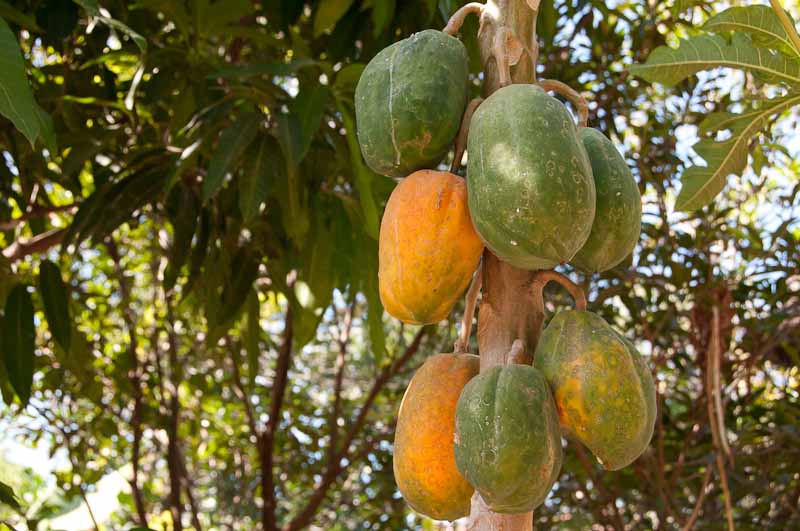
Papayas ripening on the tree
This is a very young country (half the population 15 and younger), so there are babies everywhere. This gives the old folks something to do.
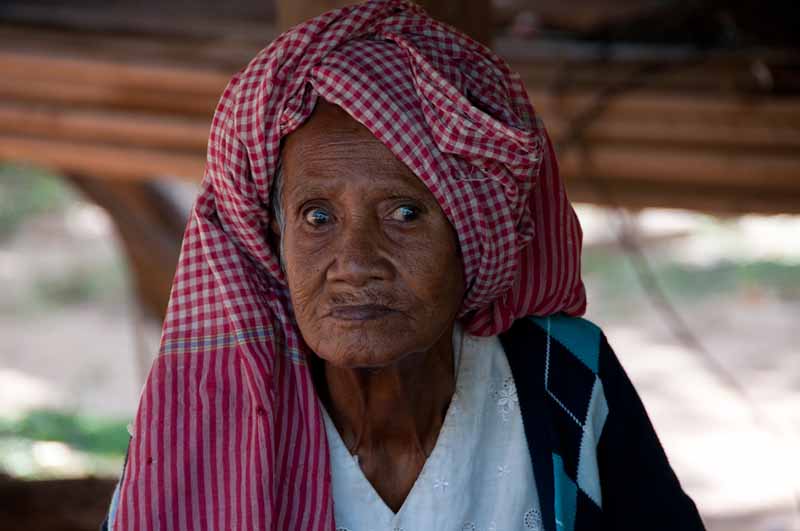
Grandmother sitting under the house
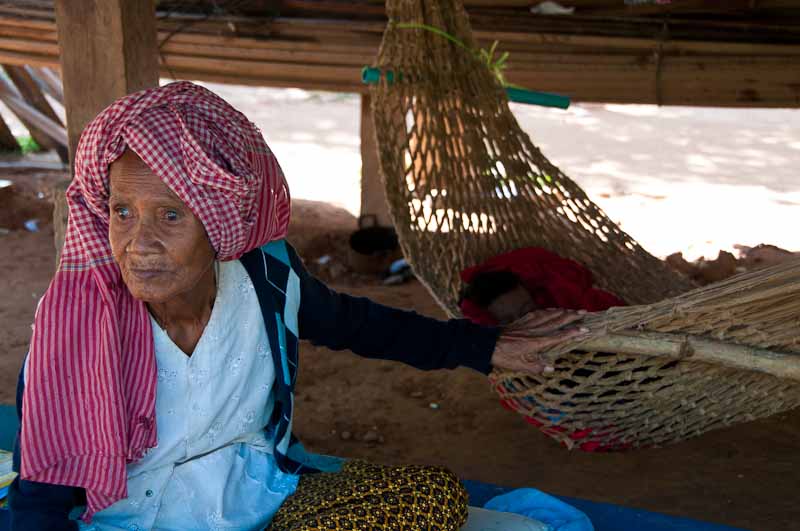
Keeping the baby swinging.
My photo books say I’m supposed to get detail shots, so this is the arty view of the loom:
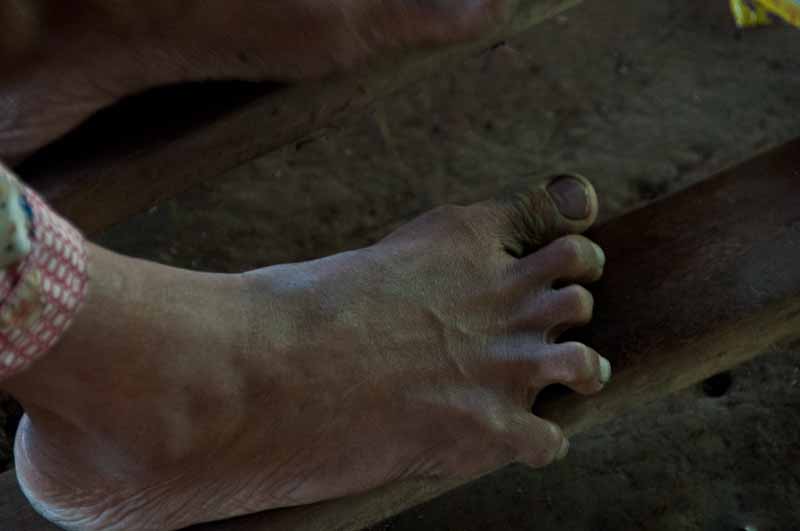
Working the pedals on the loom. This doesn't provide power, just changes where the thread goes.
We were walking for about an hour, which is just right in the warmth here. Then back to the ship, where I found Gail in the salon checking her email. So I got my computer, we logged on and played a bridge tournament for an hour–won 2/3 of a point, too. Life if good, and so to lunch.

 Totally Unauthorized