The price of living in California

The gas pump at BJ's, a local version of Costco
I like California more than I like Florida. We have better weather, no humidity, fewer bugs, no kudzu and a more interesting landscape. The highest place in this entire state is Space Mountain at Disneyworld. This isn’t the place to come for gourmet dining, great theater or world-class museums like the de Young. People come here to see Mickey and Goofy, or to retire and die.
We pay for our pleasures, as always. This is the gas pump where we filled up today-about 60¢ a gallon cheaper than Costco in Concord. There is no state income tax. The sales tax is about 6%. Property taxes are about the same here, except that there is no Prop 13 to lock them in.
I guess the basic rules of life hold here, just like everywhere else: you get what you pay for.
I’ll take Lafayette, thanks.
NASCAR drivers are sissies
That ought to get some controversy going.
This is the weekend of the big Coke Zero 400 race at Daytona Speedway, which is very close to Orlando. Karl Rowley is a major motorsports fan, so we were watching the race on television (always better than actually being there–how much of a 2.5 mile racetrack can you actually see from an overpriced, uncomfortable, loud seat?)
But the race was delayed over 90 minutes because the track was wet. Not that it should be a surprise to anyone that it was going to rain–this is Florida, and it rains almost every July afternoon and early evening. The massive humidity just builds and builds until the air can hold no more, then down it comes.
The big boys in Formula One racing aren’t frightened of a little rain–they just take off their slick tires and put on rain tires. The healthy boys in the Tour de France pedal their bicycles up and down the hills in whatever weather they come across. The Boston Marathon isn’t called on account of rain.
No, the only sports afraid to get a little wet are baseball and NASCAR racing. They even play high school girls field hockey in the rain.
Video is here!
It works!! Herewith is the very first video shot with my new phone. I think I’m going to like this:
I was playing with Susan’s friend Martha, a very nice player who runs immense games 3 times a week–she’s spent more time around bridge clubs than I can even imagine.
After the game, we went to Walgreens and I roamed the aisles, trying to think of all the things you need to put into a toilet kit. It was much less fun than I thought it would be, and much more difficult. There are some obvious choices, but then there are dozens of little things you carry along and don’t think of until you need them–I hope I got most of them, but you never know until it’s 3:30 am and you’re in a hotel room in Albuquerque and realize you don’t have any cough medicine or a nail file or ??????
We had a small dinner party tonight for Susan’s friend Kim (who many of you met when she was here for the Burlingame regional in February) and her new beau. Karl cooked up his usual storm, making roasted pepper soup, a warm salad, stuffed shrimp and Chicken Saltimbocca. Dessert was blueberries and cream. Life continues to be good.
In the morning we head for the coast to spend the day on another friend’s boat cruising the inland waterway. The party continues.
Brace yourself, there’s rowdiness afoot
The west coast should be safe this weekend: Gail and I are in Florida, visiting Susan and Karl Rowley.
They live on the 18th floor of a condo building across the street from the lake in downtown Orlando from which the firework will be launched Sunday night. We were here last year, and the view was too good not to repeat the experience. This year a party is planned, so the house will be full of people and wine. Gail, Susan, wine, fireworks, lots of people, what could happen? I hope you can wire bail money.
People have complained about airline food since the second Wright brother flight. But American gave me a “snack” today that deserves mention.
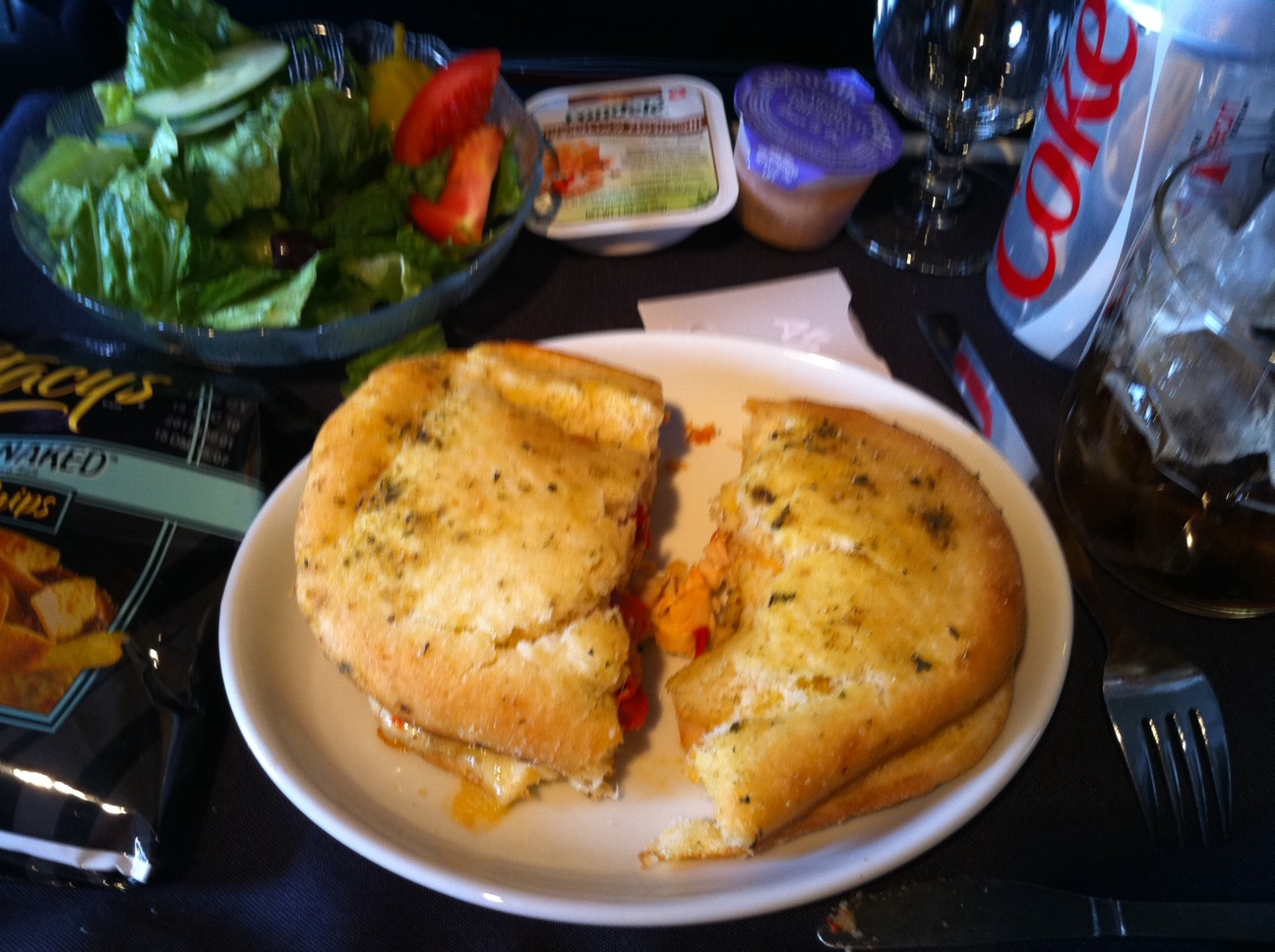
A magnificent hot sandwich. iPhone 4 photo
This was a huge chicken/cheese/roasted pepper sandwich on some special bread. It was fantastic, but then so was Gail’s Fajita Salad:
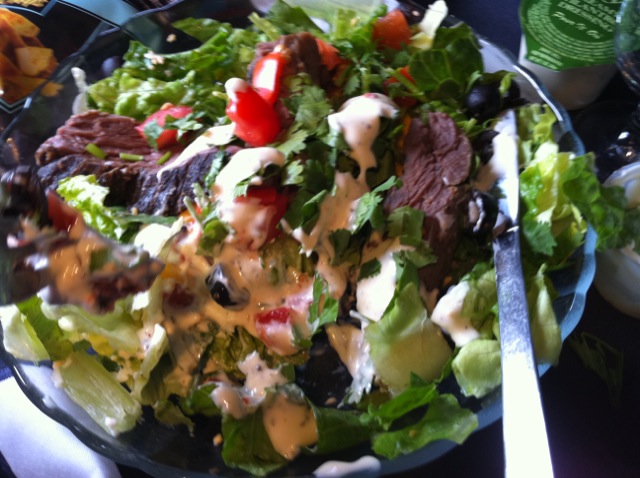
Fajita Salad, with large slices of rare roast beef. Another iPhone 4 photo
This was a happy circumstance: Gail and I both think we had the better meal.
And yes, I’m bragging about getting the new iPhones. I was passing the AT&T store Wednesday morning (the first day AT&T stores had the iPhone 4G), and saw the line, so I really stopped to take a photo and write about the silly people wasting their time queuing up for a phone. But the crowd was almost all company employees, waiting for customers who weren’t there. Turns out they had already sold out of their first consignment of phones, but they would give me a voucher to get later in the day. This was too good to pass up, so I took the voucher and went about my list of errands.
We had dinner in Oakland with Mike Rippey and his sweetie, Gretchen, (at Tamarindo, which I’ve written about before) and then I went back to get our new phones. Stupid bureaucracy on AT&T’s part made the process take over an hour, but we still were able to go off on our trip with brand new toys. I expect that I’ll be able to take video and post it to the blog so this may turn into a multimedia extravaganza in the near future. Stay tuned.
A matter of taste
Sunday night, Gail and I went out with Grant Robinson and Terry Boyd to a new restaurant in Walnut Creek, Vesu. It’s located on Locust Street, where Colton’s piano used to be, just up from Lark Creek.
The fancy Latin way to say it is: “de gustibus non est disputandum” . Or, to each his own. I liked it. Gail sort-of liked it, Grant came to the late in life realization that he is a meat and potatoes kind of guy and this is a chi-chi small plate place. Terry thought it was overpriced and sterile.
Gail and I split 5 small plate dishes. I loved the salad with the poached egg and roasted onion dressing, adored the pork belly and thought the carne asada was pretty bland. The house-specialty Arepas, cheddar cakes with citrus braised pork, didn’t have the punch I was expecting from the description. We started with white bean truffle dip, which is waaaay upscale chips and dip, but it’s darn good.
Grant and Terry went for the large plate entrees. Grant’s Flat Iron Steak was fantastic, Terry’s Halibut was closer to fair.
Service was at once over done, with too much twee explanations of almost tasteless and meaningless ingredients (we had the Lamb Kofta, which was overcooked, but were amused at the “sumac foam” on top. What the heck is “sumac foam”?) and at the same time too slow–the entrees took over an hour to arrive.
Desserts, too, tended to the precious side. I enjoyed my apricot crostada, but the associated brown butter gelato was such a small portion that it was almost invisible.
The restaurant is brand new, and ultra-modern. Terry calls it sterile, and I think she’s right on track.
Prices are indeed on the high side, especially considering the diminutive portion sizes.
We love small plate restaurants, but I think we’ll stick with Va De Vi and Nibblers. Better food, service and value. Maybe we’re all in agreement after all.
Impressionism at the de Young

Daughter Kate, Gail, granddaughter Chloe at the exhibition
My favorite museum in the world is the Musée d’Orsay in Paris. It’s a long trip, but worth it. This summer, the museum has come to us, and it is simply not to be missed.
The French are remodeling the museum, and it will be closed for a year or two. In a masterstroke of museum politics, the Fine Arts Museums of San Francisco have somehow managed to borrow much of the good stuff from Paris and put it on exhibition here.
There will be two shows at the de Young; the first of which has arrived. Masterpieces from the Musée d’Orsay: The Birth of Impressionism is just what it says–about 100 great works from the very beginnings of the Impressionist movement. Here’s what the museum says:
The de Young is proud to be the only museum in the world to present two consecutive special exhibitions from the Musée d’Orsay in Paris. The first exhibition, Birth of Impressionism: Masterpieces from the Musée d’Orsay, debuts at the de Young on May 22 and runs through September 6, 2010.
Birth of Impressionism: Masterpieces from the Musée d’Orsay presents nearly 100 magnificent works by the famous masters who called France their home during the mid- to late-19th century and from whose midst arose one of the most original and recognizable of all artistic styles, Impressionism. The exhibition begins with paintings by the great academic artist Bouguereau and the arch-Realist Courbet, and includes American expatriate Whistler’sArrangement in Gray and Black, known to many as “Whistler’s Mother.” Manet, Monet, Renoir, and Sisley are showcased with works dating from the 1860s through 1880s, along with a selection of Degas’ paintings that depict images of the ballet, the racetrack, and life in the Belle Époque.
Notable works in this exhibition include:
- The Fife Player by Edouard Manet (1866)
- Racehorses Before the Stands by Edgar Degas (1866–1868)
- Family Reunion by Frédéric Bazille (1867)
- The Magpie by Claude Monet (1868)
- The Cradle by Berthe Morisot (1872)
- The Dancing Lesson by Edgar Degas (1873–1876)
- The Floor Scrapers by Gustave Caillebotte (1875)
- The Swing by Pierre-Auguste Renoir (1876)
- Red Roofs, Corner of the Village, Winter Effect by Camille Pissarro (1877)
- Saint-Lazare Station by Claude Monet (1877)
- Rue Montorgueil, Paris. Festival of June 30, 1878 by Claude Monet (1878)
- Snow at Louveciennes by Alfred Sisley (1878)
- L’Estaque by Paul Cézanne (1878–1879)
- Portraits at the Stock Exchange by Edgar Degas (1878–1879)
- The Birth of Venus by William-Adolphe Bouguereau (1879)
When, not if, you go, be sure to rent the audio tour. It is particularly well done, and provides you with a tremendous amount of information and insight–like taking a private tour with the curator. Yes, you look like a dork with the silly headphones and bright orange neck strap, but that’s what all the cool people are wearing this summer.
As with most special exhibitions, you have to buy a special ticket, which includes a specific entry time. I saw at Costco that they had discounted tickets which included the audio tour–I think you buy it and then go online to arrange the entry time. The museum closes at 5:15 most nights; we had the last tickets of the day, 4:00 pm, and had plenty of time to see everything as there were very few other people in the gallery.
The Moss Room, at the Academy of Sciences
What’s a trip into the city without dinner? We wanted to go out after the Impressionists, so I looked on Opentable and found the miracle answer: The Moss Room.
There is now a very good restaurant in the lower level of the Academy of Sciences, just across the Concourse from the de Young, a 2 minute walk. The entrance is around the right side of the building, then you go down the stairs
They aren’t very busy on Saturday nights, especially if you are eating at the children’s hour of 5:30, a drawback of the museum closing at 5:15.
The Moss Room is very modern, very hip. Too hip, sometimes, since everything has to be local and sustainable–and that means they don’t carry things like Baileys Irish Cream. The good news is that the food is inventive and delicious, even if their iced tea is “chrysanthemum”, they were at least willing to make a pot of Earl Grey and ice it down for me.
Four of us started with the corn/lobster soup, which was just fabulous. Being different, I had to have the duck liver terrine, which was also splendid. Son-in-law Brad declared the scallops (cooked inside squash blossom) the best he’d ever eaten. I had the lamb shoulder with lentils–the lamb was pretty standard lamb, but the lentils in Moroccan spice were spectacular.
I noticed that the New York steak came with “beer battered bone marrow”. Didn’t want the steak; had to have the marrow. So I ordered a side, which seemed to confuse the heck out of the waitress but the kitchen worked it out. We got four tiny squares of melting marrow encased in a very crisp batter. Marrow is death food, to be sure, but it’s great. The soaked me a puny $4.00 for the side order.
Granddaughter Chloe had to have the Valhrona Chocolate dessert, so I kept her company by having the Summer Fruit Trifle. It isn’t often that a dessert is so large and rich I can’t finish it, but even with Gail’s help there was leftover trifle.
The service was first rate, the food was excellent, the location is perfect. If you go to the de Young mid-day, the Moss Room is open for lunch, too.
The coolest place I ever was
Writing is easy–thinking of a subject is hard. Even Gail and I stay home and do nothing occasionally, and what am I supposed to write about then?
So up pops a new website dedicated to making my life easier by suggesting a topic every day. No, I don’t have any idea how they think they’ll make a living, but I do this for fun so maybe they do too.
This is today’s topic–the coolest thing you’ve seen in another country. Here goes nothing:
It’s no secret that I like to travel. Going to a World’s Fair is like going to 150 countries in a few days–and seeing the best of all of them.
In the spring of 1992, I went to a World’s Fair in Seville, Spain. It made sense to me–I didn’t have a job or any money, why not go see the world? I got a ticket from a consolidator for peanuts, stayed in cheapo pensiones , travelled in 2nd class train cars. If you’re looking for adventure, it’s sometimes easier to find on no money.
I spent a few days wandering Madrid, hanging out in the Prado, enjoying the free music in the Plaza Mayor. Then the bullet train to Seville. I watched Star Trek II: the Wrath of Khan in Spanish. Oddly, it was just as good.
The Fair was the greatest thing I ever saw, and that hasn’t really changed in the intervening 18 years. Over 130 nations put on exhibits–the rich ones built their own huge, ultra-modern pavillions, the poor ones just brought some native goods to sell and set up in pre-fab block buildings.
At night, there were marvelous concerts under the stars, Giant shows on the first Sony Jumbotron I’d seen. Multi-lingual sing-alongs in the many pubs (but the Aussies did it the best, naturally)
I saw a dozen IMAX movies, including some in 3-D with technology that is only now becoming commonplace. The nightly fireworks were better than Disneyworld. It was just an incredible experience.
Gail and I went to a World’s Fair in Lisbon, but it couldn’t compare. There is a fair going on right now in Shanghai that is reportedly drawing 500,000 visitors a day, with 9 hour waits to get into some pavilions. I wouldn’t wait 9 hours in line for a front row seat to the second coming, so we won’t be going there.
After Seville, I spent a few days on the beach at Marbella girl gawking (topless beaches in Spain), then the long train ride back to Madrid, in a very full 2nd class cabin. Turns out that Spanish farmboys ride in 2nd class, too, and they don’t shower much. It was a verrrrry long train ride.
Okay, that worked pretty well, I’m glad someone suggested this topic, and I had fun remembering the trip. Hope you had fun reading about it.
The Mash-up goes cultural
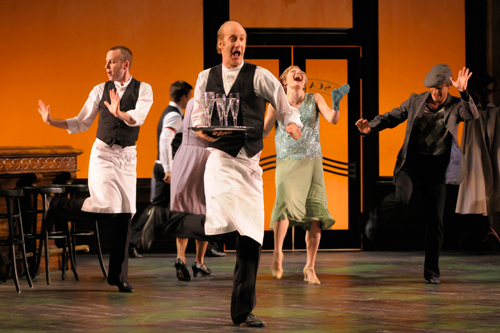
Members of the ensemble of The Tosca Project (from left: Nol Simonse, Peter Anderson, Sara Hogrefe, Pascal Molat) dance the Charleston during the roaring '20s. Photo by Kevin Berne.
The mash-up: mixing and matching from more than one source to create a new work of art. Overlaying the video from a presidential press conference with the sound track of a Simpson’s episode, for instance, or intercutting different musicians playing the same piece. It’s mostly a video exercise, adorning blogs and YouTube.
But now there’s a new, uptown high class version–ACT is collaborating with the San Francisco Ballet in the new work, The Tosca Project. Actors and dancers tell the story of long-time San Francisco landmark, the Tosca Cafe.
I’m an easy sell for pretty much any kind of innovative, experimental theater, and then I was lucky that I managed to convince Gail, and Micky and Linda Bandler, that it would be fun. The promise of dinner across the street at Colibri before showtime sealed the deal.
Dinner was great, even if Micky didn’t let me have the chocolate pudding for dessert. I always love the Pato in Pippian (duck in some kind of really great sauce), and Gail raved about the Carnitas.
Oh yeah, I’m supposed to be writing about the theater. Good food always sidetracks me.
The Tosca Project is the kind of production Gail always likes: short. One act, 90 minutes and out the door. Fortunately, they manage to pack a lot into that 90 minutes.
Essentially, it is just a review of the last 90 years of San Francisco history, as it played out across the floor of the cafe. The creators, ACT artistic director Carey Perloff and SF Ballet Choreographer Val Caniparoli, have fashioned a story regarding a bartender who loses his love in Italy and comes to America–and the ghost of the love follows him through time and space, tying the theme together. There is no real dialog or exposition, you only derive this from the dance. Since the dancers are great, you understand viscerally before you understand intellectually.
The play (dance? ballet? opus?) is a series of set pieces examining life in San Francisco over the past 90 years. Each scene/piece/dance brings an era to life–the depression, the war, the beat era. The same 10 performers take on all the roles, chameleoning into a series of deftly drawn characters who exemplify each era.
It was great, OK near great. Considerably more dance than drama, I liked all but one of the scenes. Micky liked most of them. Gail woke up at 5 that morning, and still stayed awake for almost all of it. Linda decided that she liked dance more than she thought she would. Everyone cheered at the finale, and applauded all the way through the unique individual curtain bows.
The Tosca Project was supposed to close tomorrow night, but has been extended a week, until July 3. Colibri is right across the street, and reservations are available on Opentable. Go have fun.
African wrap-up

HIV positive, but she's being adopted by a family in Italy
So I’ve been home a week, sorted photos, gotten a barbershop shave, showered for hours, and now I’m ready to try to sum things up. Didn’t have to spend any time unpacking, of course. I get a phone call every day from the insurance company telling me that they haven’t found my bags.
Modesty
The Ethiopian people are by far the most modest I have ever seen, both male and female. I didn’t see a single man shirtless, or even wearing shorts. Most of the women wear shawls covering their heads–not just the Muslims. Long skirts are the fashion, without any sort of sexy adornment or thigh-high slits up the side. Tops have sleeves, and long-sleeve shirts are what most of the men are wearing.
Yes, I saw a few of the younger women in very tight pants or short skirts, but darned few. Even the hookers on the street were more modestly dressed than students I see every day in Berkeley.
The one exception, by American standards, is breastfeeding. Babies are at the breast all over the place, and nobody pays it any attention. Half the beggars knocking on the windows of our van were mothers with nursing infants. There’s a moral here somewhere–why do Americans get so exercised over the natural purpose of breasts while fetishizing them in fashion and art?

Public Display
The people of Ethiopia are very touchy-feely. Men hold hands walking down the street because they are friends. Women walk arm in arm, or with arms around each others waists. People stand closer to each other to talk than Americans are comfortable with. When we arrived at an orphanage, all the children would come up to shake hands with us. The typical Ethiopian greeting seems to be a hand shake coupled with a half-embrace and some shoulder bumping, maybe a few air-kisses, too.
These are a warm and friendly people, easily given to displays of affection. As we drove through the country side, people stopped and waved. Children raced to the side of the road to see us. Farmers waved as they plowed. Taxi drivers shake your hand after a ride, waiters after a meal. Being in Addis is like living in a tiny town where everyone is your friend, except that there are 6 or 8 or 10 million of your ‘friends’ there.

Opportunity Lost
The rate of growth here is astonishing. Modern tall buildings tower over corrugated steel huts (many of which have satellite dishes). Cell phones are everywhere. And America influence? Nowhere to be seen.
The Chinese are the driving force in Ethiopia. They are building roads and factories–the manufacturing we exported to China for cheap labor they are in turn starting to export to Africa for even cheaper labor. The investment that isn’t Chinese is Arabic, but it sure isn’t American.
In two weeks in Addis Ababa, I saw a total of TWO American cars. The streets are full of Toyota Hi-Ace vans, which comprise the fleet of jitneys criss-crossing the city. Toyota simply owns the auto market here, with Chinese marques like Geely and Li Fon slowly making inroads. (more…)
Education, or creativity stifled

The worst teacher I ever had was Sister John Lucy, in the first semester of the sixth grade before we moved to Orinda. She was a strict, rigid, unyielding caricature of the Catholic nun of the 60’s, and an absolute disaster to any student with a questioning mind. Rules were to be followed, not questioned. Authority was to be respected at all times, without debate. She hated me as much as I hated her. The sixth grade was not fun.
I thought of her last week when we went to the woodcarriers school. Woodcarriers are pretty close to the bottom rung of Ethiopian society–unmarried women who walk as much as 9 miles from the city to the forest, cut down 5o or 60 pounds of eucalyptus and carry it back to town to sell if as firewood. No carts or horses or fancy backpacks, just backbreaking labor to earn a few cents a day to feed the inevitable children.
Fortunately, there is now a school for their children. Just one room, one teacher, more kids than desks. Nobody has any money. Notice the pretty little girl in the front row of the photo, in the pink chair. She is wearing a beautiful satin party dress–because some rich kid in the states or Europe wore it once and donated it to charity. The teacher, a kind hearted and friendly woman, is no classroom tyrant like Sister was, but she doesn’t know much about teaching. The kids learn by rote–repeat, repeat, repeat. There doesn’t seem to be much understanding, just repetition.
So we show up, and try to get them working on various art projects. I got the easy one (benefit of having no artistic talents), taking a bunch of them onto the paved part of the yard and giving them chalk to draw with. Amazingly, to me, they couldn’t think of anything to draw–the teacher told them to write their ABC’s, so in short order the yard was littered with neatly drawn letters. Too much rule following and repetition seemed to have driven the creativity right out of the lovely 5 and 6 and 7 year old kids. They just couldn’t bring themselves to scribble or draw a cat or house or monster.
We kept at it, and eventually they were able to free themselves somewhat from the shackles of conformity. I drew a very bad cat, and then the kids embellished it so it looked like something.
It’s good that these exceedingly poor children are getting a semblance of an education. They can count in English, they say “good morning” and “hello” and “good bye” in perfect, joyful unison, they are very well behaved, hopefully one day they will be able to get help from a GCSE group in order to finally graduate from high school and pursue a better future .
They are also in dire danger of having the creativity drummed out of them, in the name of education. Which is not that unlike what Sister John Lucy tried to do. Which seems to be the point of much of modern education–take the creativity and inventiveness and rebelliousness out of people and turn them into well-behaved sheep, who will willingly do what the state tells them to do.
Fortunately, there are iconoclasts who wander into classrooms, hand the kids a paintbrush and make them expand their minds and think for themselves. When I wonder if we actually did any good, I remember that yard covered in letters instead of drawings and think we had a purpose after all.

 Totally Unauthorized