My kind of baseball
Living around here, I’m surrounded by baseball fanatics. Giants fans, A’s fans, even the odd Boston fan. I don’t much care for any of it–I was raised with Vin Scully calling the Dodger games my mother loved, but it didn’t take root.
Now I’ve found some baseball I can get behind–we were in Fresno to watch grandson Beaux play Little League. Not only is the game fun, but I finally got some sports photos I’m proud of:

Star pitcher at work
Beaux is 12. He’s allowed 80 pitches a week in competition, and the pitch count is kept right on the scoreboard. What they aren’t counting are the pitches thrown in practice. The night before, we went to his private coach, in a pretty big facility with lots of coaches helping lots of kids get better—even one 8 year old girl who was so small she looked like she was 6. But she could take some might cuts at the ball…………….
The grandson took about 20 minutes of pitching coaching and 20 minutes of batting. This kind of intensive work is often the difference between good and great, and who doesn’t want their kids to be great?
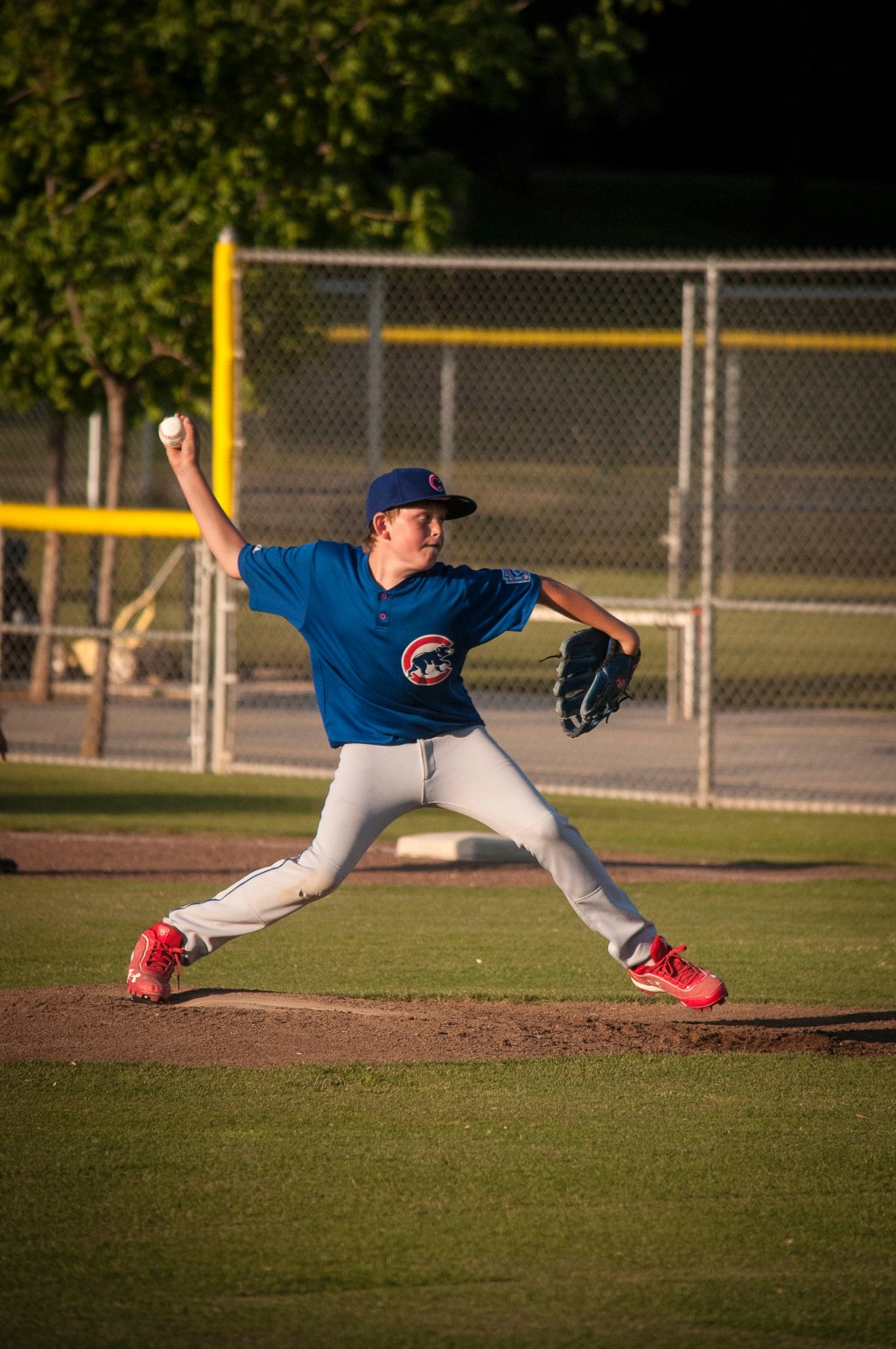
This looks like a very professional stretch to me.
Pitching isn’t everything–somebody has to hit the ball, too. Beaux reached his pitch limit, so they moved him to 3rd base. Then in the bottom of the sixth (and final) inning, with the team behind 4-3, Beaux came up to bat:

The kid is a star.
Beaux got on base, the next kid doubled him home and the Cubs won the game. That just has to be baseball I can learn to love.
Big fun in Fresno
Okay, that sounds like a self-cancelling phrase, but it is indeed possible to have fun in Fresburg.
Last week we spent 2 days there, and I’m finally getting around to talking about it.
On Thursday, we had to get out of the house early so we could be there before noon. We were going to some property Gail’s son Ross owns just north of town, the Historic Cobb Ranch. Yes, “Historic” is part of the name–it’s a smart way to get your own personal adjective, like the arena in Philadelphia named “The Legendary Blue Horizon” or the boxing announcer whose professional name is “The Classy Jimmy Lennon”.
The event was the annual growers lunch Panoche Creek Packing puts on for the almond farmers they buy from. Ross is an independent almond broker, buying from the farmer and selling to users all over the world. You can’t sell what you don’t have, so it is important that he keeps his supply channel full and his growers happy.
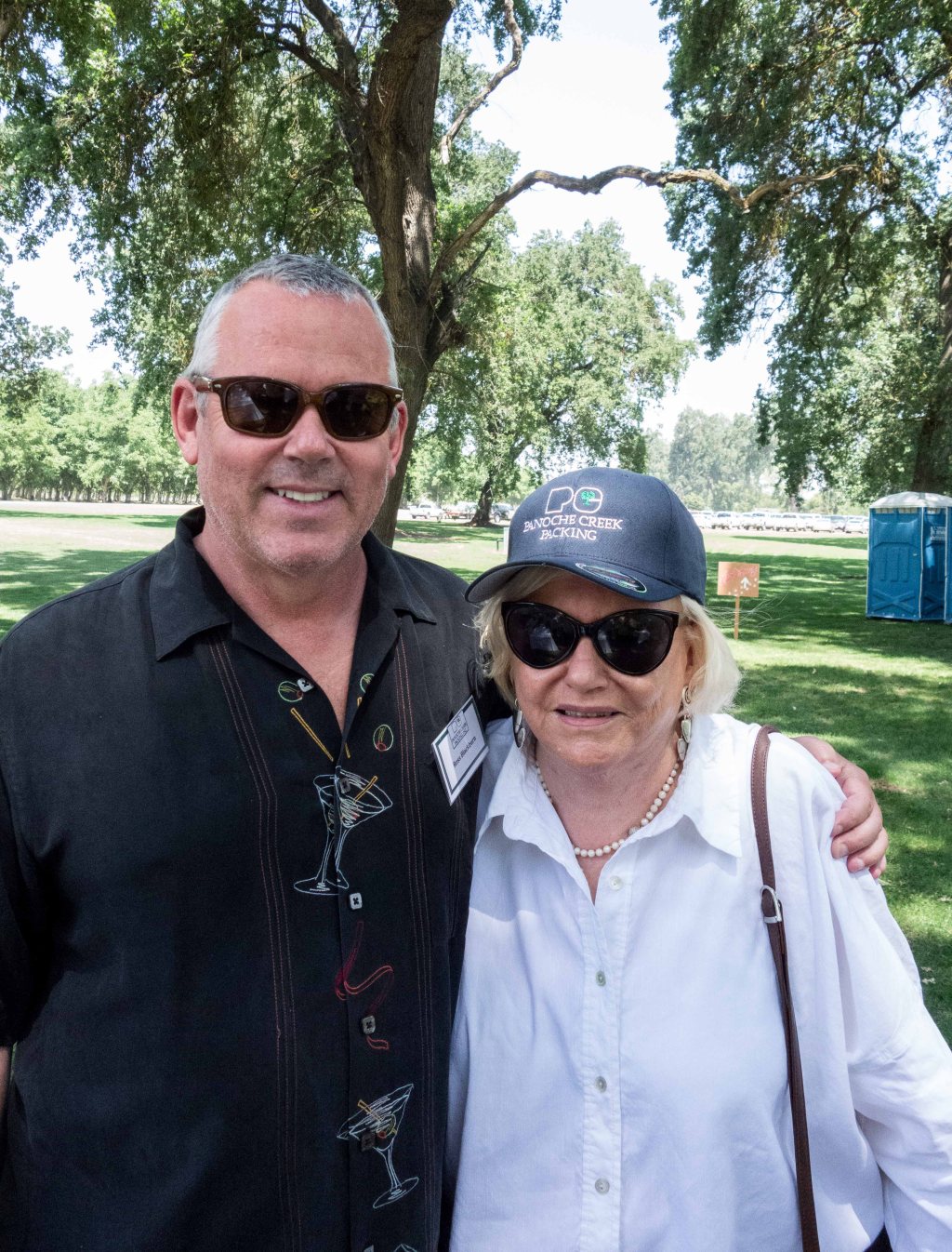
A boy and his mom.
A farm machinery manufacturer brought a few models for display, and I was fascinated. These are very specialized machines you would never come across in suburban life, so I had to explore and ask lots of questions:
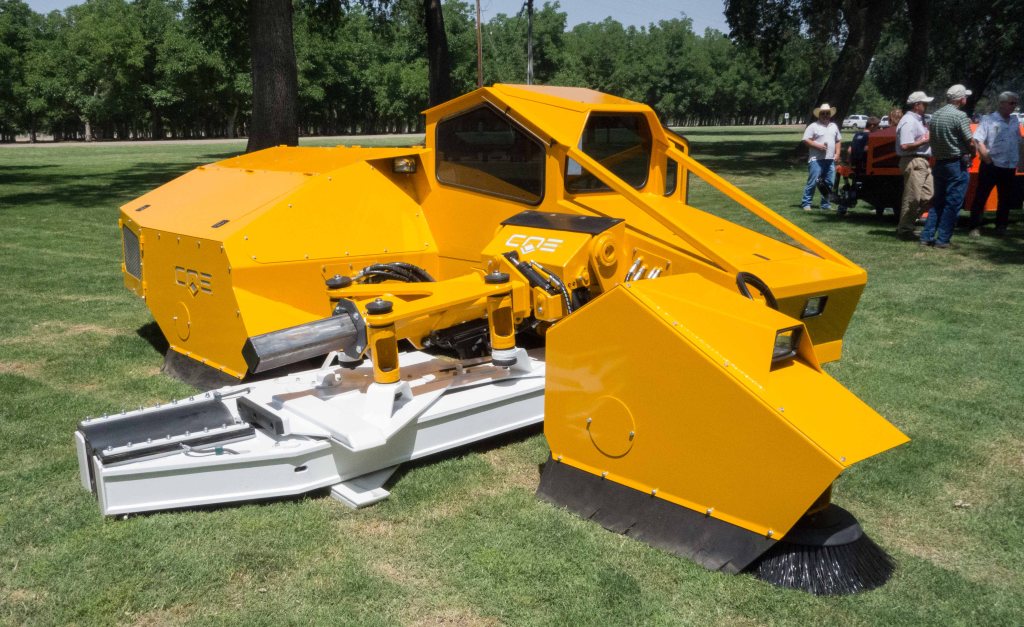
This is an almond knocker, the machine that shakes the nuts out of the tree.
Almonds are harvested by grabbing the tree with the white arm of this behemoth and shaking the hell out of it. In the old days, big strong men would hit the tree with hammers to accomplish that task; they were known as “almond knockers”. Sometimes a big stick is still used for particularly recalcitrant nuts.

This sweeps up the nuts and puts them in a pile
The sweeper collects the nuts and puts them in a long pile extending the length of the orchard between the rows. Then a harvester picks them up, they are transferred to trucks and off to the processing plant.
These machines cost over $100,000 each. Some farmers own them, some contract with harvesting firms. Either way it’s big money.

This is what a tractor looks like today.
Even the humble farm tractor is a modern piece of technology. With a low center of gravity and a tiny turning radius (due to a hinge in the middle of the machine), this tractor is much more efficient and capable than the John Deere of old.
The growers weren’t entertained solely by machines: there were speakers. Got to start with some sports celebrities and the inside dope on next years teams:

Fresno State Football offensive line coordinator
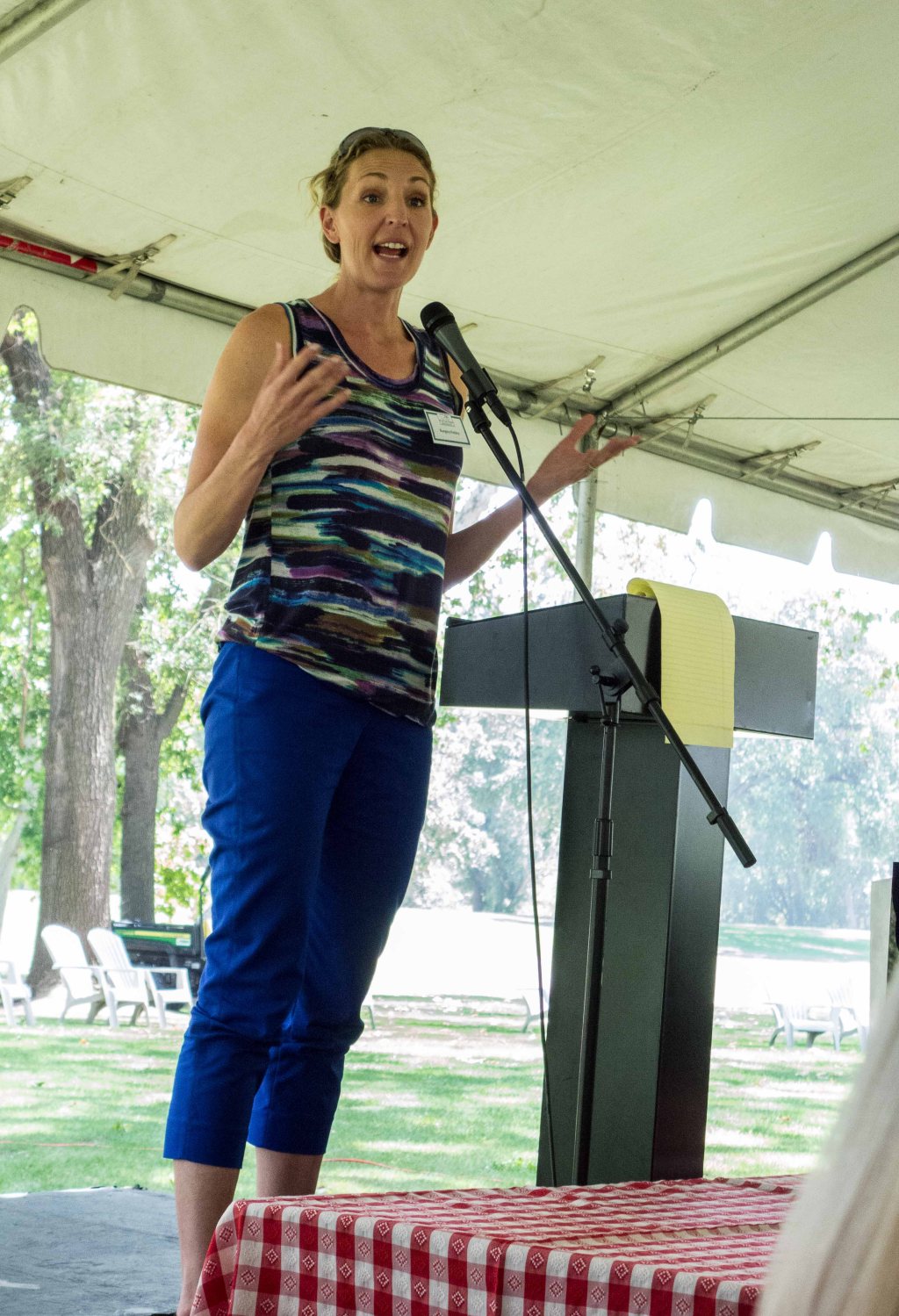
Raegan Pebley, FSU women’s basketball coach
There was a presentation from an industry insider who gave us the industry outlook for the year. The short answer–we’re gonna grow a lot of almonds. Everybody was happy.
A buffet with steaks and chicken and jambalaya filled everyone up. Prizes were raffled off, by Ross’s partner Frank and his kids:
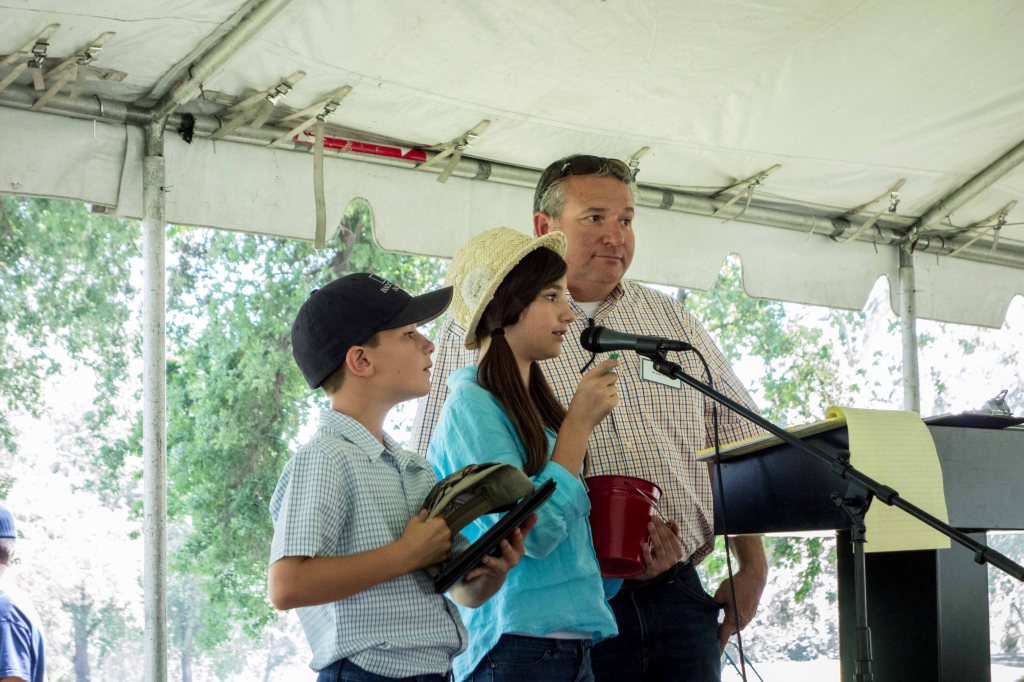
Frank and the kids running the raffle.
There were plenty of prizes, to be sure, but I didn’t win any, as usual. I don’t really need a farmers coat, anyway.
Friday morning we drove out to the processing plant. Health regulations require proper attire:

The professional look
Almonds arrive at the plant in large packing boxes. They have a few:
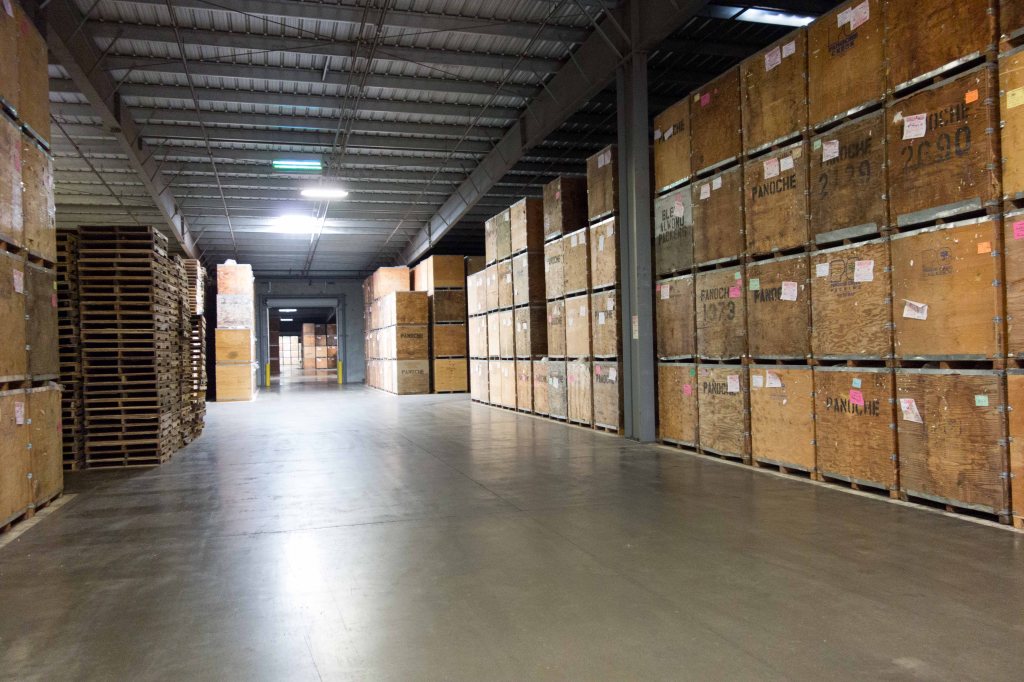
Rows and rows and rows of boxes.
The almonds have to be cleaned and sorted. There are machines that can look at tens of thousands of almonds a minute and reject stones and wires and branches and obviously bad almonds. Sorters separate the big from the small. Finally, though, it requires a human eye to to get the job right. We went into the sorting room where the final inspection occurs:
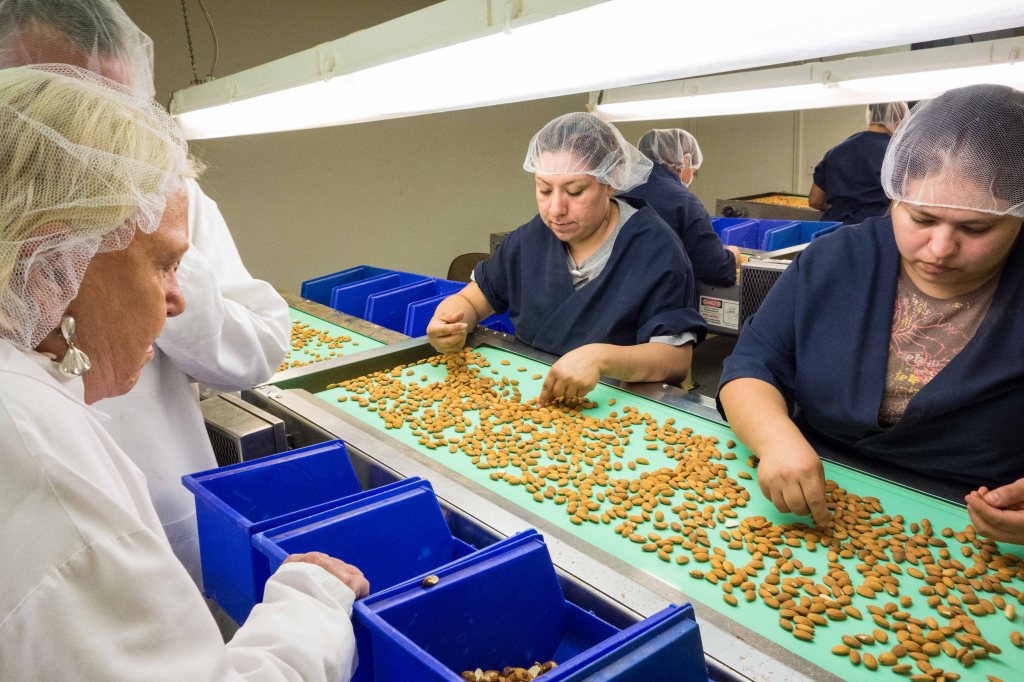
Those nuts are moving by really quickly.
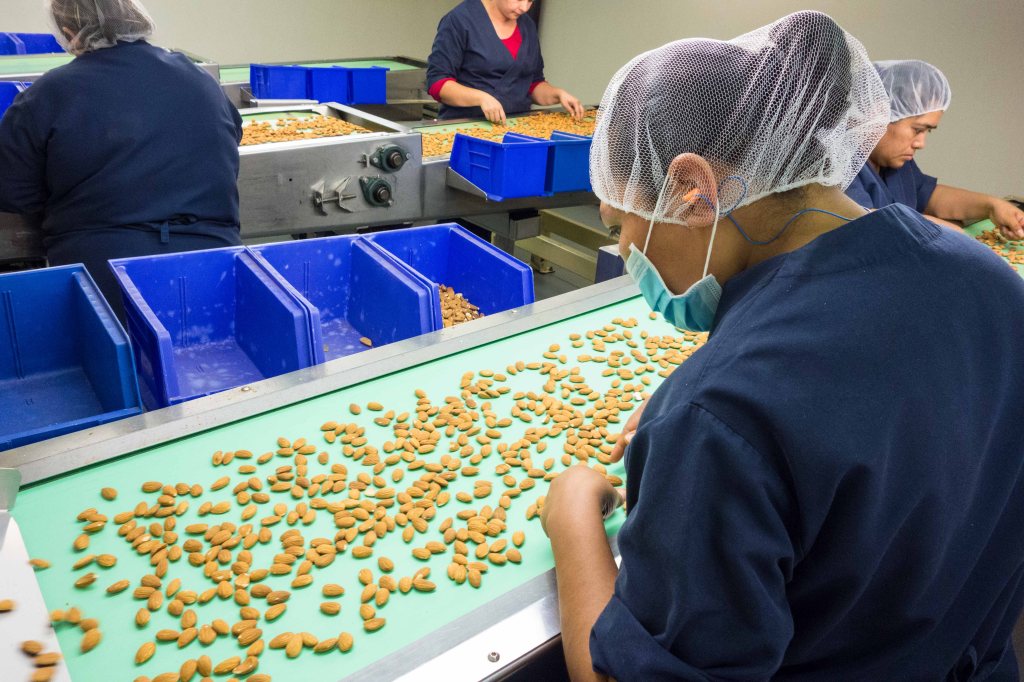
I could not watch that all day.
And that’s life in the almond processing business. Keep the growers happy and full of steak. Own a lot of big old boxes and make sure the product is cleaned and sorted properly. It sounds easy, but I don’t think it is.
Then we went to a Little League game, but that’s the topic of the next post.
The Business of Art
Day 3 of the Art Guild Trip.
Packing up and loading the bus at the reasonable hour of 9, we drove to an industrial park to the studio of Richard MacDonald, a noted figurative sculptor.
I’ve seen lots of artist studios. They are usually cluttered, small, and overburdened with work in various stages of completion. Not here. This is a 24,000 square foot factory, employing perhaps 30 talented artisans, which cranks out a steady stream of bronze sculpture.
On Wednesday, we visited the Hawthorne Gallery, where they take pride in the fact that each piece they sell is unique. At the MacDonald Studio, creating an endless stream of copies of a few memorable sculptures is the raison d’etre. There is definite artistry here, but it is art in thrall to commerce.
Before we could enter, we were all required to sign confidentiality agreements, pledging not to reveal what we saw inside. Fortunately, there is really nothing to violate–we didn’t see anything special or secret, just a well oiled machine for the production of art on a schedule.
The art here tends to the monumental–MacDonald makes really big pieces to adorn public facilities like the Olympics or the London Ballet. Then smaller versions are sold to the public.

Part of the Olympic sculpture. The only room we were allowed to photograph in.
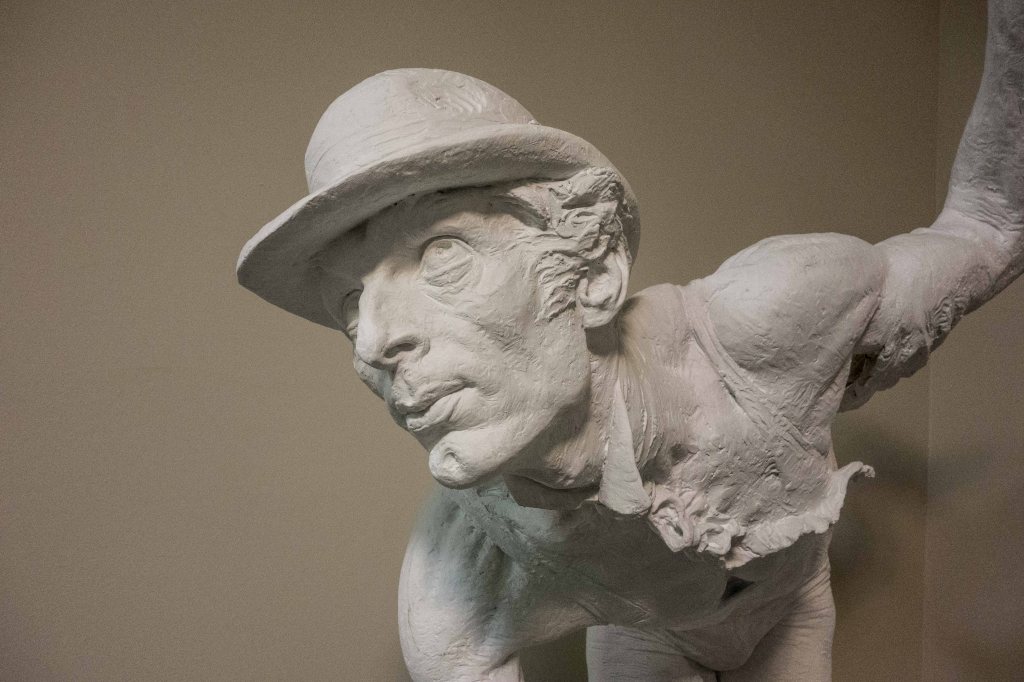
A considerably larger than life size piece from the Cirque du Soleil–the artistry is magnificent.
Although there is just the one factory, MacDonald maintains 2 other studios–one in Las Vegas, to sculpt the artists of the Cirque du Soleil, one in London to sculpt the dancers of the London Ballet. He shuttles among them week by week. It’s a rough life.

You can’t have a tour with a group photo.
The marketing is relentless. We were offered copies of a book of MacDonald sculptures for $39.95, or $69.95 signed by the artist. I’ve never seen an artist selling autographs before. They held a raffle for one of the books; the entry was an information sheet so they could put us all on the mailing list. The great man himself was somewhere on the premises, but did not deign to meet with us. He said hello privately to our tour leader, but then she owns one of his works.
Richard MacDonald is undeniably a great artist–his ability to recreate the human form in bronze is exceptional. That he has chosen to leverage his talent to make a huge pile of money is certainly a valid choice. There is no particular virtue in being a starving artist, being rich and famous is a pretty reasonable way to go.
We had a pleasant lunch at Tarpy’s, named for a vigilante who got hanged for shooting a neighbor in a land dispute. Live by the mob rule, die by the mob rule.
Our final stop was the Monterey Museum of Art–which has more than one location, as we found out when we went to the wrong site. But that was just a minor glitch, we just got back on the bus and motored to the right building. We were there to see the work of Johnny Apodaca, who may be the nicest guy in the entire county.
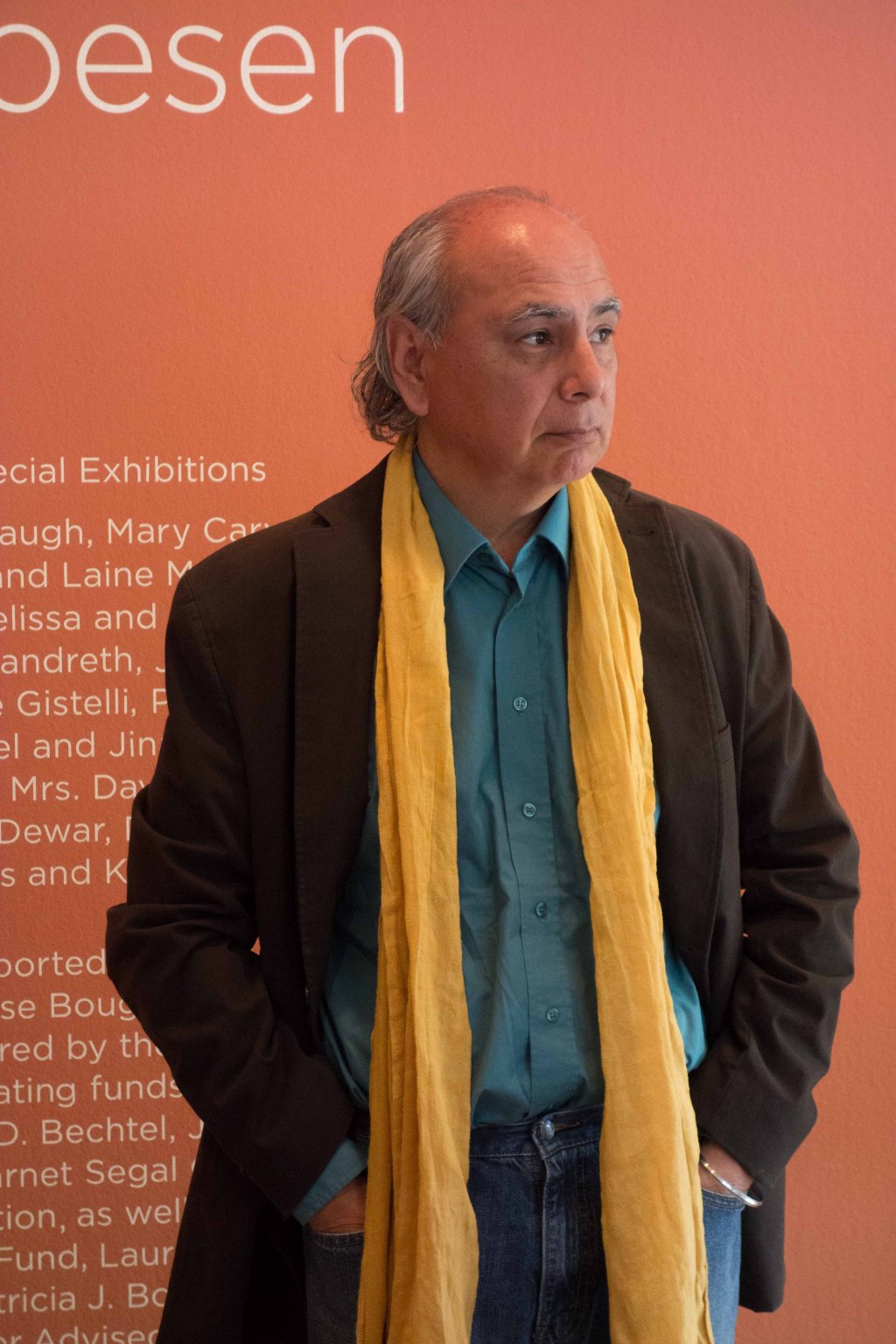
The very stylish Johnny Apodaca
Formally trained in the school of abstract expressionism, Johnny made a living as a hospital orderly for 25 years while continuing to paint. He has found a way to blend abstraction with realism to create his own very emotive style.
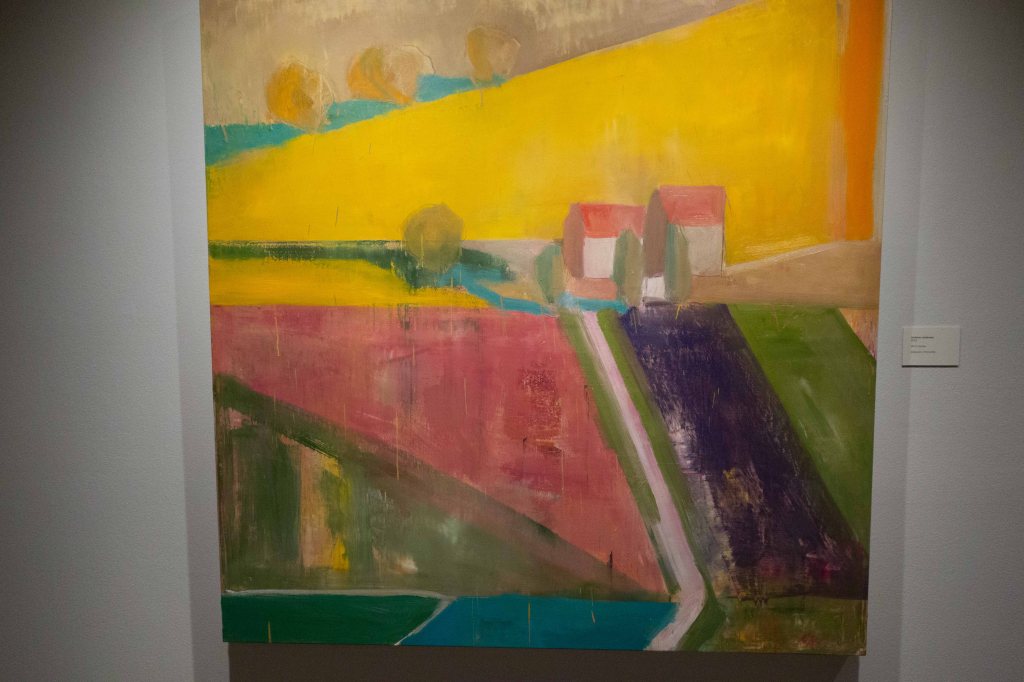
Landscape

You don’t just see this, you feel it.
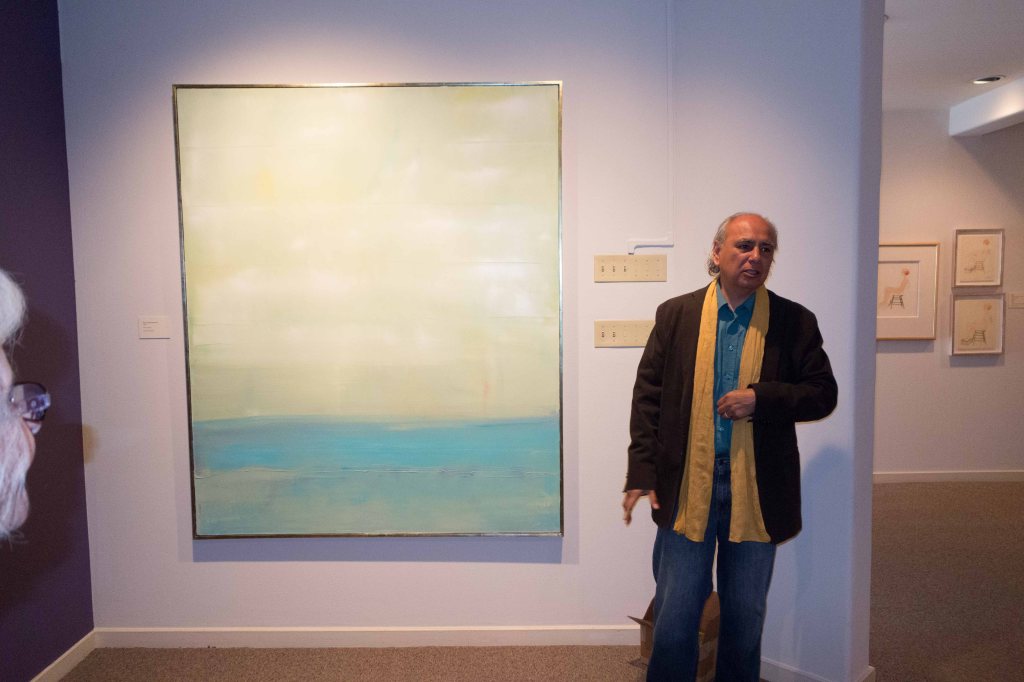
Johnny was very generous with his time
I really liked this work. I like the artist, I like the art, I like the museum it is hanging in. Johnny was a pleasure to listen to, and just to be around. He is warm and open and easy to talk to. I guess you can tell which of the artists we visited today I prefer.
Finally, back on the bus for the 2 hour drive to Oakland. We had a wonderful trip, beautifully planned and executed by Sharon and Bev. We saw some incredible art, and some very interesting places. If you want to explore the art world the easy way, come on a trip or two–most of the them are simple day trips, other excursions go all over the world. Broaden your horizons and let Pete do the driving.
A Convocation of Eagles
Readers with good memories will remember two years and two months ago, I posted about Aaron Bandler receiving the highest honor in Scouting; he became an Eagle Scout.
Tonight, I saw Aaron again, at the ceremony where his brother Alec became an Eagle, too.
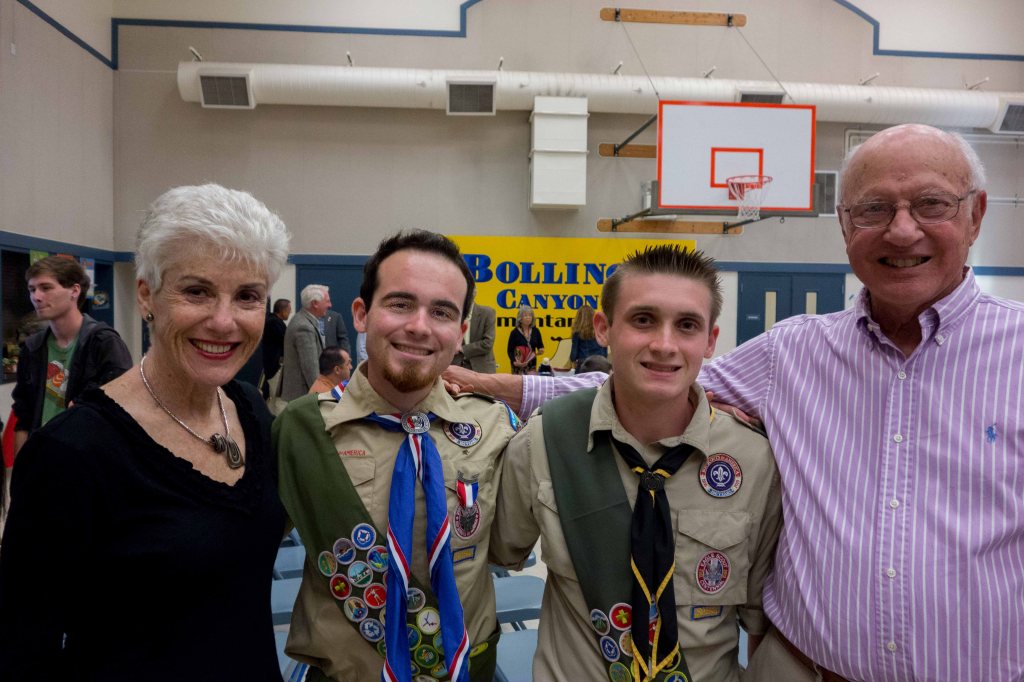
Linda, Aaron, Alec and Mike–one very proud family
Alec’s mother, Melinda, is a professional scrapbooker, and has saved, sorted, categorized and preserved the ephemera of his Scouting life.

From the tiny shirt of a tiger cub to Eagle, the story of a life in scouting.
There were three young men being honored tonight–Alec, Casey Albert-Hall and Jacob Gee. The room was full of proud parents and relative and friends.
The mayor of San Ramon, Bill Clarkson, attended and presented a city proclamation to each of the new Eagle Scouts.

Alec receiving his proclamation from Mayor Clarkson
Becoming an Eagle Scout requires not just hiking and camping. The Scout need to earn merit badges, symbols of proficiency in a variety of areas. Alec won 23 of them. The prospective Eagle must complete a public service project–Alec worked with the Blue Star Mothers of San Ramon to solicit items to prepare care packages for our troops overseas.
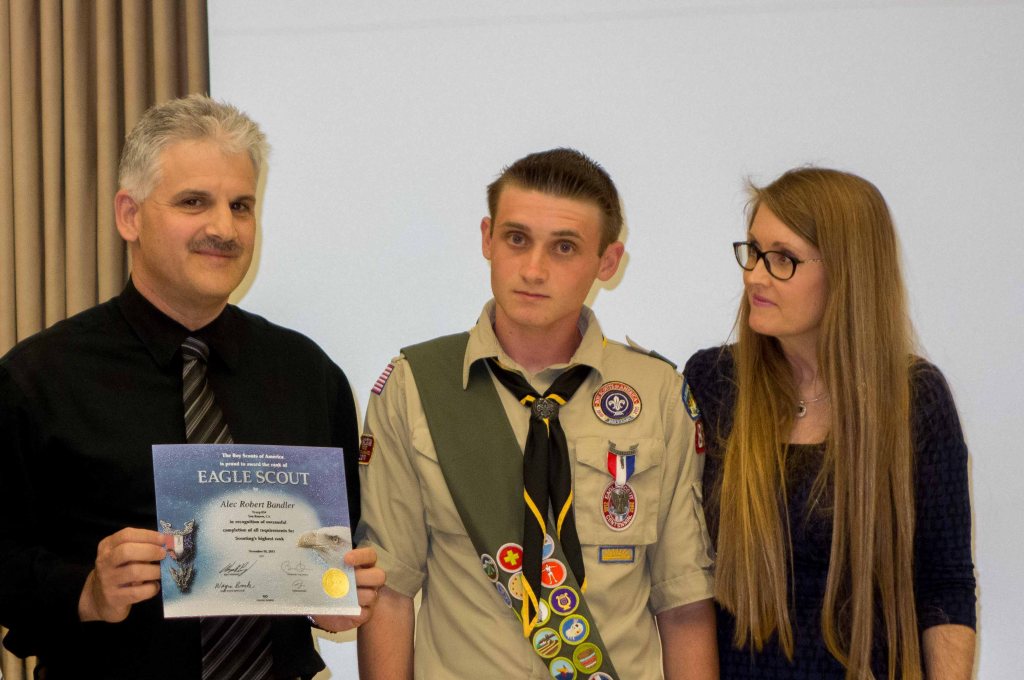
David, Alec and Melinda Bandler,
Only about 7% of Scouts persevere to become Eagle. Two in the same family is even more rare. Mike has already told us to be ready to travel to Dallas in 3 more years for the next grandson. The honor will be ours to attend.
Carmel highs and lows
Day 2 of the tour dawned. A couple of hours later I got up. We had to be on the bus by 9, and made it with 30 seconds to spare. The hotel puts out a buffet breakfast with good eggs and not so good potatoes. I snagged a couple of pieces of bluberry loaf for a snack later in the day, but never got around to eating them.
Heading down the coast towards Big Sur we just enjoyed the beauty of the ride. It’s rare for me not to be behind the wheel, and it was a pleasure to just look out the window. I never knew how many homes there are along the beach side of highway 1, from small seaside shacks to enormous stone palaces, all built before the California Coastal Commission took over and essentially ended development near the water.
Our first stop was the Hawthorne Gallery, across the road from Nepenthe, which Orson Welles built for Rita Hayworth. It’s a really cool restaurant today and a favorite place to stop along the coast.
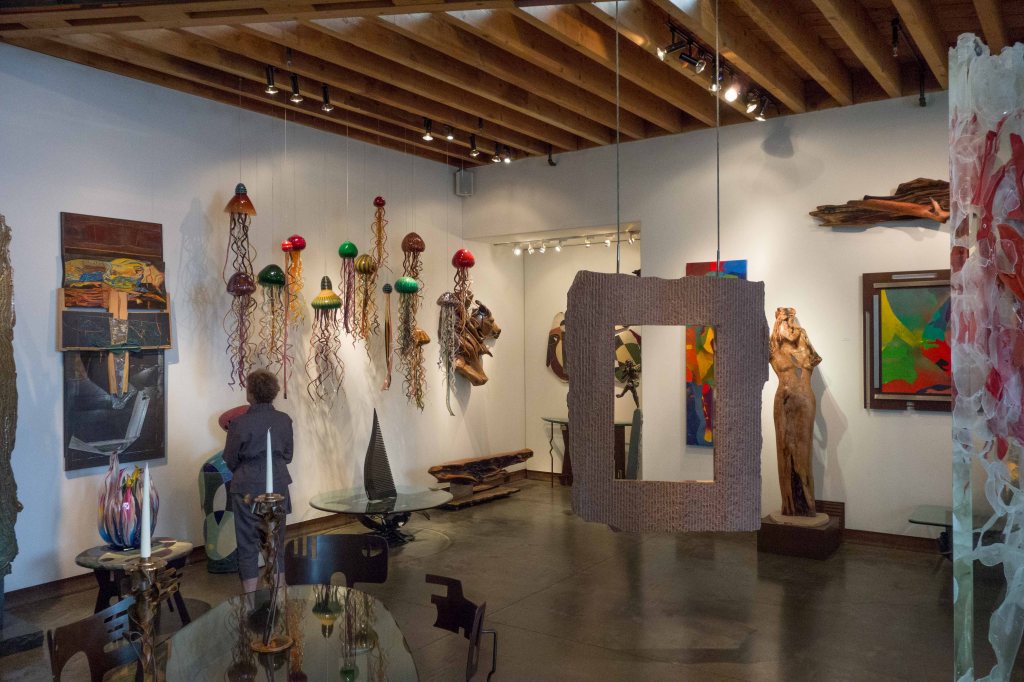
Hawthorne is an amazing establishment. All the art is produced by the Hawthorne family–every one of them is an artist. Brothers, wives, children, sons and daughters in law, artists all. The art is all one of a kind, they don’t do prints or editions. Among them, the Hawthornes work in wood, steel, glass, ceramic, stone, oil and acrylics.
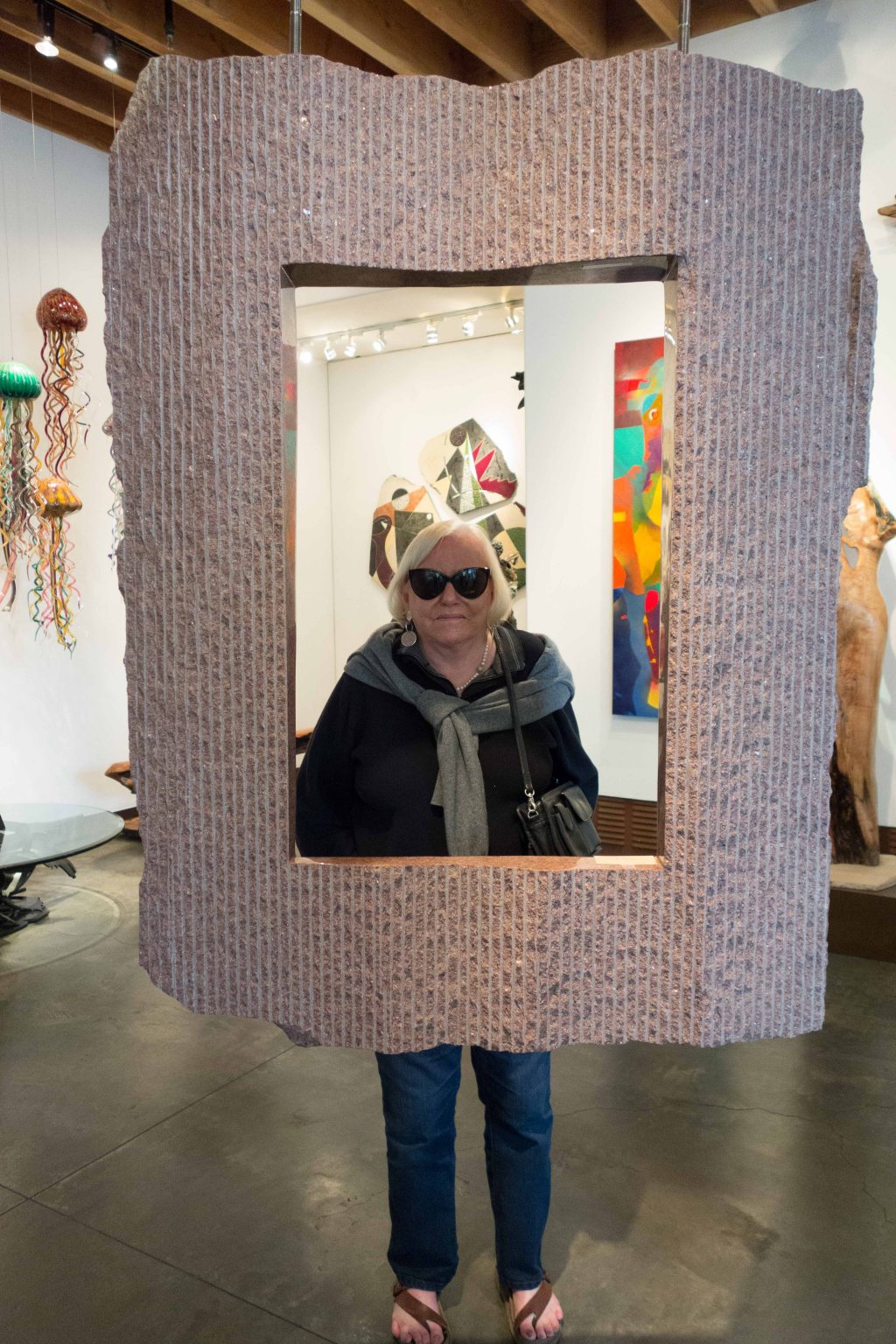
A solid stone frame floating in space.
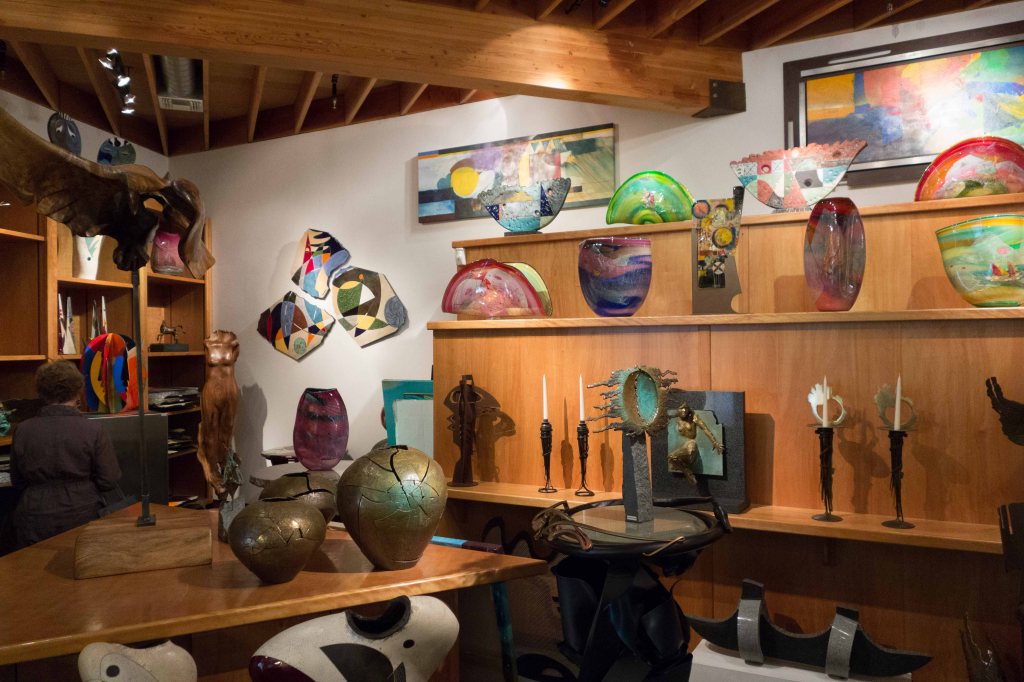
The ‘storeroom’ in the back has more art than many full galleries.
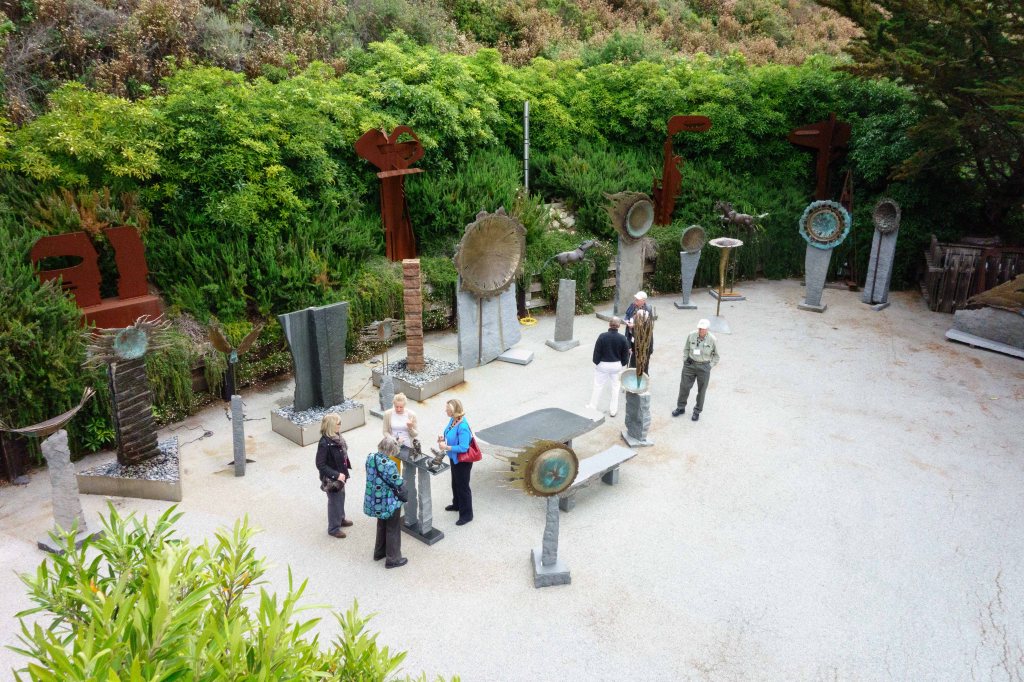
Large sculpture fills the rear patio.
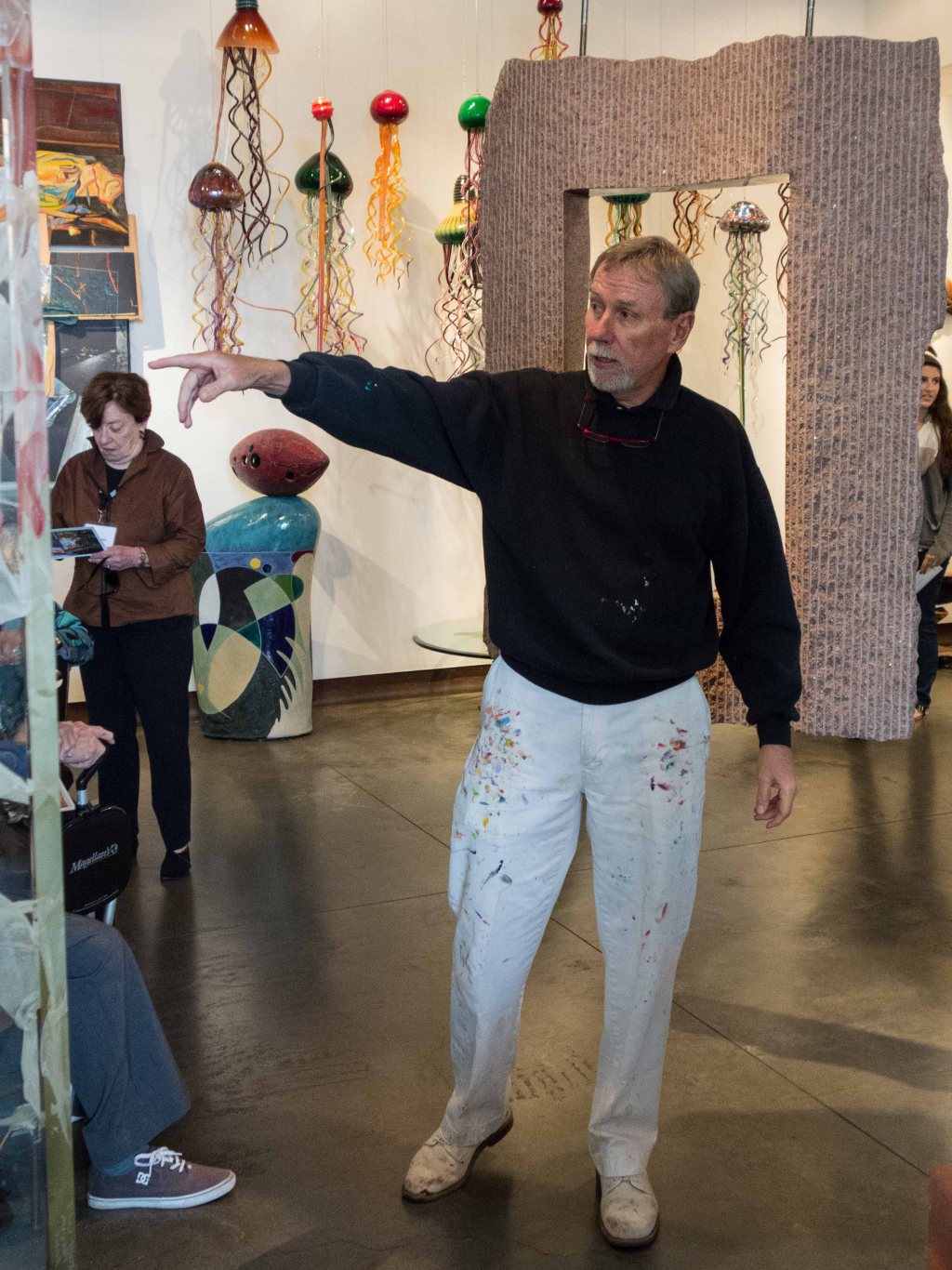
Greg Hawthorne, gallery superstar. Very cool pants too.
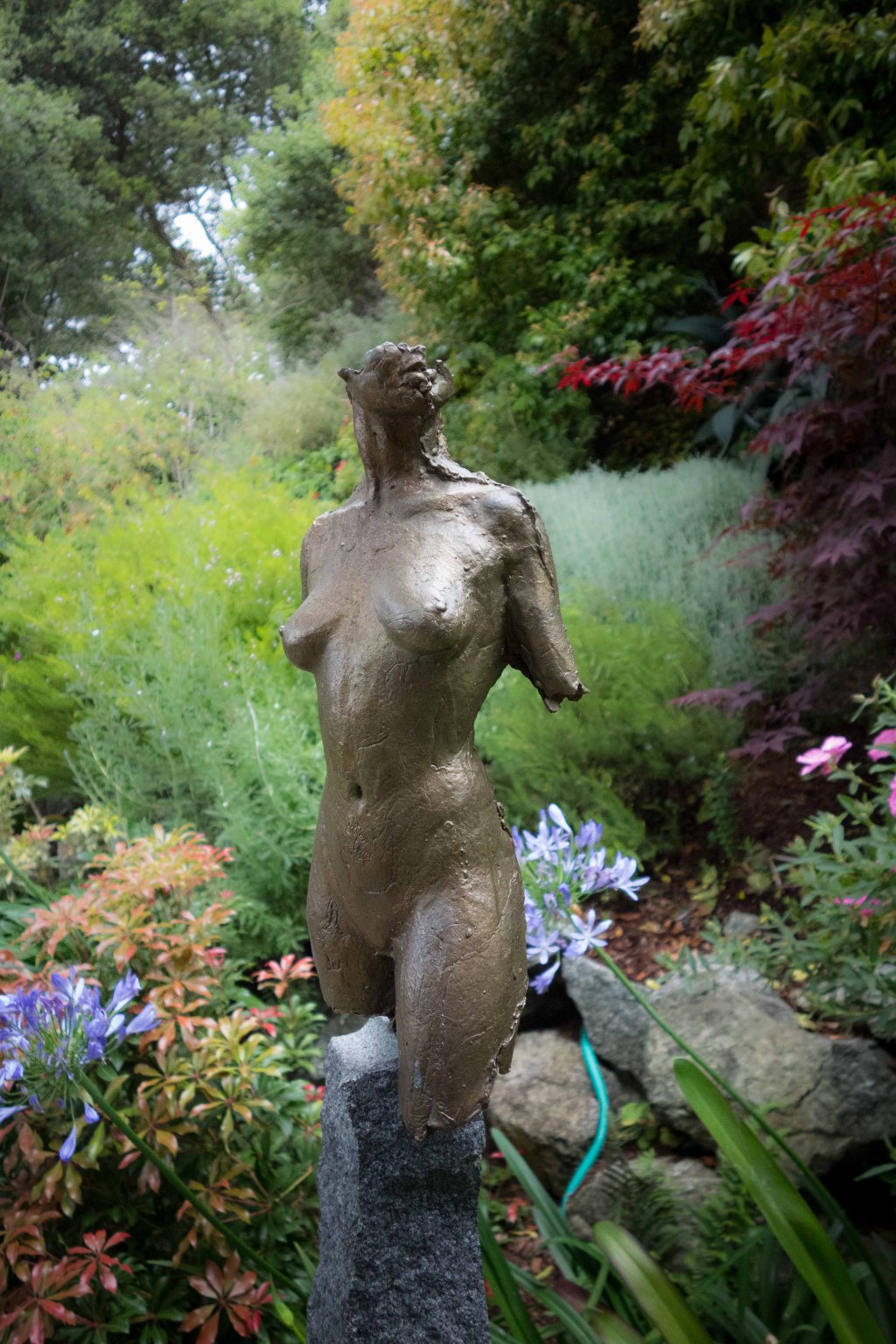
Not the biggest piece, but the one I liked the most
After an hour or so enjoying Hawthorne, we headed further south to the Coast Gallery, a temple of tourist tacky that impressed none of us.
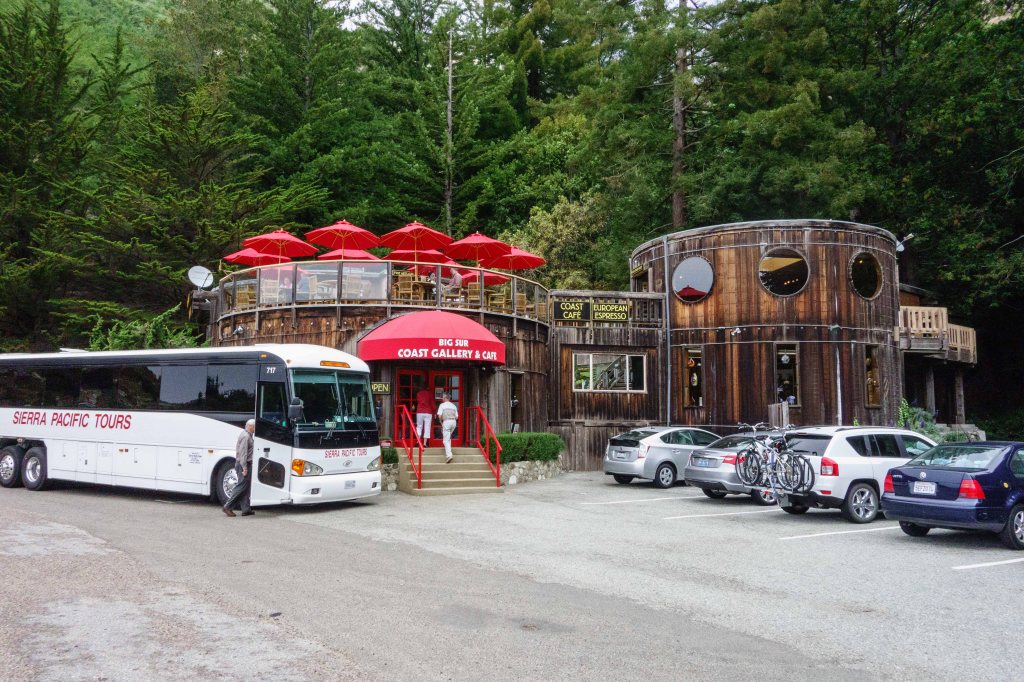
Just a little bit of Coney Island by the Pacific.
Okay, I like art with delicacy, subtlety, style and emotional depth. This isn’t it:
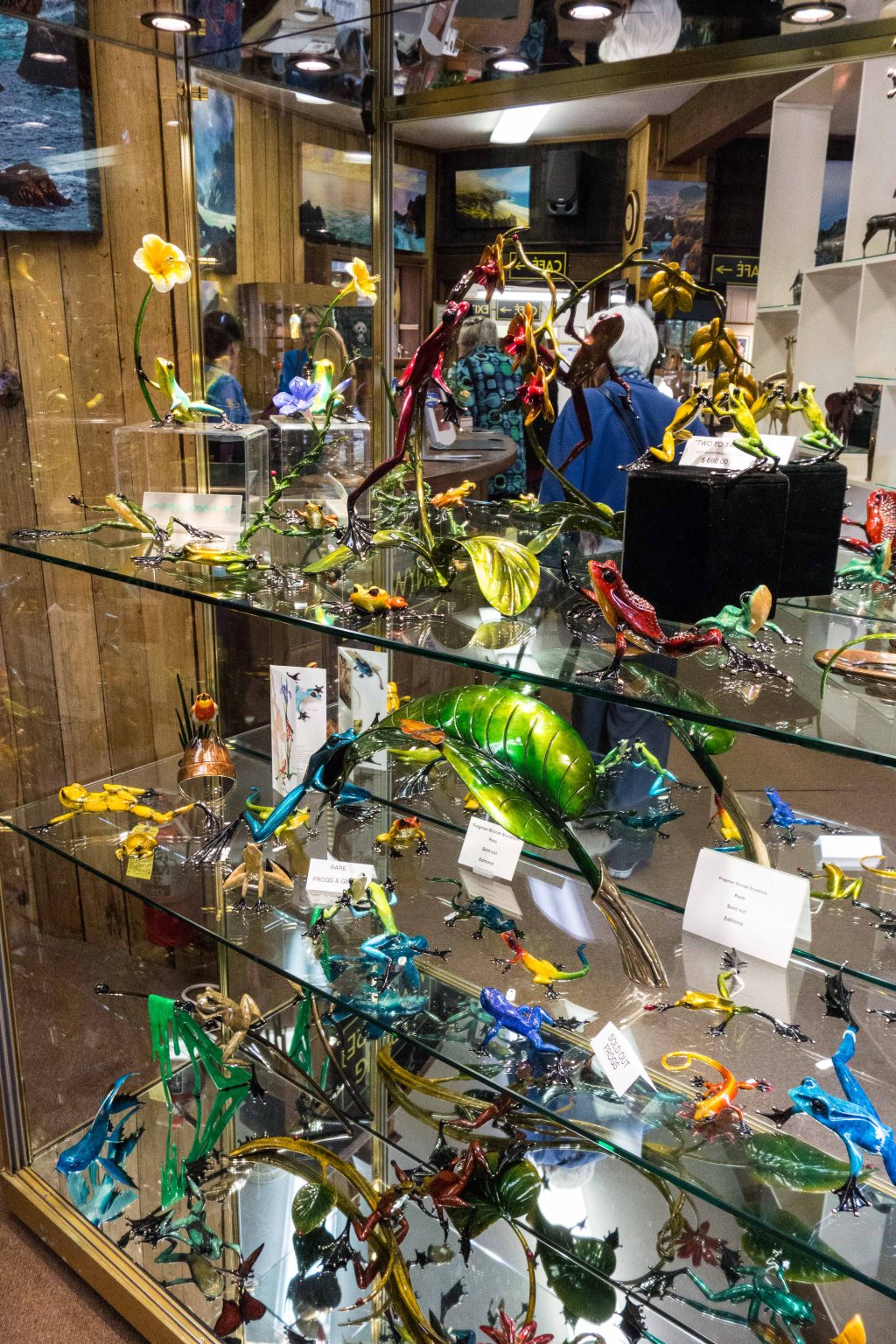
An etagere full of gaudy enameled frogs. Matisse would not be envious.
After wasting an hour amongst the kitsch and the chatchkis, we turned back north for lunch at Ventana, a beautiful resort high in the hills. The restaurant has considerable outside seating (with many, many, gas heaters to protect against the coastal chill), and we enjoyed an excellent lunch with a view all the way to Tokyo.
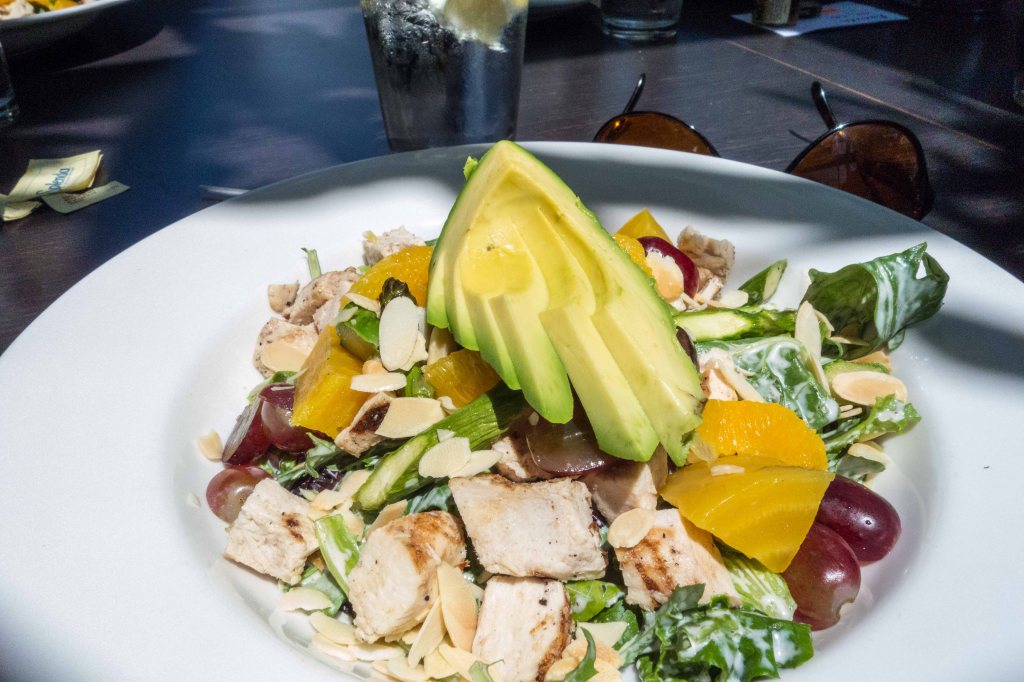
Chicken Salad
Gail had an interesting take on a deconstructed fish taco:
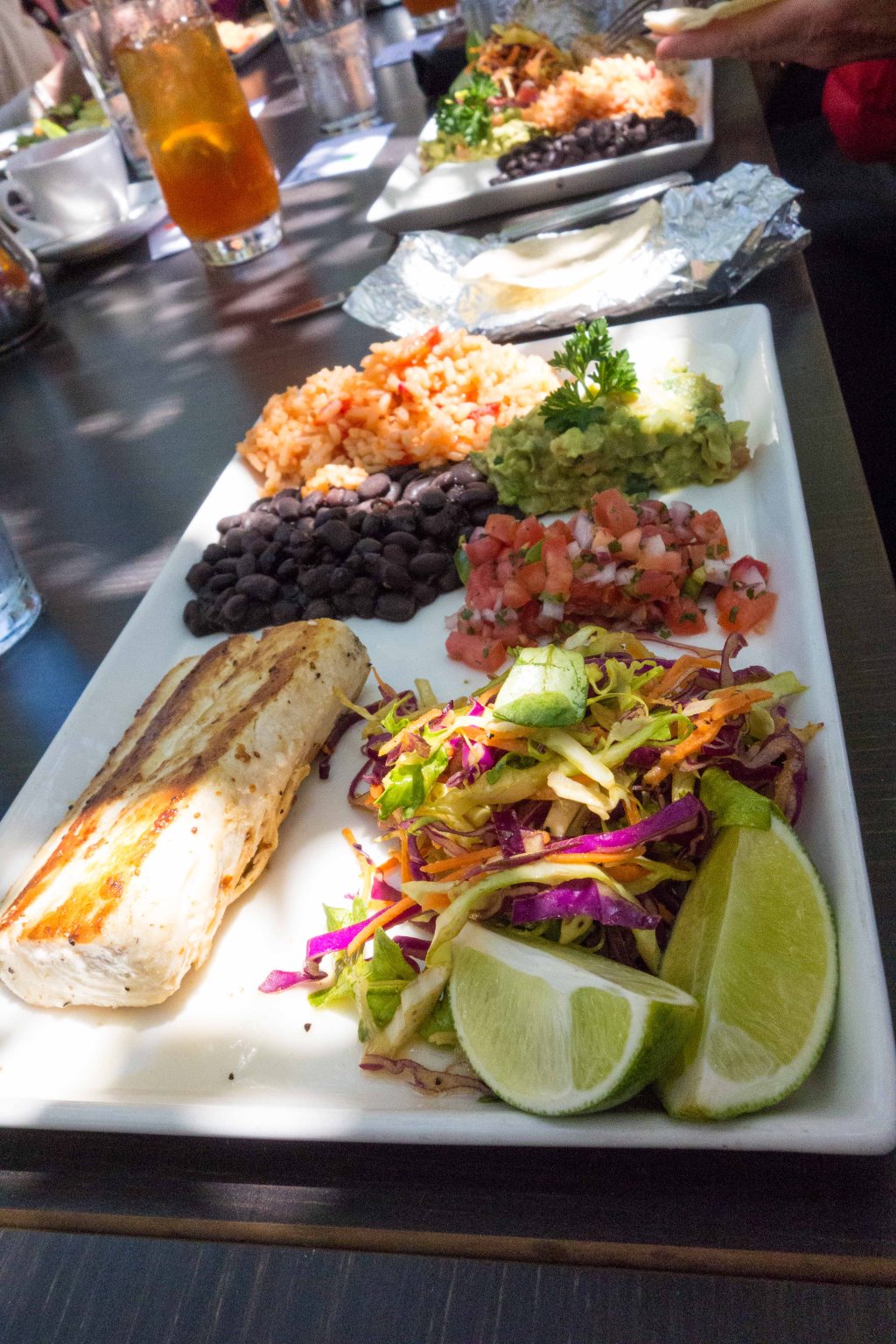
All the fixings for a fish taco, you just have to do the work for yourself
Now came the highlight of the day. We stopped at a turnout in the road, and moved from our big tour bus to a smaller, 25 person van for the 3 mile ride up a narrow, twisty private road to the home of Emile Norman, an artist and sculptor who created the enormous murals in Masonic Hall on top of Nob Hill.
The home was basically hand built over many years by Norman and his life companion, Brooks Clement. The workmanship is invariably meticulous, just as his art was.
Emile and Brooks loved music, and had a baroque mechanical pipe organ installed. Brooks played the organ; Emile learned the cello so he could accompany him.
Emile’s sculptures were like mosaics, composed of thousands of tiny, hand cut pieces of wood or tile glued to a form then filled with epoxy. His workshop, in the basement of the house, still contains hundreds upon hundreds of jars filled with infinitesimal bits of material, carefully color sorted, to create his work from.
We were lucky to get to see the house. His heirs have hopes to turn it into a museum, but it is so inaccessible that concrete plans are hard to formulate. The experience was magnificent, and definitely the high point of the trip so far.
Wednesday night we had dinner at a French restaurant, topped off with Bill Ryan playing the harmonica while I sang God Save The Queen. The wine everyone else drank was provided by Bob Hussey from his personal winery, who was scheduled to be on the trip with us but decided to spend the time in Kaiser Hospital with pneumonia instead.
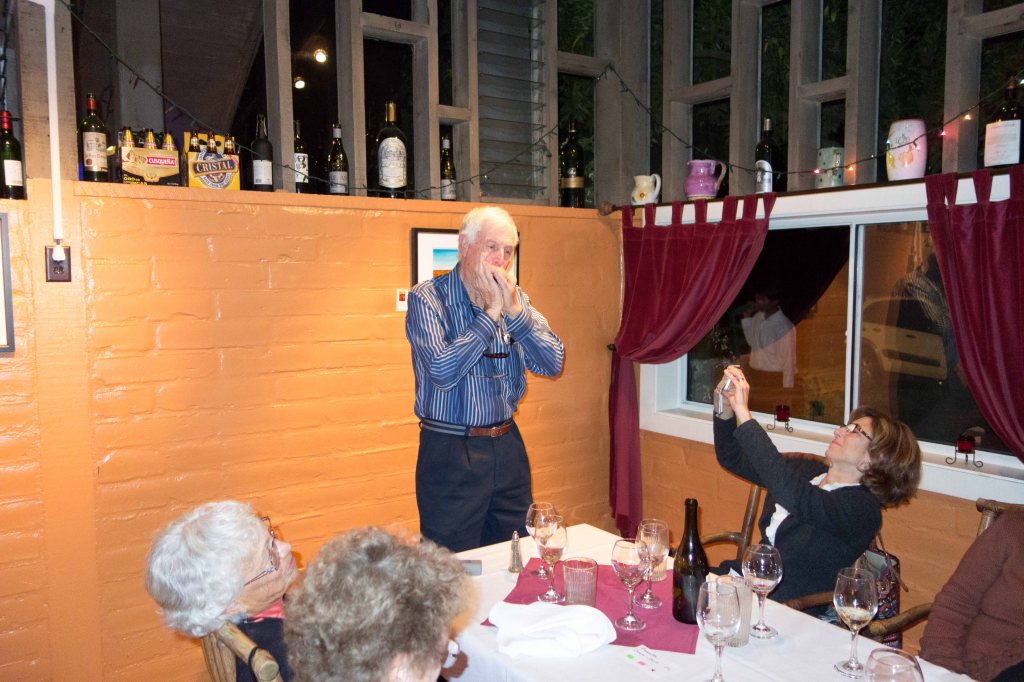
Bill Ryan performing for the crowd
Another very full day, and back to the hotel. More fun tomorrow.
Different strokes.
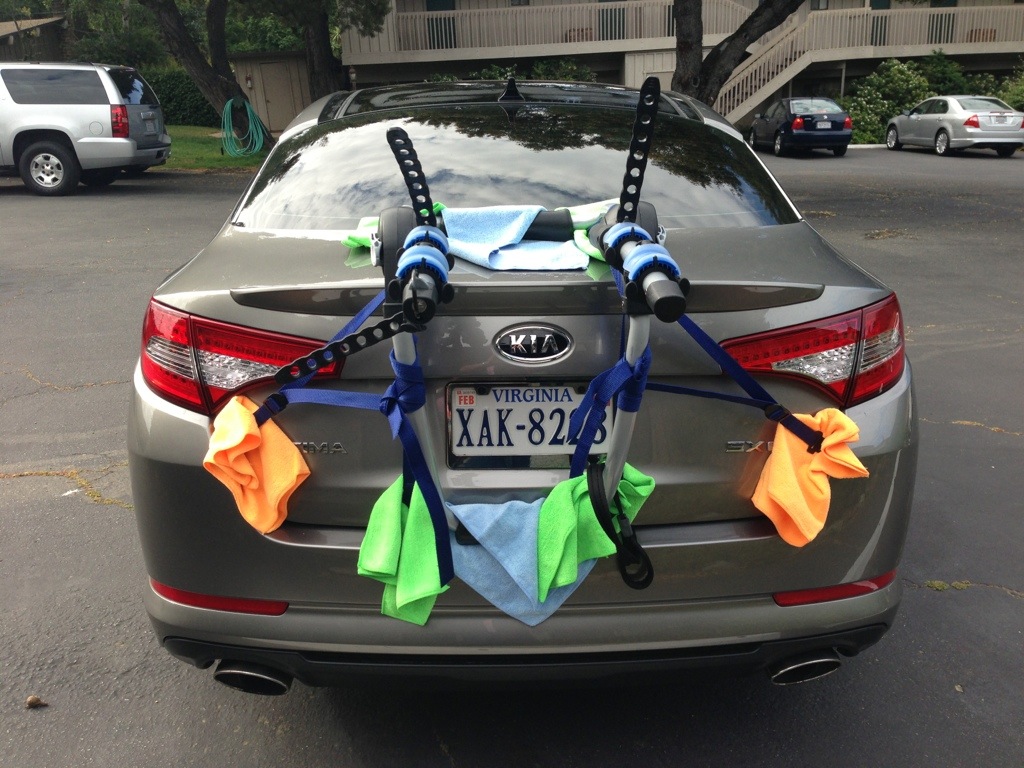
This car is parked outside our room in Carmel Valley.
It’s hard enough to imagine that anyone even makes this hideous dish rags, but why anyone would adorn their car with them is beyond comprehension.
On the art trail in Carmel
I’m beat. Bushed. Knackered. All in. This has been a long day; sometimes being on vacation can really be work.
After our quick sojourn in Seattle yesterday, we grabbed a short nap and headed out this morning on a 3 day trip to Carmel and Big Sur with the Oakland Museum Art Guild. We had to be at the museum, on 11th street in Oakland, at 8:00 am. These people don’t understand vacation, but that’s when the bus was leaving so we had to be there. Yes, I’m now one of the old geezers I used to laugh at taking bus trips around the state.
For some odd reason we took a bizarre route–through Oakland to 580, all the way to 680 and then down through Sunol. Seems like much the long way around, but I guess it doesn’t matter–I was just sitting there, with no plans for 3 days in any event. Our regular, trusty driver Pete was at the wheel, why should I worry?
A little over 2 hours later we hit Carmel. Tour busses have to park in a specific spot, feeding $10/hour into the meter. First stop–restrooms. I saw this sign on a gallery that wasn’t open yet, and hoped it would not be an omen for the trip:
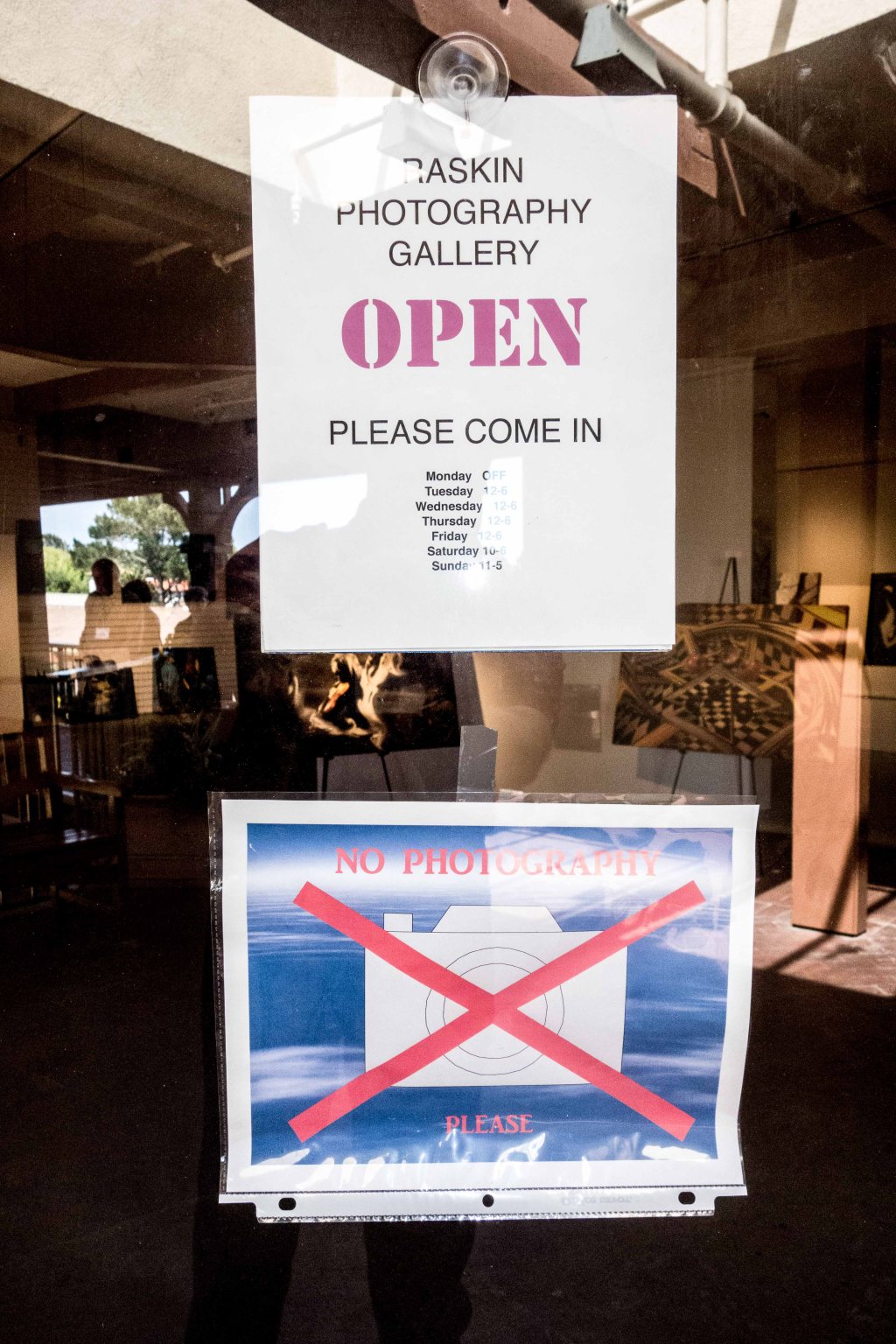
I wonder if they see the irony here.
Then we walked a few blocks and came to the first stop–the Cassandria Blackmore gallery.
Ms. Blackmore, the owner, is also the artist. Her metier is painting in acrylics on the back of a sheet of glass, then carefully shattering it. The resulting work is both planned and random, and quite interesting.
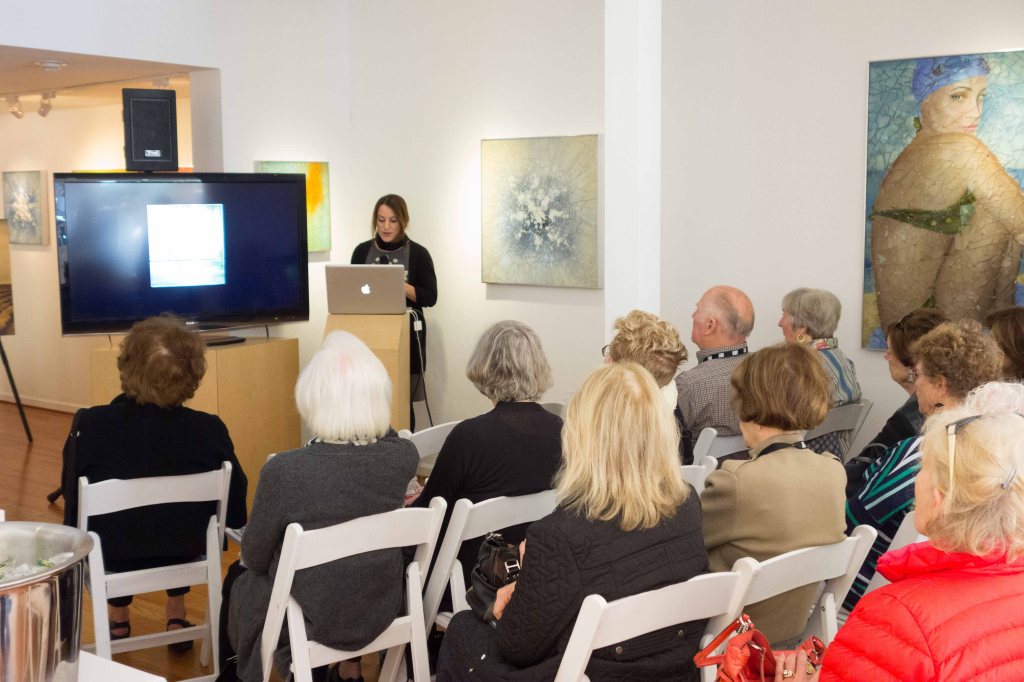
Cassandria Blackmore giving us a talk about her work.
Cassandria does work both figurative and abstract. I like the figurative much better:
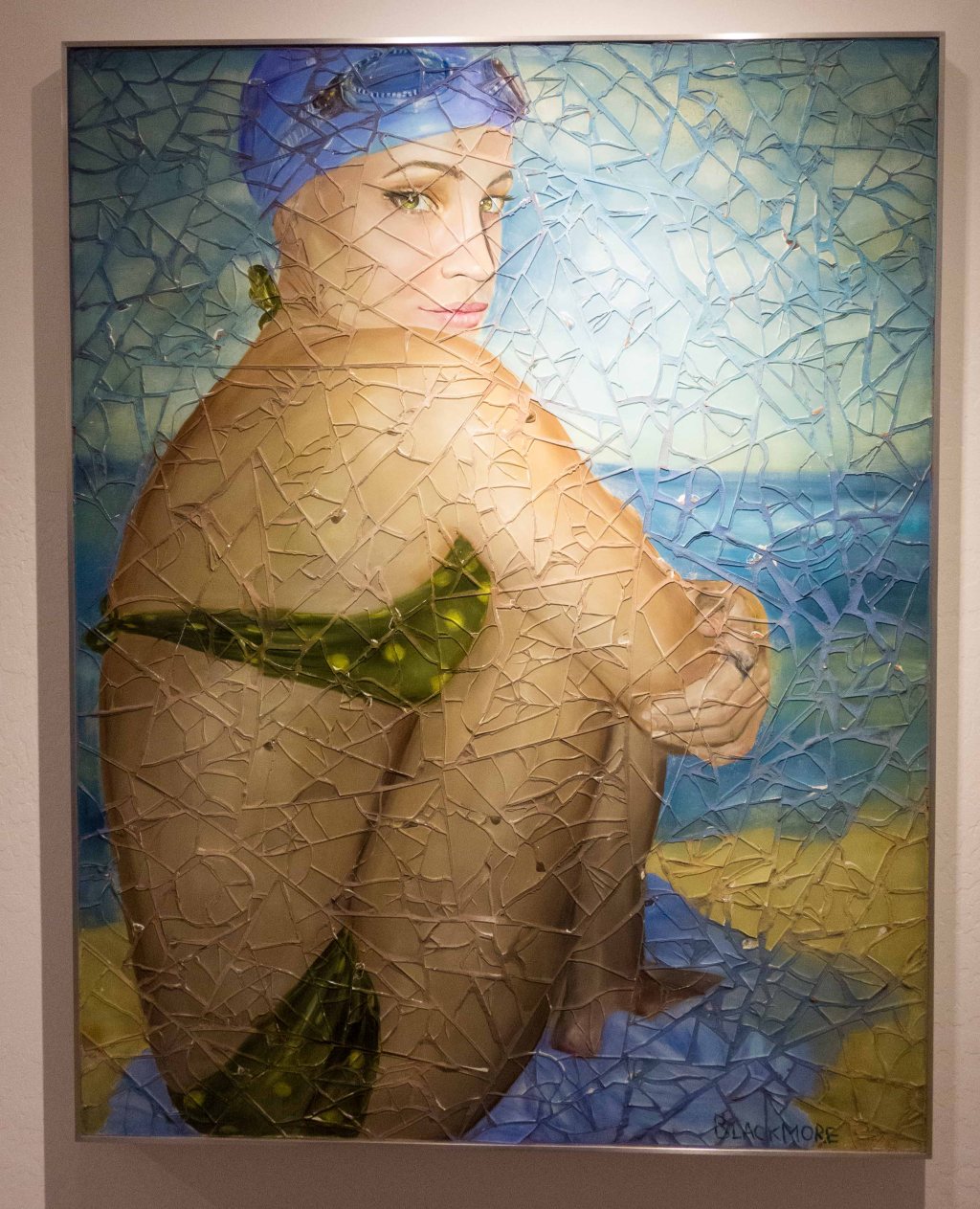
This I could have in the house.
The abstract sells better, because it’s safer. Hotels, banks, consulting practices, law firms, all want good looking, non-confrontational art to decorate the wall, and Blackmore’s abstracts fill the bill.
We ate lunch at il Fornaio. On a tour like this the menus are planned well in advance–you get a choice from a couple of salads, two or three entrees, it’s all planned before you leave home. Gail did the planning for this trip while I was in Gatlinburg, so it will all be a surprise to me. For lunch I had a spinach salad, with too many mushrooms (well, one is too many, but this salad was 35% mushroom) and some grilled salmon. The salmon was not bad.
A major reason to come on a tour like this is that you get to see things you could not see by yourself. We next visited the private homes of two collectors, on on 17 mile drive and one up in the hills. The group leaders claim that the homeowners don’t allow photos of their houses, but I’m not a believer. Perhaps some indeed don’t want photos, but it is not probable that they ALL don’t. I think that’s just a rule the leaders made up by themselves, but I’m stuck with it. You’ll have to believe me that we saw a couple of beautiful homes with interesting art collections. The house on 17 Mile Drive was cooler–it was formerly used as a guest house for members of the Firestone Family. The house on the hill had the better art collection, some really priceless works from early California painters.
Our day was not over yet. We next drove way the heck out into Carmel Valley, on lovely back roads I’m told. I fell asleep immediately after the last collector’s house and slept the entire way. We were going to the studio of Patricia Qualls, a self-taught abstract expressionist who used to be a clinical psychologist who used painting as a means to unwind. Then she got addicted to the joy of creating art, and now she’s a very successful full time painter–all in the space of about 10 years.
Her large studio displays many of her works:
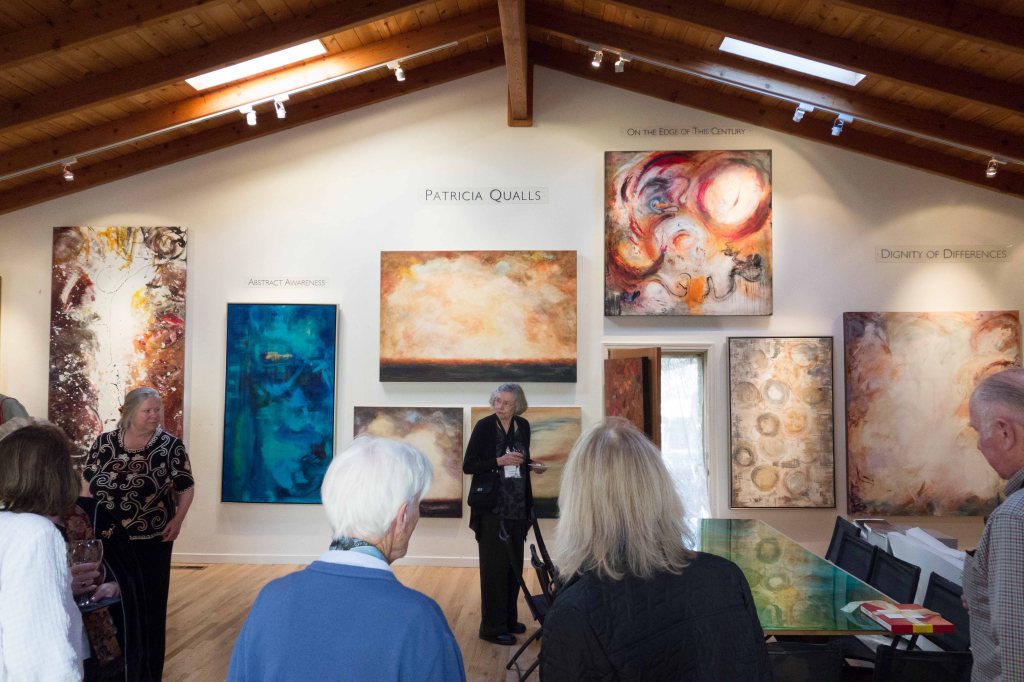
Patricia works in large canvasses
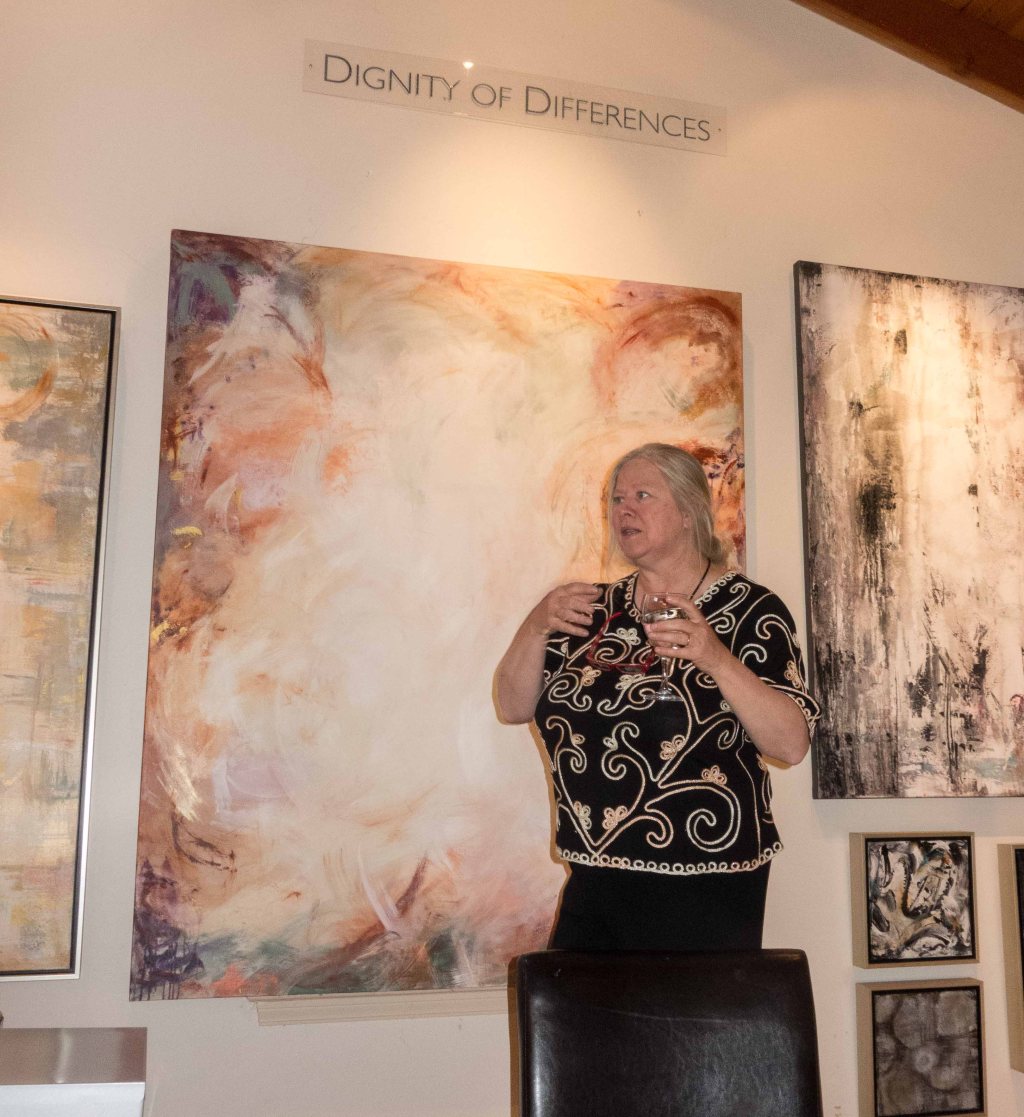
Here’s Patricia talking to us. Her personality, vivacity and excitement fill the room.
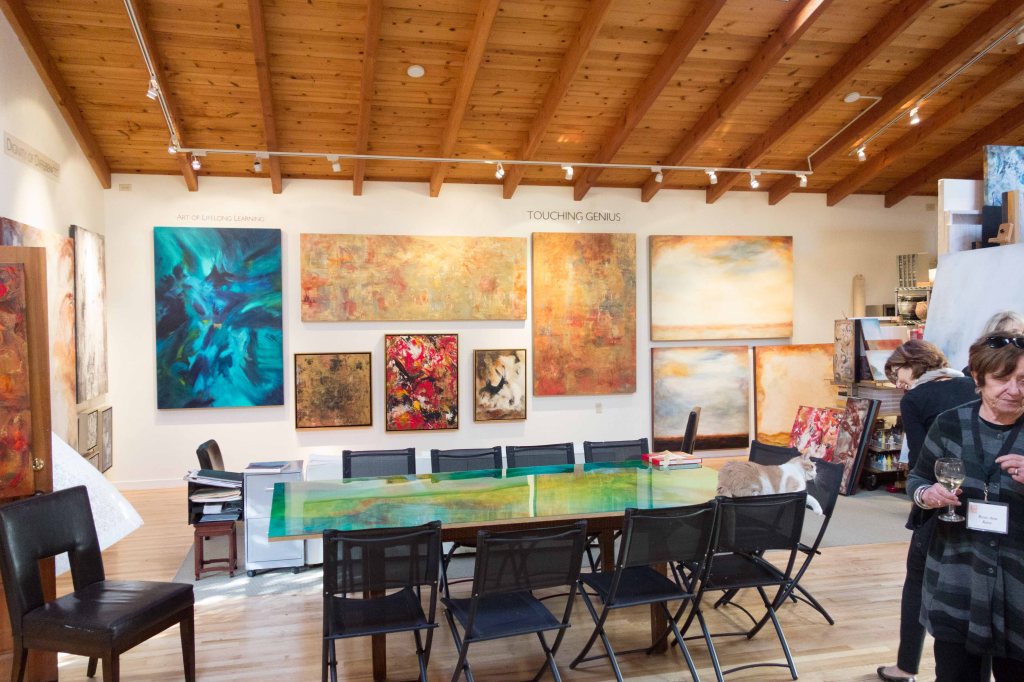
The other side of the room.
And here’s where the world comes full circle. See that table in the photo above? It is a large sheet of plastic, which Patricia painted on the back–just the same technique Cassandria used in the first gallery we saw this morning. Although Patricia won’t be shattering it, the similarity of style, method and purpose, coming from two such very different artists, was incredible.
Last photo of the day, which has no purpose at all. I just hadn’t seen a caterpillar in ages, and here this fellow as creeping along a railing.

Some kind of little caterpillar–this guy was just over one inch long.
We got to our hotel about 7 pm, then went out at 7:30 for dinner at the Quail Inn. Gail ordered me a spinach salad and salmon. This was better, though. No mushrooms, better salmon. Strawberry pie for dessert. It was almost 10 by the time we got back, and I had writing to do. This recreation keeps me busier than work does.
Have to be on the bus early tomorrow for the drive to Big Sur. I think we’re having lunch at Ventana. Life is good.
Day Tripper
We hadn’t seen Gail’s son Toby since early January, so it was time to head up to Seattle for lunch with the young master. We made quite a troop at Oakland airport, Gail and I, daughter Kate and granddaughters Demi and Chloe. If we can’t have a party at home, we’ll take the party with us.
It was a spectacular day–85 degrees in Seattle while it was threatening rain here in the Bay Area. The whole damned world is topsy turvy these days.

The view off the deck of Ray’s Boathouse
We had lunch at a great place call Ray’s Boathouse. They served us a great lunch with a great view of Bainbridge Island.
Looking for new experiences, we headed down to the waterfront and went for a ride on the new ferris wheel. This isn’t some cheesy carnival ride, it’s a huge, permanent attraction. It costs $13 for three spins, and it’s worth it. Air conditioned cabs that hold 8 people each rise maybe 150 feet over the dock and give you a view you won’t forget.

Looking south towards the football and baseball stadiums.
All tourists are required to pay a visit to Pike Place Market–it’s in the state constitution.

This photo is required before you can leave the state.
One must also make a pilgrimage to Starbucks #1.

The rock upon which the empire was built.
Then it was time to get back to the airport and fly home. It seems silly to some people to go all the way to Seattle just for lunch, but how much time do the kids really want to spend with the folks? We had a wonderful afternoon and we’re back home to sleep in our own bed. That works for me.
One more thing to end this story. The geniuses who run SEA-TAC have “improved” the place, if by improved you mean made it much less useful.
The car rental agencies used to be right across the road from the terminal. 10 minutes after you left the plane you could be driving away. That was far too efficient, though, so they spent untold millions of dollars to build a beautiful, brand new rental car terminal.
All you have to do is walk 10 or 12 minutes to the very far end of the airport, then get on a bus for a two mile ride. In a mere 20 or 25 minutes, you can be in line to get your car. I guess that the tradeoff is a couple of hundred parking spaces opened up in the airport garage, but the convenience factor of the airport is diminished hugely.
The bright light in this fiasco is the attitude of everyone involved. All the people I met at Alamo rental today were cheerful and helpful, and continually asking if there was any way they could do something more for me.
Then there was the driver of the shuttle bus on my return, Dwayne.

The kind of employee a boss dreams about
This guy is great! He is warm and friendly and helpful, and without a motive, because he is forbidden to accept tips. He gave us a running commentary and guided tour on the way back to the terminal, pointing out the Cascades and the Coastals and Mount Rainier. He helps with the luggage and knows which airlines are at which terminal. If there were more great people like him SEA-TAC would be more fun and less of a miserable hassle. He makes the silly relocated terminal a pleasure.
Southwest Air brought us home only a few minutes late. Now I have to hit the sack; another adventure starts at 8 am Tuesday morning. Stay tuned.
Moving to the big time
I started this blog 4 years ago thinking it would be mostly about Unit 499 bridge. It hasn’t worked out that way.
So today, I’m making a change. The new name is simply Totally Unauthorized and the new address is totallyunauthorized.com. You don’t have to do anything, the old address will work forever, but now I can give people an address that reflects more on what is happening here–one very opinionated guy spouting off without any authorization from anyone.
Having my own address looks better, sounds better and makes me feel better. Hard to beat all that for the $13 a year it will cost. I’ll still be talking about restaurants, movies, theater, art and travel. Politics when I just can’t stand the arrant stupidity of either side. Bad customer service stories, even good customer service stories on the rare days that it occurs. Bridge now and then. No kitten or puppy pictures ever, even though they improve readership.
Writing a blog was something my brother David pushed me into, and I am continually astonished at how much I enjoy it. It also gives me a place to display and use my photographs, which has been a hobby, passion and sideline of mine since I was a kid and my cousin Nick taught me to use a camera and develop my own film.
Thanks for reading, thanks for commenting and being part of the conversation.
Out of my league
Bridge league that is. We played bridge where the league never steps.
Gail and I got invited to play social bridge tonight by our friends Helen and Raleigh Davis. I am so accustomed to official, scheduled, planned, ruled, authorized bridge games I’d pretty much forgotten that most bridge in this country is played in houses and country clubs, not ACBL sanctioned clubs.
The facility was pretty damn nice:
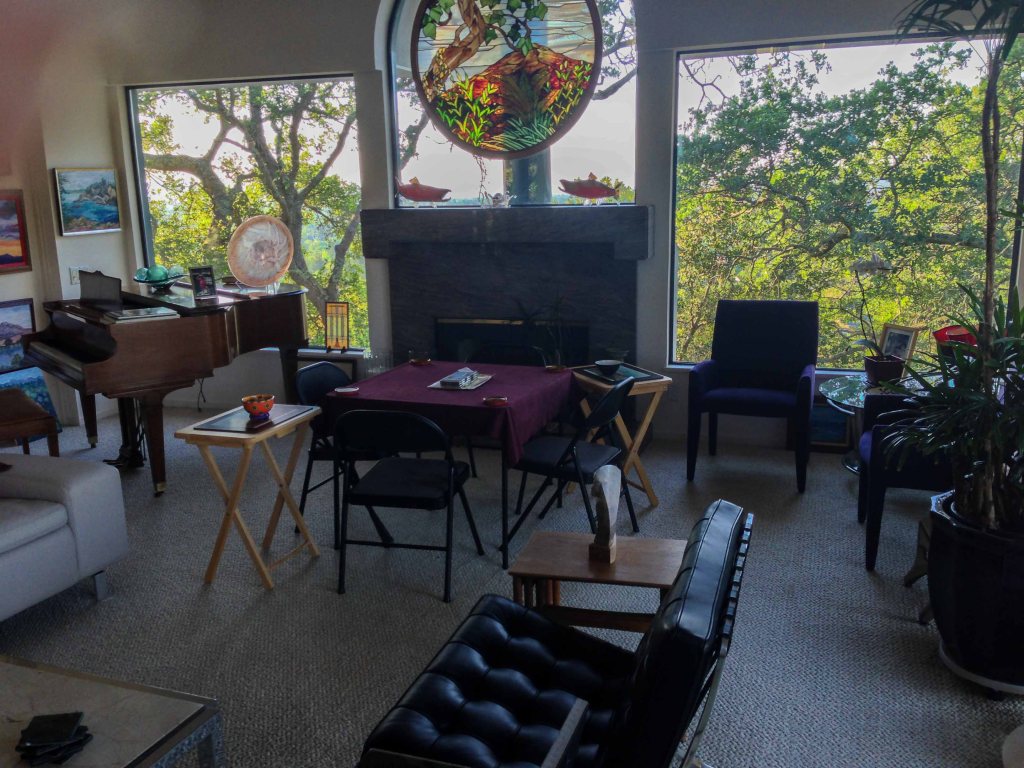
Bridge clubs don’t usually look like this
Our host is an architect; he designed his own home in the Walnut Creek hills. Surrounded by oak trees, it’s a palace with a view all the way to the delta.
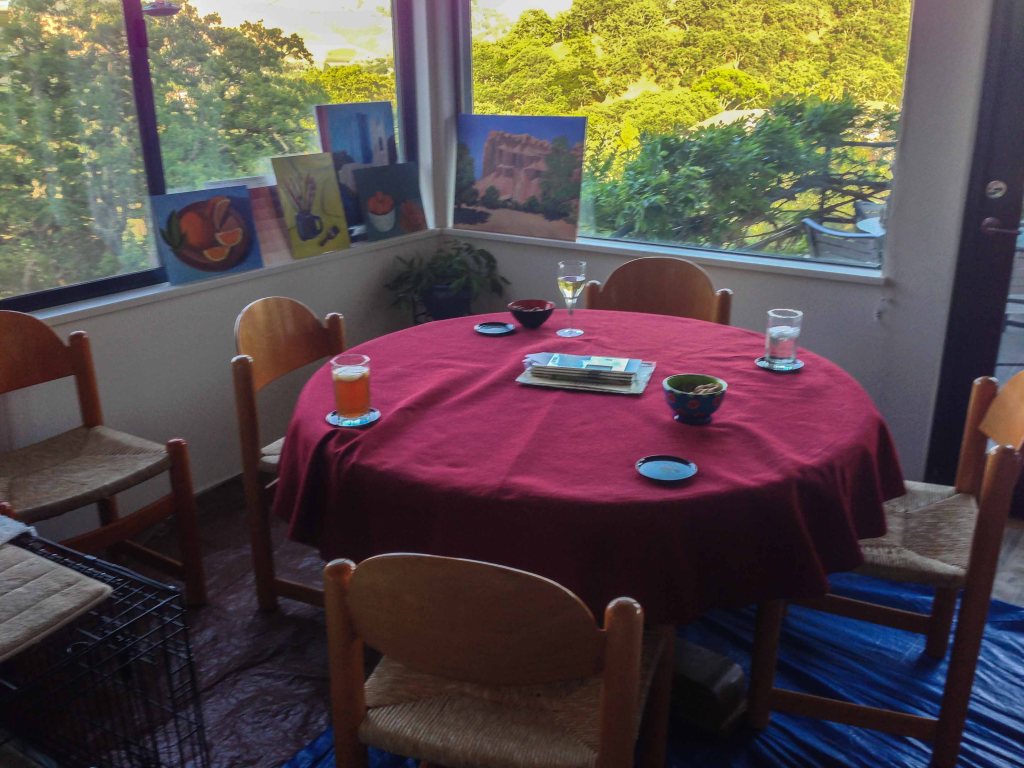
Table #1, in the den. More great views. The floors are covered because they have a new puppy.
I just kept wanting to take more photos, the house is so nice:
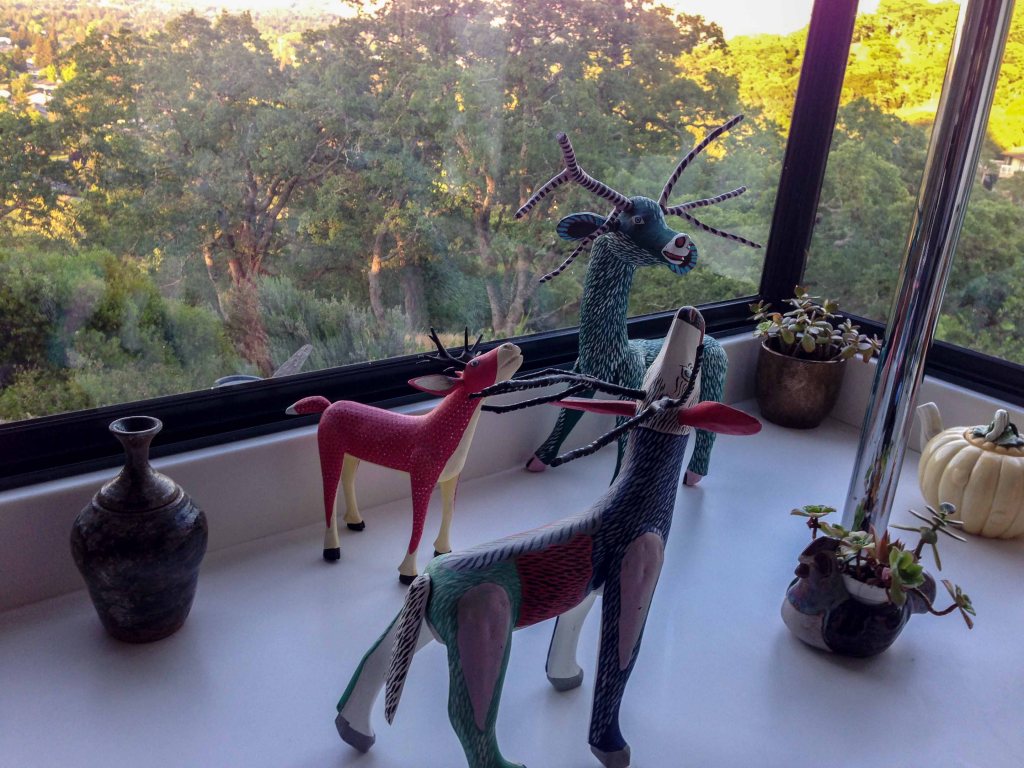
The decor here is outstanding.
There were 3 tables in play. We were the substitutes for a couple who couldn’t make it. Besides our hosts, we didn’t know the other players, but it turns out that we have many friends in common–they play in Moraga with David Geary, Conrad Robertson, Winnie and Jerry and Barbara Hanson.
The food at a home game is pretty good:
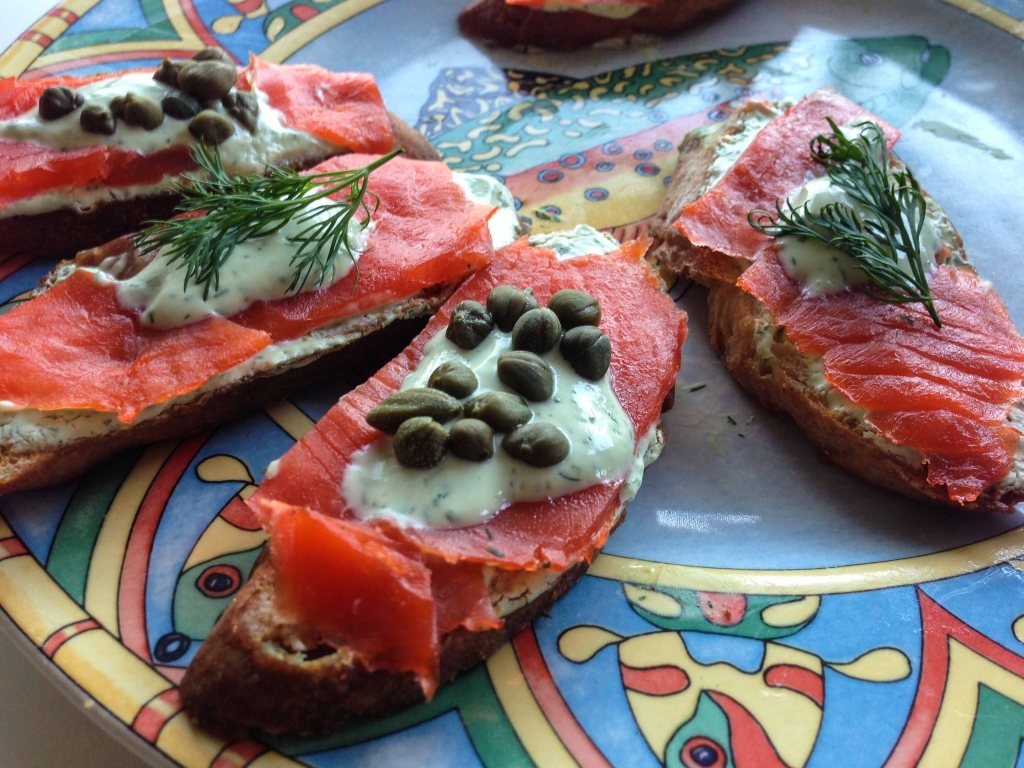
Smoked salmon beats peanut butter pretzels any day.
After the game there was homemade carrot cake in the dining room:
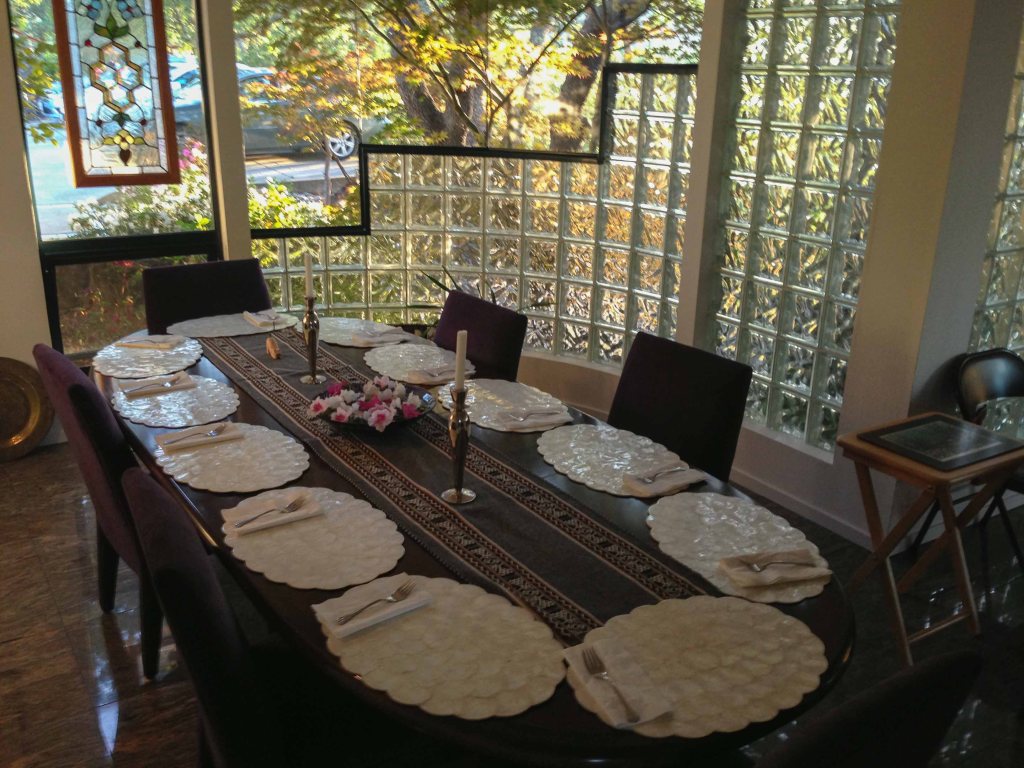
Much better than eating at card tables
This was just a fun evening. The competition wasn’t strong; we came in 2nd out of 6. There were no masterpoints, and nobody cared. There was also no director, no timer, no rule book and no pressure. Just a pleasant evening with friends old and new. It doesn’t hurt to remember that bridge can be a pastime, not always a cutthroat battle.

 Totally Unauthorized